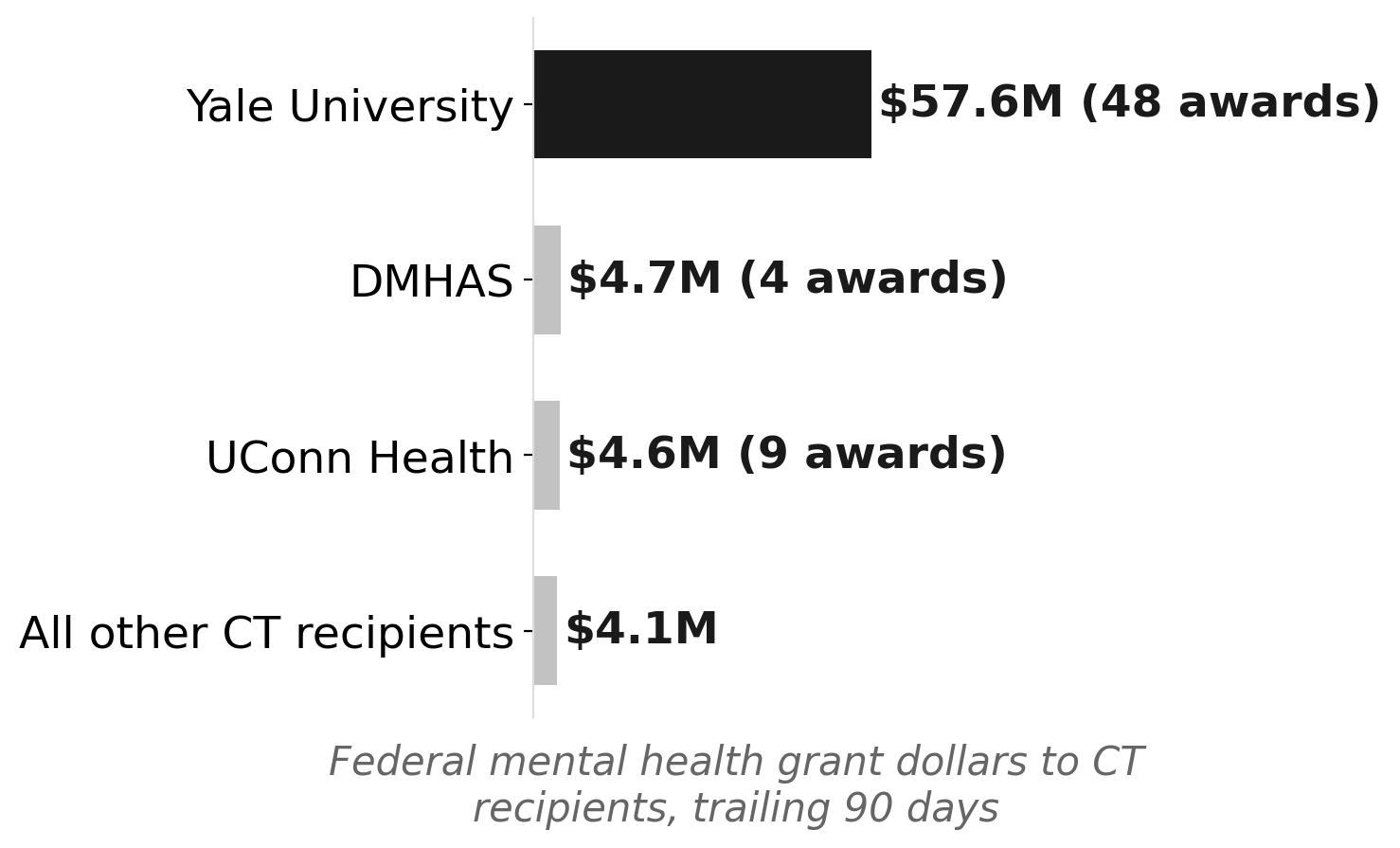
Connecticut received $71.0 million in federal mental health grants in the last 90 days, up 64% from $43.3 million in the same window a year ago. The number looks like momentum. It is closer to a recovery from a wound and a hedge against the next one.
Two entirely separate forces produced the surge, and conflating them misses what is actually happening.
The larger force is Yale. The university captured 48 new federal awards totaling $57.6 million in the trailing 90 days, about 81% of Connecticut's total, most of it from NIH programs covering mental health research, neuroscience, and addiction science. That figure is roughly four times what Yale pulled in during the same window last year. The reason is twofold: September 30 is the federal fiscal-year-end deadline, and NIH reliably concentrates awards in the final weeks before it, 55 grants started in Connecticut in September 2026 alone, accounting for $43.4 million. But September's rush cannot fully explain a nearly fourfold jump. The deeper reason is what happened 18 months earlier.
Source: NationGraph.
In spring 2025, the Trump administration terminated at least 17 Yale NIH grants totaling approximately $42.7 million, flagging them for keywords including "mental health," "gender," and "minority" under a DEI executive order. Yale's terminations left roughly $11.4 million in approved funding unspent and disrupted research pipelines across its psychiatry, neuroscience, and public health programs. A February 2026 federal court order blocked NIH's related plan to cut indirect-cost reimbursements in 22 states including Connecticut, preserving the financial structure of Yale's surviving grants. The new awards arriving this fall are, in substantial part, the pipeline refilling, competitive multi-year grants replacing or extending work that was interrupted or terminated. Yale's FY2026 NIH total has reached approximately $688 million across 1,124 grants, with its neurosciences department ranking sixth nationally. The research enterprise is not broken. But the 2025 terminations created a gap, and September 2026's award rush is partly what closing that gap looks like in the data.
The second force is smaller and serves an entirely different purpose. Connecticut's Department of Mental Health and Addiction Services received a new $2.5 million SAMHSA 988 Behavioral Health Crisis Services grant on September 30, 2026, running through 2029, to expand crisis center capacity statewide. It also received a $1.08 million substance abuse treatment award the same day. SAMHSA distributed $255 million nationally for 988 Lifeline implementation in May 2026, and Connecticut's share is meant to add mobile crisis teams and stabilization infrastructure. DMHAS is simultaneously running an RFP to establish up to four 23-hour crisis stabilization REST Centers in rural Connecticut under a separate CMS Rural Health Transformation grant.
These are not the same grant stream as Yale's NIH awards. They are administered by a different HHS sub-agency, flow to different recipients, state agencies and community nonprofits rather than research universities, and serve a different function: direct crisis services, not biomedical research. The only thing the two streams share is the HHS umbrella and the timing of their September 30 deadlines.
The timing matters partly because of what happened in January 2026. SAMHSA abruptly terminated approximately $2 billion in discretionary grants nationally on January 13, affecting an estimated $92 million in Connecticut awards, before reversing course within 24 hours after bipartisan pressure led by Rep. Rosa DeLauro. The reversal preserved the funding, but it demonstrated exactly the kind of policy-shift risk that makes locking in multi-year federal grants before the window closes look like strategy rather than routine administration. Connecticut's legislature separately considered a 25-cent monthly phone-fee surcharge to sustain 988 locally, a signal of how seriously state officials are taking the possibility that federal support may not hold.
For Connecticut residents, the practical stakes differ by which stream they depend on. For patients and families relying on community mental health services, the DMHAS awards represent real capacity: more crisis counselors, more stabilization beds in rural regions that currently lack them. For the researchers, and the graduate students, postdocs, and clinical trial participants whose work depends on Yale's NIH portfolio, the new awards mean continuity that was not guaranteed 18 months ago.
Connecticut's active federal mental health grant portfolio now stands at $851 million total obligated across all currently running awards, with $266 million already disbursed. That is a substantial base. But the 64% single-window jump is not evidence of a system hitting its stride. It is evidence of two systems, one recovering lost ground and one racing to claim infrastructure before the rules change again, both crossing the finish line at September 30.