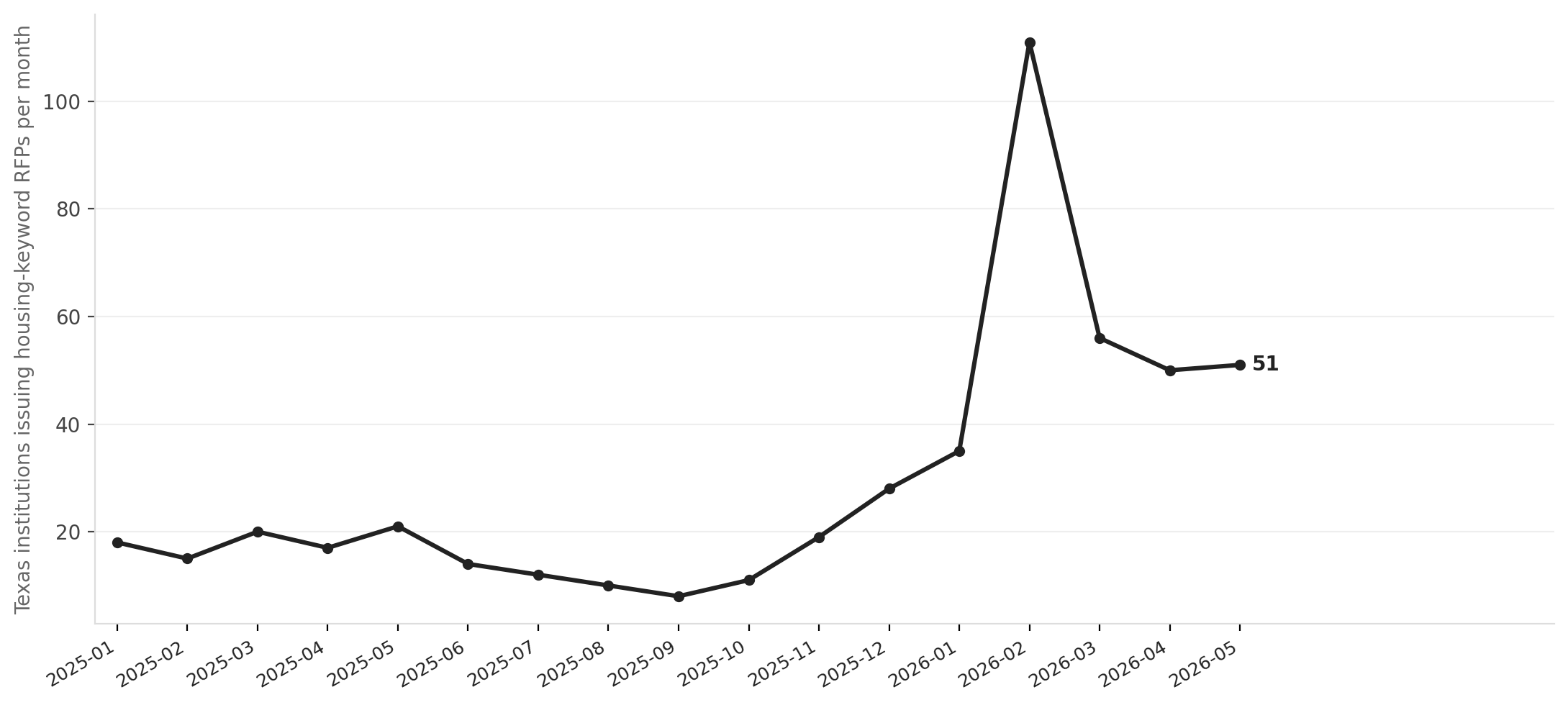
Fifty-one Texas local governments issued a housing procurement request for the first time in over a year during the trailing 30 days of May 2026, and the surge is not a blip. Monthly housing RFP volume across the state collapsed to as few as 8 institutions in the fall of 2025, then exploded to 111 in February 2026 and has held between 47 and 56 institutions per month ever since. Texas municipalities did not suddenly discover a housing crisis. They finally got new rules and new money at the same time.
The rules came first. On June 22, 2025, Governor Abbott signed four bills out of the 89th Legislature that rewrote the fundamentals of Texas housing development. SB 15 allows 3,000-square-foot minimum lots in larger cities. SB 840 mandates by-right approval for mixed-use and multifamily construction in commercial zones. SB 2477 fast-tracks office-to-residential conversions. HB 21 overhauled Housing Finance Corporation accountability and added new requirements for HUD voucher acceptance. All four took effect September 1, 2025, precisely the moment the old procurement dormancy began breaking. As Foley & Lardner's analysis of the reform package notes, these bills represent a structural shift in what Texas municipalities can approve, not merely an incremental loosening of local discretion. Jurisdictions that had RFPs in draft suddenly needed to re-scope them under new zoning-by-right and HFC rules. Many shelved procurements and started over.
The money arrived in two waves. HUD approved the Texas General Land Office's CDBG-DR Action Plan for 2024 Disasters on August 21, 2025, unlocking a fresh disaster recovery housing pipeline layered on top of still-flowing Harvey-era funds. Then, on February 5, 2026, HUD acknowledged a non-substantial amendment to that action plan, and February was the month 111 Texas institutions simultaneously issued housing RFPs, the highest single-month count in the dataset. The timing is not coincidental. When the GLO's Disaster Recovery Reallocation Program released roughly $140 million in de-obligated CDBG-DR funds from older disaster cycles, it received $1.4 billion in project submissions against that pool, a ratio that illustrates how much latent municipal demand had been waiting for a funding trigger.
Source: NationGraph.
The active federal housing grant portfolio in Texas now stands at $2.06 billion obligated across 2,331 HUD grants, with $458 million still flowing in disbursements. In just the January-through-May 2026 window, HUD renewed more than $400 million in Section 8 Housing Choice Voucher tranches to housing authorities in Dallas, Houston, San Antonio, Austin, Fort Worth, Harris County, and El Paso. That capital doesn't sit in agency accounts, it generates procurement cycles, and 51 first-time-in-a-year RFPs in a single month is what that looks like on the ground.
The geographic spread of May's cohort matters as much as its size. This is not a Houston-Austin phenomenon. Hidalgo County on the border is running multiple demolition-and-reconstruction RFPs across nine housing units. Midland issued both a Target Area Housing Development and a Workforce Housing solicitation in the same window. Laredo posted housing rehabilitation and plumbing contracts. Flower Mound rebid its Housing Rehabilitation Specialist contract. Waco issued a Section 3 CDBG compliance monitoring RFP. San Marcos advertised CDBG-DR housing construction and rehabilitation work. The cohort is suburban, rural, border, and urban simultaneously, which tracks with state-level legislation whose effects are not geographically concentrated.
The political backdrop makes the pace legible. The Texas Comptroller reported in October 2024 that the state's housing affordability index had hit its lowest level since 1985. That figure gave the 89th Legislature the political cover to pass reforms that in prior sessions would have stalled over local-control objections. Texas adds more residents than any other large state, but until September 2025 it had no mechanism to compel municipalities to permit denser housing or convert underused commercial stock. The new laws changed the calculus for city managers who had been watching their housing queues grow without a legal or fiscal pathway to act.
For residents, the procurement wave translates into a visible pipeline of construction and rehabilitation activity over the next 18 to 36 months, though the $1.4 billion in project submissions against $140 million in reallocation funds is a sharp reminder that demand still dwarfs available capital. The next signal to watch is how quickly GLO awards flow from the 2024 disaster cycle action plan and whether HUD approves any substantial amendments that unlock additional tranches. If the February 2026 peak of 111 active institutions was driven partly by the non-substantial amendment acknowledgment, a substantial amendment approval could push volume higher still.