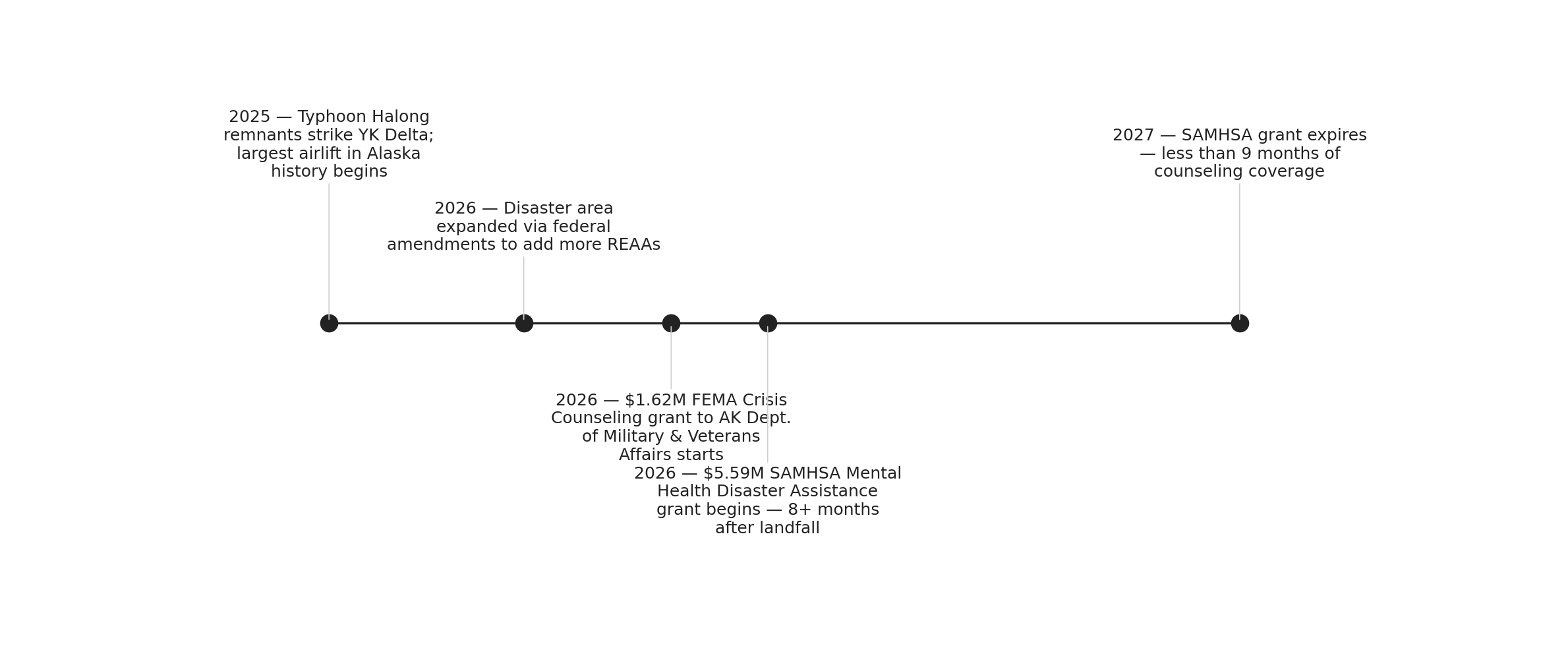
Federal mental health grant commitments to Alaska have hit $5,586,054 in the trailing 90 days, a 666% increase over the $729,643 committed in the same window a year ago. The entire surge traces to a single award: a SAMHSA Mental Health Disaster Assistance and Emergency Mental Health grant to the Alaska Department of Military and Veteran's Affairs, issued June 22, 2026, running through March 21, 2027. It is not a behavioral-health investment. It is a trauma bill for the Yukon-Kuskokwim Delta.
The money's arrival follows a specific bureaucratic chain. On October 22, 2025, the White House issued Presidential Major Disaster Declaration DR-4893-DR after the remnants of Typhoon Halong swept across Western Alaska on October 8–13, destroying or severely damaging more than 1,000 homes across at least 15 villages. That declaration unlocked SAMHSA's disaster mental health program and FEMA's Crisis Counseling Program. A companion FEMA Crisis Counseling grant of $1,622,910 to the same state military-affairs agency started April 27, 2026, as part of the same disaster stack. Together, the two awards represent something notable about how federal disaster mental health works: the money flows through emergency management, not through the health department, because this is triage, not treatment infrastructure.
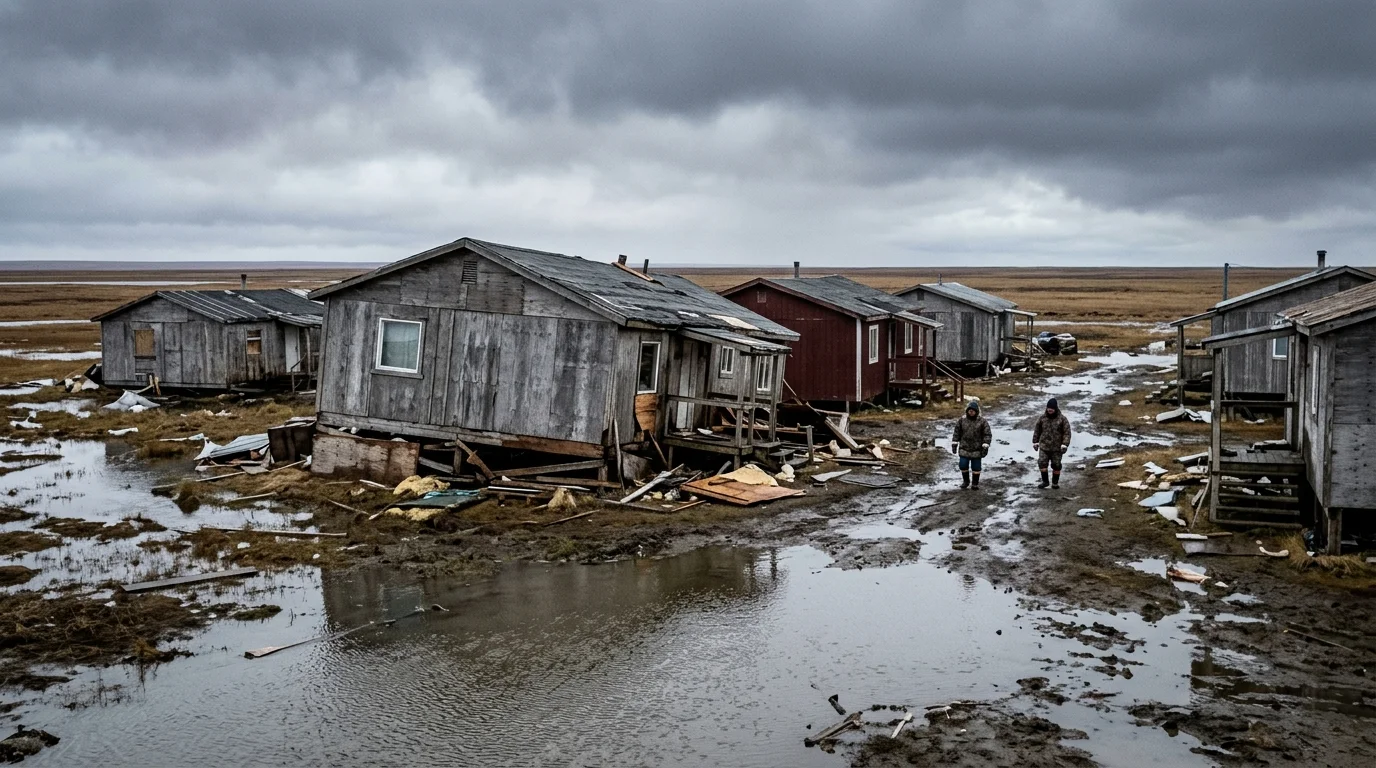
The storm itself was historic by any measure. State surveys counted 208 homes totally destroyed and 471 with major damage as of mid-November 2025. In Kipnuk, 90% of structures were destroyed or severely damaged. More than 1,500 people were evacuated in what state officials called the largest emergency airlift in Alaska history. The NPR account from the days immediately after the storm described communities facing not just physical ruin but the loss of stored fish, game, and beluga, the subsistence stores that carry Yup'ik households through winter. Homes and food supplies vanished in the same storm.
Source: NationGraph.
Nine months later, the mental health money is only now arriving. That lag is built into the system: FEMA's Crisis Counseling Program requires a disaster declaration before states can apply, then a separate review and award cycle before funds move. The structure is not unusual, but the timeline is brutal when layered onto the specific geography of the YK Delta. These are air-access-only communities scattered across an Oregon-sized region with no road connections to the rest of the state. Counselors must travel by small plane or boat to reach survivors. The per-unit cost of care in this environment is a fraction of what $5.6 million can cover at scale, and the grant clock runs only through March 2027, giving outreach workers fewer than nine months to reach communities that remain in limbo about whether to rebuild in place or relocate permanently.
The trauma compounds because the storm was not the beginning. Kipnuk and neighboring villages were still in the early stages of recovering from major flooding in summer 2024, federal disaster aid for that event was approved only in January 2025, weeks before Halong hit. In May 2026, six months after the storm, survivors testified before the Senate Committee on Indian Affairs in Anchorage and Bethel. Kipnuk's tribal chief described ongoing displacement and questioned whether federal recovery infrastructure was built for communities like his. The hearing produced testimony but no new statutory commitment.
Alaska already carried some of the nation's highest rates of suicide and behavioral health need before the storm. The YK Delta sits at the far end of that spectrum. The $5.6M SAMHSA award is large relative to Alaska's usual mental health grant baseline, and it dwarfs comparable 90-day award volumes in analogous rural states: New Mexico received roughly $1 million across five separate grants in the same window; South Dakota received $453,000. But scale-of-need comparisons matter here. Reaching a single village in the Delta can require a chartered flight. The money is real; the arithmetic is difficult.
What changes practically for people in these communities is the deployment of outreach workers and crisis counselors under the FEMA Crisis Counseling Program framework, which focuses on community-based, culturally grounded support rather than clinical treatment. FEMA's program design emphasizes reaching survivors where they are rather than pulling them into clinic settings, a model that fits the Delta's geography better than most disaster-response tools. Whether the staffing and logistics materialize in time is the open question.
The next signal to watch is whether the state requests a grant extension before the March 2027 deadline, or whether communities in active relocation discussions, Kipnuk most prominently, are folded into a longer-term managed-retreat planning process that would require a different funding authority entirely. The disaster mental health window closes in nine months. The displacement it is meant to address may not.