Roughly 14 active transit procurement solicitations have hit Montana's public contracting channels in the last 30 days, concentrated almost entirely in Billings and Butte-Silver Bow, a genuine surge for a state where eight such notices in a month was the recent norm. The dollars behind that activity are larger: Montana DOT currently holds more than $47 million in active federal transit grants, including $12.5 million in Buses and Bus Facilities funding that has seen only $1.8 million outlayed so far. The rest needs to move within the next 12 to 18 months.
The urgency is structural. The Bipartisan Infrastructure Law authorized five years of elevated transit funding through FY2026, and the Federal Transit Administration's January 15, 2026 announcement in the Federal Register of $2.03 billion in national Bus and Low-No Emission awards across 165 projects marked effectively the final major competitive round under the law. For state DOTs and local transit agencies that secured grants in that cycle or earlier rounds, the message is the same: the procurement window is now.
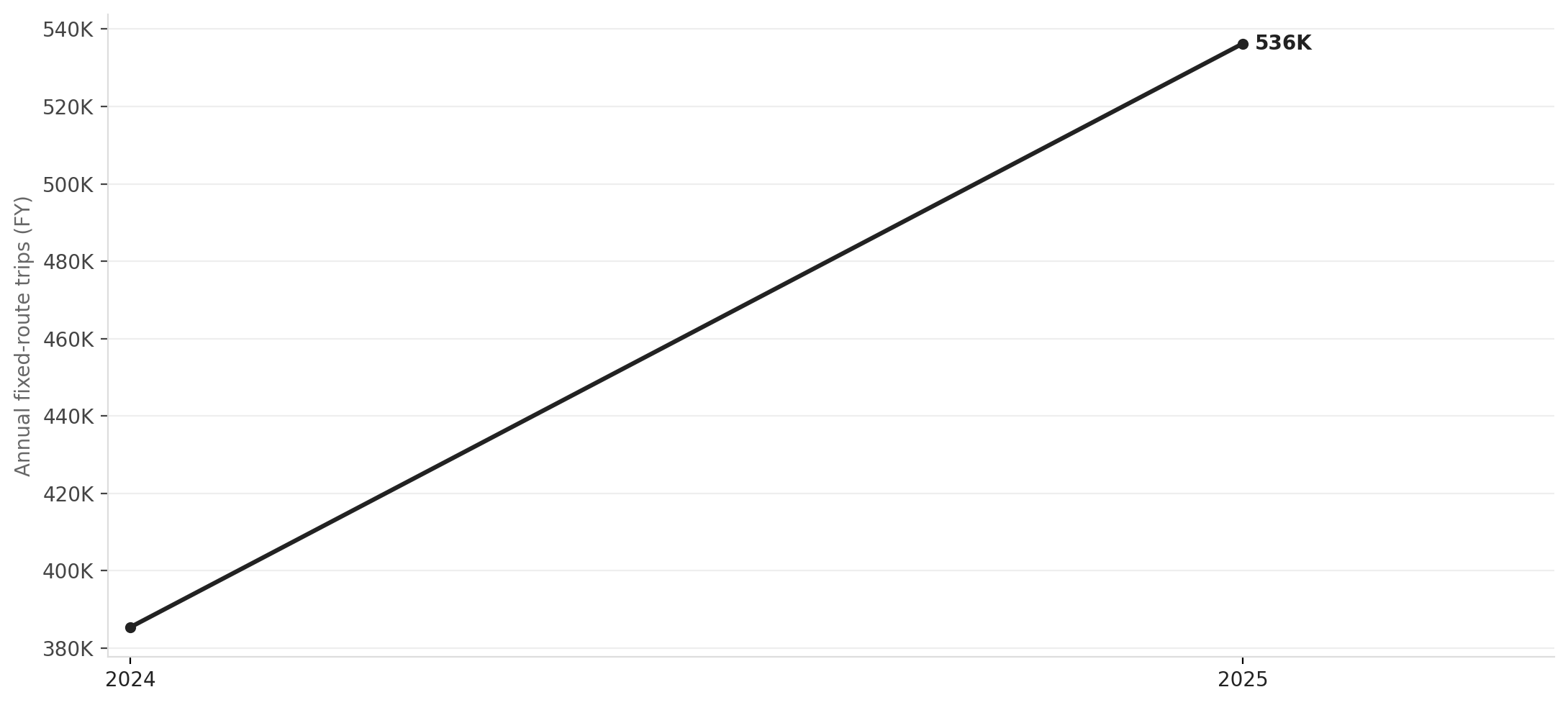
Billings MET Transit is the most visible expression of that pressure. The agency, which operates on roughly $7.8 million a year and serves 117,000 residents across 44.6 square miles, recorded 536,256 trips in FY2025, a 39 percent jump from 385,381 the year before. That ridership surge arrived faster than anyone in the agency's planning documents appeared to anticipate, and it is now running directly into a capital upgrade cycle driven by grant deadlines rather than long-range master planning. The City of Billings holds a $2.9 million Federal Transit Formula Grant that expires in September 2026. Open solicitations include a security and fire alarm system upgrade due June 2, 2026, an EV charging station installation, a GPS automatic vehicle location system for fixed routes, a bus wash facility upgrade, and a building roof replacement. These are not aspirational projects. They are active contracts with imminent due dates.
Source: NationGraph.
Butte-Silver Bow adds a different dimension. The city operates a fare-free transit system serving Butte's urban core and both Montana Tech campuses, a model that eliminates fare revenue and makes the agency structurally dependent on federal capital and formula grants for every major infrastructure dollar. Its current active solicitations include a Traffic Safety Action Plan due June 18, 2026, alongside fleet and infrastructure work. Because Butte-Silver Bow Transit does not collect fares, any interruption to federal formula funding hits the system harder than it would a conventionally financed agency.
Montana DOT's transit grant portfolio also includes $12.3 million in active Rural and Tribal Formula grants running through March 2027, with separate awards to the Crow Tribe ($1.1 million) and the Fort Peck Assiniboine and Sioux Tribes ($1.5 million). Rural and tribal transit in Montana is not a niche program. The state's low population density means that Section 5311 rural formula funding is the operational backbone for dozens of communities that have no realistic alternative to federal support. The current cycle is funding capital improvements on reservations at the same time it is funding bus wash facilities in Billings, a coincidence of timing, not policy design.
What makes this moment unusual for Montana is less the dollar amounts, which are large by the state's standards but modest by national ones, and more the speed of conversion from grant award to active procurement. Montana DOT distributes roughly $680 million in total federal transportation dollars annually across all modes, and transit has historically been a small fraction of that. The current pipeline is asking transit agencies that have rarely managed multi-million-dollar capital programs simultaneously to run several at once, against hard federal performance deadlines.
For residents of Billings, the near-term visible changes will be incremental: updated security cameras at transit facilities, new charging infrastructure for electric buses, GPS tracking that improves on-time performance data. The larger question is whether the ridership growth that has driven FY2025 numbers 39 percent above the prior year holds through the capital improvement period, or whether it reflects a temporary pattern that will recede before the new infrastructure is fully operational.
The clearest signal to watch is the September 2026 expiration of Billings' $2.9 million Federal Transit Formula Grant. If local procurement moves fast enough to obligate those funds before the deadline, the city's capital cycle closes cleanly. If it doesn't, the money returns to FTA, and the next authorization cycle that might replace it is not yet written.