At least 80 California institutions issued a housing-related RFP for the first time in more than a year during the past 30 days, a volume that signals something more consequential than a procurement uptick: the state's 2026 legislative building push is finally reaching the agencies that have spent years on the sidelines.
The figure spans a wide range of issuers. City governments account for the largest share, with 29 cities putting out 69 RFPs in the trailing 30-day window. But the more telling signal comes from school districts. Pasadena Unified, Antelope Valley Union High School District, Moreno Valley Unified, and Oxnard Union High School District all issued workforce or employee housing RFPs in this window, in most cases for the first time in over a year. When school districts start procuring employee housing, it means the shortage has moved well past the jurisdiction of planning departments.
Three laws explain the timing. AB 130, authored by Assembly Member Buffy Wicks, created a sweeping new infill CEQA exemption and requires local governments to take final action on qualifying projects within 30 days of submission. AB 920, which passed the legislature 75-0 before being signed in September 2025, mandates that any city or county with a population of 150,000 or more launch a centralized online housing permit portal by January 1, 2028. And the 6th Cycle Regional Housing Needs Allocation compliance deadline requires updated local Housing Elements. All three took effect January 1, 2026. According to a breakdown of California's 2026 housing laws, the combined effect is the most aggressive pro-building legislative package Governor Newsom has signed in his final term.
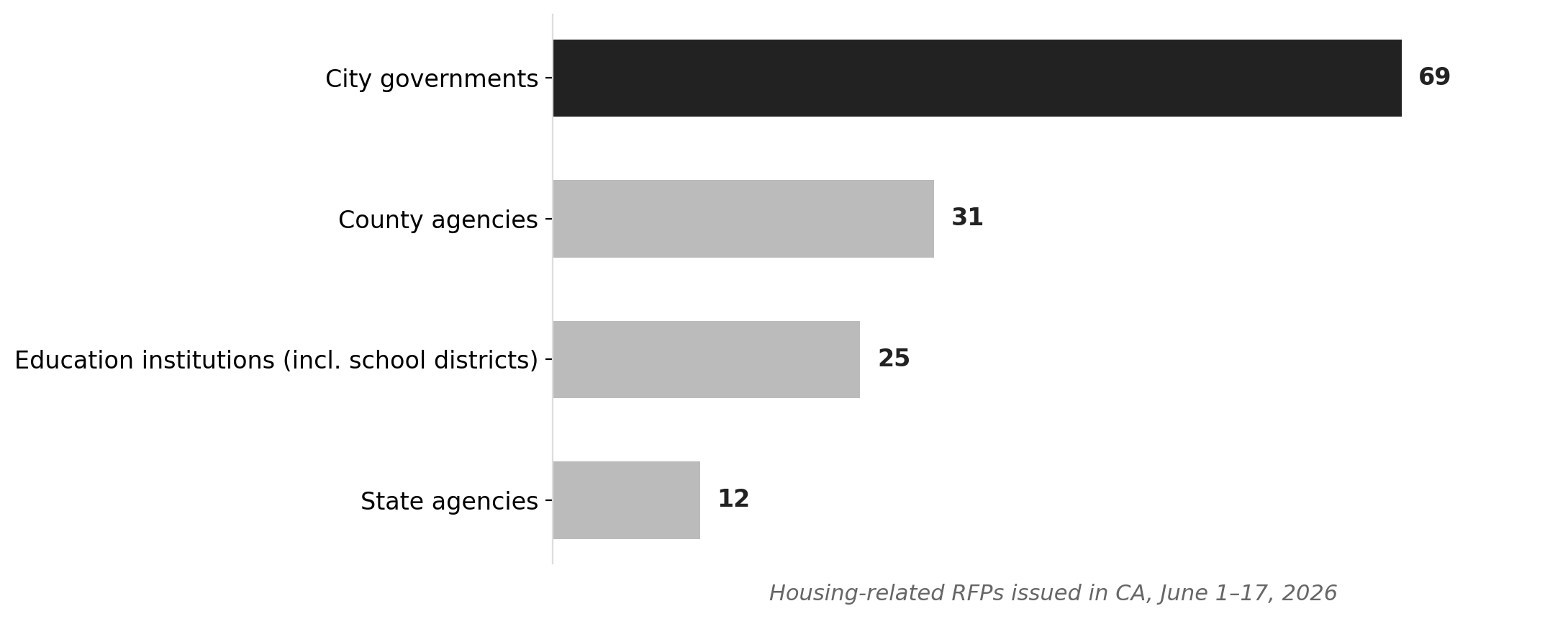
Source: NationGraph.
The AB 920 deadline deserves particular attention because it explains the procurement urgency. Selecting and implementing a permitting software vendor typically takes 6 to 12 months. A jurisdiction that has not yet issued an RFP for that system is already behind a compliance schedule that ends in January 2028. As ResponsiveGov notes in its analysis of AB 920, the law was designed to eliminate the patchwork of paper-based and siloed permitting systems that have slowed housing approvals for years. The procurement wave is, in part, a direct response to that clock ticking.
The geographic spread of the new entrants reinforces how broadly these mandates are landing. The 13 verified first-time issuers in this window stretch from Lakeport in Lake County to Lindsay in Tulare County to UC Davis in Yolo County. These are not the coastal cities that typically drive California housing headlines. Selma, Turlock, and Newark are mid-sized communities that have historically been slow movers on housing infrastructure. Their simultaneous re-entry into the procurement market suggests the legislative pressure is reaching second-tier jurisdictions that earlier rounds of housing law left largely unmoved.
Federal money is also a factor. HUD's active obligated housing grant portfolio in California stands at $4.08 billion, with only $1.07 billion outlayed. That $3 billion gap represents federal dollars already committed to California but waiting on local action to draw down. California's Department of Housing and Community Development has a 2024 Permanent Local Housing Allocation NOFA open on a rolling basis through June 2027, which specifically targets smaller non-entitlement jurisdictions. For a city like Lindsay or a county agency in San Luis Obispo, issuing a housing RFP is often the first step toward accessing that funding.
The monthly pace is striking in context. June 2026 is on track to match or approach the February and March peaks of 108 institutions per month, based on 37 institutions issuing housing RFPs in just the first 17 days. That sustained volume across multiple months suggests this is a structural shift in procurement behavior, not a one-month spike driven by a single grant deadline.
For residents and developers watching the California housing market, the procurement pipeline is the earliest measurable indicator that legislation is converting into construction-side activity. RFPs for permitting portals become portal launches, which become faster permit approvals, which become more housing units moving through entitlement. The chain is long, but it starts here.
The next signal to watch is how many of these first-time issuers actually award contracts before the end of 2026. Jurisdictions that issue RFPs but fail to complete vendor selection within the calendar year will face a compressed implementation window heading into 2027, with the AB 920 deadline two years out and no margin for a second procurement cycle.