Maryland has posted five homelessness-response RFPs in the last 30 days against a 12-month monthly average of roughly 1.7, a threefold surge that is less a symptom of worsening crisis than a signature of what a coordinated legislative-budget win looks like when it hits the procurement calendar.
The mechanism is straightforward: Governor Moore signed the Maryland Housing Certainty Act and the Maryland Transit and Housing Opportunity Act on May 26, 2026, and Maryland's FY2026 budget simultaneously locked in $73.4 million for DHCD's Division of Homeless Solutions, including $5 million earmarked for Permanent Supportive Housing. That alignment of new law and new money set a hard deadline: every county and city agency that draws on state homeless services funding had to complete its contracting cycle before the July 1, 2026 fiscal year start. The result is a compressed procurement window that registers as a spike.
The five RFPs that landed in this window illustrate how wide the cascade runs. Montgomery County issued a solicitation for emergency overflow shelter accommodations through December 2026. Kent County's Local Management Board posted two separate RFPs for family homelessness navigation services, plus a housing study. A federal VA rideshare contract covering homeless veterans in Anne Arundel County rounded out the set. Four of the five dropped in July alone, consistent with agencies moving the moment the new fiscal year opened. Baltimore City's Mayor's Office of Homeless Services issued its FY27 Consolidated Funding Application RFP as early as February 2026, and Baltimore County set a February 3 deadline for its own FY27 homeless services proposals, both agencies getting ahead of the summer rush.
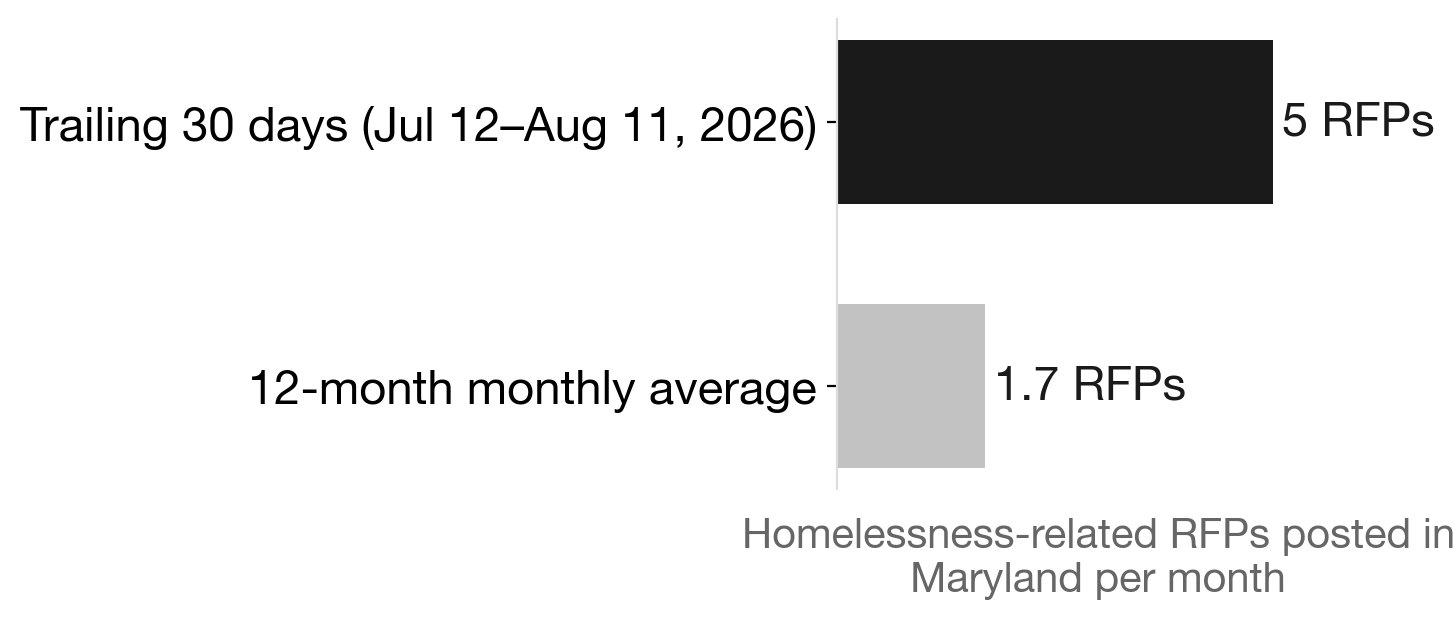
Source: NationGraph.
The structural reason the signal is so legible is Maryland's decentralized CoC architecture. The state operates 10 Continuums of Care, with DHCD administering three directly for the Eastern Shore and Western Maryland. When a single statewide budget cycle triggers funding releases, all 10 CoCs and their member jurisdictions begin procurement on roughly the same schedule. That synchronization is what turns a policy win into a measurable statistical anomaly.
The grant backdrop behind these contracts is substantial. Baltimore City alone holds $18 million in active HUD Continuum of Care grants running through the end of 2026. Across DHCD, Baltimore City, the Maryland Department of Health, and Anne Arundel County, non-Section-8 homelessness grants newly started since early 2025 total more than $75 million. The 2026 legislative session also more than doubled the Community Schools Rental Assistance Program from $5 million to $11 million, a change projected to keep roughly 2,500 families out of eviction court, a prevention-side investment meant to keep people from entering shelter systems in the first place.
The Moore administration's rationale for the legislative push is grounded in a stark affordability floor. The National Low Income Housing Coalition's 2026 Maryland profile puts the housing wage for a two-bedroom at fair market rent at $39.15 per hour. That figure shapes who ends up needing the services these RFPs are procuring. Maryland was also selected in June 2026 for the New America Eviction Data Response Network's 2026-2028 cohort, with DHCD Assistant Secretary for Homeless Solutions Danielle Meister describing eviction data as a tool to "identify trends earlier, target prevention resources more effectively", a signal that the administration is building an early-warning layer alongside the contracting surge.
Not everything passed. The General Assembly debated but did not enact HB 1501, which would have required DHCD to operate a formal shelter certification program. Its failure leaves shelter quality oversight largely at the agency's discretion and signals that legislative attention on the issue will carry into the 2027 session.
For service providers and nonprofits working in Maryland's homeless services ecosystem, the immediate practical reality is a narrow and active bidding window. The FY2027 cycle is the first in which both new supply laws and the higher Division of Homeless Solutions appropriation are simultaneously in effect, meaning contract sizes and program scopes may differ from prior years. Agencies that missed February and March deadlines in Baltimore City and Anne Arundel County are likely watching for any supplemental rounds.
The next signal to track is whether the RFP volume translates into signed contracts at the pace the July 1 deadline implied, and whether the Permanent Supportive Housing set-aside moves to award before the end of the calendar year.