Twelve to fourteen Colorado institutions issued their first housing-related procurement request in more than a year during the 30-day window ending September 9, 2026, the densest cluster of first-time issuers in the trailing data, and a window that opened just four weeks after a new state law rewrote the ground rules for who can build housing and where.
The institutions span a wide range: Adams County, with more than a million residents, procuring temporary respite housing; the City of Aurora procuring modular homes for its Wild Horse Tiny Home Village; and Denver Public Schools issuing its first housing RFP in over a year, titled "Attainable Educator and Staffing Housing," on September 9. Smaller cities including Golden, Canon City, and Evans issued housing needs assessments and action plans in the same window. What they share is timing, and timing here is almost entirely explained by two converging deadlines.
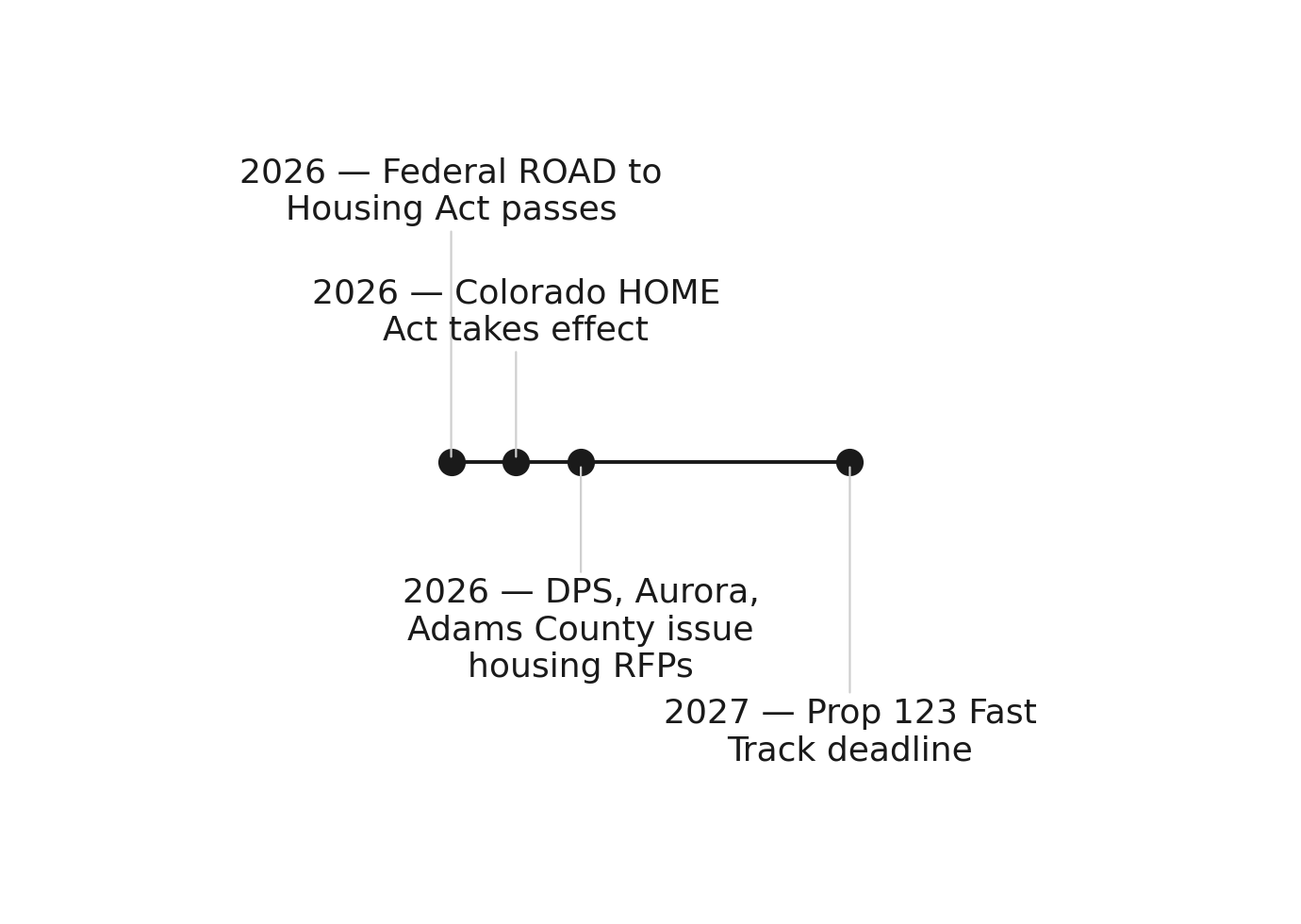
The first is the HOME Act. Governor Polis signed HB26-1001 on March 25 and it took effect August 12, 2026. The law allows school districts, nonprofits, transit agencies, and housing authorities to build housing on up to five acres of their own land through an administrative approval process, bypassing the discretionary local rezoning that had previously made institutional housing projects legally and politically complicated. Proponents say the new process cuts typical approval timelines by roughly 28 percent. Denver Public Schools' educator housing RFP, issued 28 days after the law took effect, is the most direct downstream product of that change visible in procurement data. The district serves a metro area where teacher retention is directly tied to housing costs, a dynamic that communities in Colorado's high-growth corridors have already tried to address through unconventional means.
Source: NationGraph.
The Colorado Municipal League opposed the HOME Act. Executive director Kevin Bommer warned it would "drive up the cost of housing, not lower it," arguing that bypassing local zoning removes the community input that keeps projects financially rational. That tension has not resolved; it has simply been overtaken by the calendar.
The second deadline is harder. December 31, 2026 is the Proposition 123 Fast Track compliance cutoff. Proposition 123, passed by voters in 2022, generates roughly $300 million per year from a portion of state income tax and distributes it to municipalities for affordable homeownership programs, homelessness services, and local planning capacity. To remain eligible, municipalities must file a housing commitment and implement a Fast Track permitting process. Miss the December 31 date and a jurisdiction loses access to Prop 123 funding indefinitely, not for a cycle, but permanently, until the state changes the rules. The Department of Local Affairs has made the stakes explicit. A budget cut of $25.7 million from the Prop 123 FY2026-27 allocation has already reduced the pool, making the remaining dollars more competitive and the cost of disqualification higher.
DOLA's fall 2026 Local Planning Capacity Grant cycle opened in September 2026, offering up to $250,000 per jurisdiction for housing needs assessments, action plans, and Fast Track permitting implementation, with an early adoption incentive of up to $45,000 requiring no local match. That grant opening is the direct procurement trigger for the cluster of planning RFPs from Golden, Canon City, and Evans. Those cities are not building housing yet; they are buying the plans and permitting infrastructure that will keep them eligible to build housing with state money.
A third incentive sits on top of both. Congress passed the 21st Century ROAD to Housing Act in July 2026, adding competitive federal grants for local governments that ease zoning and permitting rules. The program is described as offering relatively modest new spending with technical assistance, but for a Colorado municipality already moving toward HOME Act compliance and Prop 123 Fast Track certification, it represents a third source of reward for the same reforms. The three programs operate in parallel: the HOME Act unlocks what institutions can build, Prop 123 funds the planning and some construction, and the ROAD Act adds a federal reward for the same permitting reforms. They are separate programs with separate applications and separate eligibility rules, but for a city trying to act before December 31, they all point in the same direction.
What is notable in the procurement data is not just the volume but the institutional composition. The large Colorado cities that have issued housing RFPs consistently over the past two years are still active. What changed in August and September is that school districts and special districts appeared in the data for the first time in over a year. The HOME Act was specifically designed to activate that class of landowner, and Aurora's modular housing project and the DPS educator housing RFP suggest it is working as written, at least at the procurement stage.
Colorado's housing shortfall is estimated at roughly 106,000 units, in a state that has now surpassed 6 million residents. Whether the procurement surge translates into delivered units depends on what happens after the RFPs close. The December 31 Prop 123 deadline is the next hard signal to watch: how many of the municipalities now buying housing plans will have filed their Fast Track compliance paperwork in time to keep the funding they are planning around.