New federal hurricane recovery grant starts for North Carolina totaled $17.3 million in the trailing 90 days, compared with $129.7 million in the same window a year ago, an 87% drop. That number looks alarming, but it understates the actual problem. The deeper crisis is in the grants already on the books: billions of dollars nominally committed to Helene recovery that are barely moving.
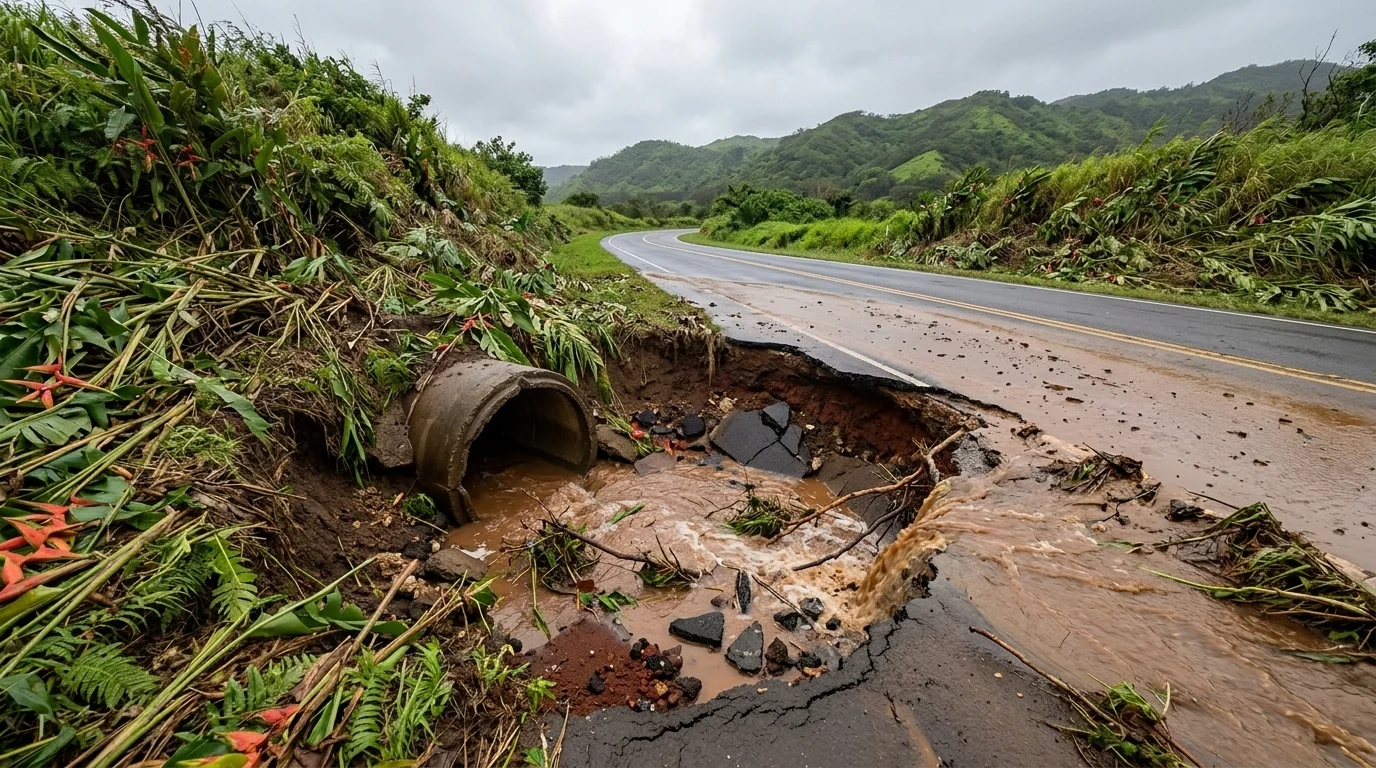
The active FHWA Emergency Relief portfolio for North Carolina's roads alone runs to more than $616 million, spread across multiple grants. The largest single tranche, $1.34 billion in Highway Planning and Construction funds, has disbursed just 22.7%. Two separate Emergency Relief grants totaling more than $418 million combined are disbursing at 1.5% and 4.3%, respectively. Money that was awarded, announced, and counted as relief is sitting largely unspent while mountain roads remain damaged and communities wait.
The reason traces directly to a single administrative decision. On June 11, 2025, then-DHS Secretary Kristi Noem issued a directive requiring her personal sign-off on any DHS expenditure exceeding $100,000. According to a Senate HSGAC minority staff report, the policy had produced a documented logjam of 1,034 FEMA contracts, grants, and disaster assistance awards by September 2025. North Carolina, managing one of the largest inland hurricane recovery portfolios in the country, was among the states hit hardest by the delay. North Carolina Senator Thom Tillis publicly accused Noem of violating the Homeland Security Act of 2002 by restricting FEMA's ability to deploy congressionally appropriated funds.
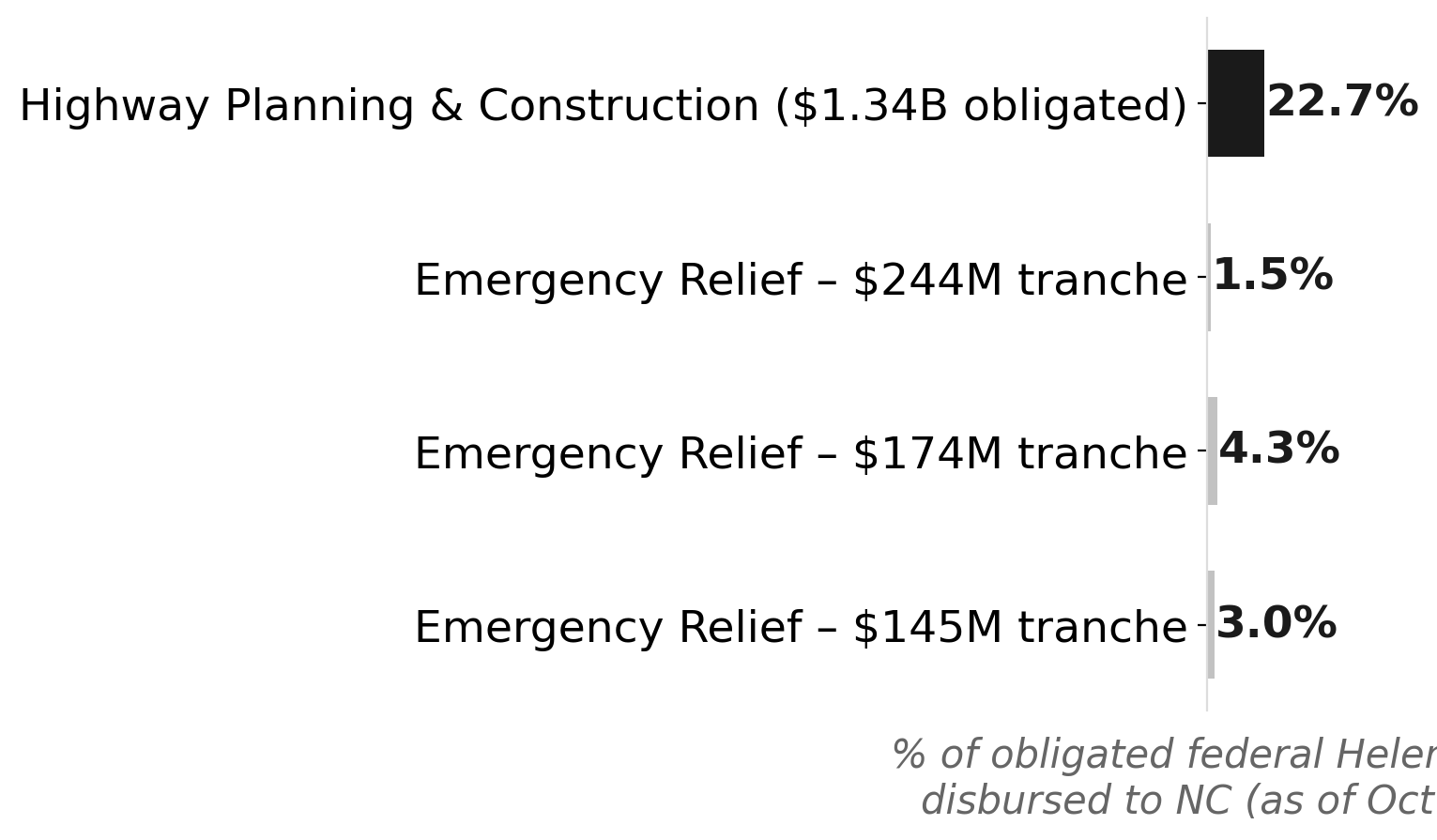
Source: NationGraph.
New DHS Secretary Markwayne Mullin rescinded the directive on April 2, 2026, as his first major policy action in the role. But rescinding a policy does not instantly unsnarl a bureaucracy. FEMA has lost up to 3,700 employees since January 2025, gutting the processing capacity needed to move queued applications through approval chains. The disbursement pipeline remains structurally backed up months after the directive was lifted.
This is the gap between paper commitments and real money. Across the full scope of Helene damage, estimated at roughly $60 billion, federal funds obligated to North Carolina amount to approximately $7 billion, or about 12 cents on the dollar. That $7 billion spans several distinct programs doing different things: FEMA Public Assistance reimburses governments for work already completed; the FHWA Emergency Relief Program funds direct road reconstruction; EPA grants capitalized state revolving loan funds for water infrastructure; and HUD's $1.4 billion CDBG-DR block grant, with its Action Plan approved in April 2025, targets housing and unmet needs through the state's Renew NC programs. Each program moves through a separate approval chain, and each chain was compressed by the same bottleneck.
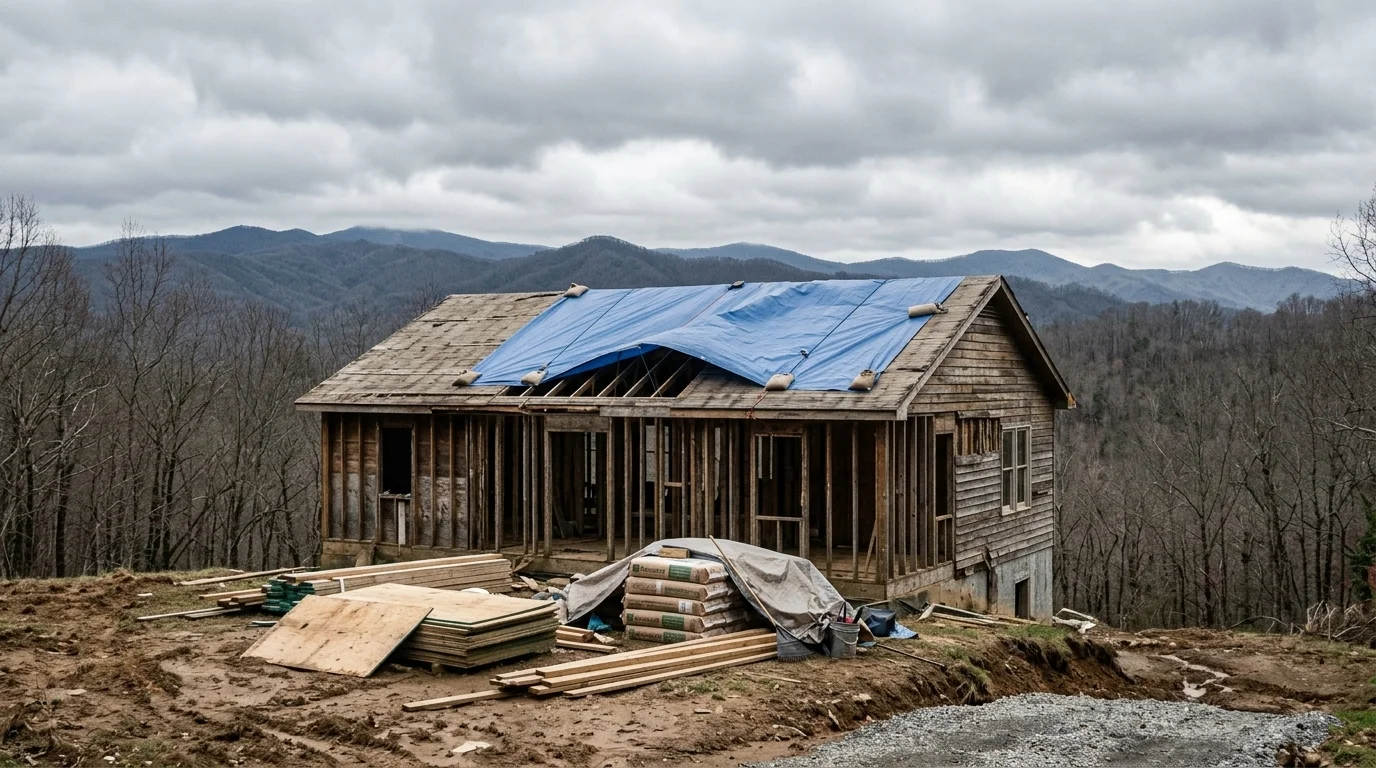
Asheville Mayor Esther Manheimer has described the uncertainty over which FEMA payments will arrive and when as a planning crisis for a city expecting roughly $1 billion in relief over six years. Project managers cannot sequence construction if they cannot predict cash flow. Local governments that fronted costs for FEMA-reimbursable work, the standard mechanism for public assistance, are waiting for reimbursements that have not materialized on anything close to a predictable schedule.
North Carolina has responded by spending its own money at a scale few states could match. The General Assembly has deployed $4.4 billion in state appropriations since Helene struck in September 2024. Governor Josh Stein's Phase 3 budget proposal in March 2026 sought an additional $827 million in state funds explicitly to cover federal gaps and pre-fund projects that FEMA has committed to reimburse but not yet paid for. State money functioning as a bridge loan for federally promised aid is not how disaster recovery is designed to work, and it is not a model available to states with smaller reserves.
The year-over-year comparison does capture one real shift: last year's 90-day window included two large Helene-specific grants that were always one-time awards. A $63.7 million USDA Cooperative Forestry Assistance grant and a $61 million EPA hazardous waste recovery grant, both explicitly tied to Helene, drove the prior-year spike. Those programs have been funded; the issue now is not finding new commitments but moving existing ones. The $17.3 million in new starts over the past 90 days consists almost entirely of small DOT Emergency Relief tranches, the program-maintenance activity of a recovery that has not yet reached its operational peak.
The signal to watch over the next two quarters is disbursement rate, not new award announcements. If the FHWA Emergency Relief grants remain below 5% disbursed by early 2027, two years after Helene, that would confirm the processing backlog has not meaningfully cleared despite Mullin's policy reversal. The EDA's $34.2 million in Disaster Supplemental grants announced in July 2026, including a $29.2 million manufacturing hub at Asheville-Buncombe Technical Community College, represents a separate economic revitalization track that could accelerate if administrative capacity recovers. Whether FEMA has rebuilt enough staffing to process the queue is the question that the next disbursement report will begin to answer.