Federal AI grants flowing to Utah have hit $8.82 million across 19 awards in the past 90 days, nearly four times the $2.27 million the state received in the same window a year ago. That 289% jump is not a windfall. It is the measurable return on a deliberate sequence of state spending, infrastructure construction, and governance work that Utah began years before the federal dollars arrived.
The University of Utah is the dominant recipient, capturing the top four awards by dollar value: a $2.34 million HHS grant for AI applications in cancer cause and prevention, a $1.49 million Department of Commerce Manufacturing Extension Partnership award, a $900,000 NSF grant for AI in STEM education, and several additional NSF and HHS awards rounding out the portfolio. NSF leads all federal funders by count, contributing 12 awards totaling $3.69 million. HHS follows with 4 awards totaling $3.14 million, and the Department of Commerce has added $1.60 million across 2 awards.
The reason federal program officers are selecting Utah institutions at this rate comes down to two things the state built before it asked for the money: compute capacity and a credible match mechanism.
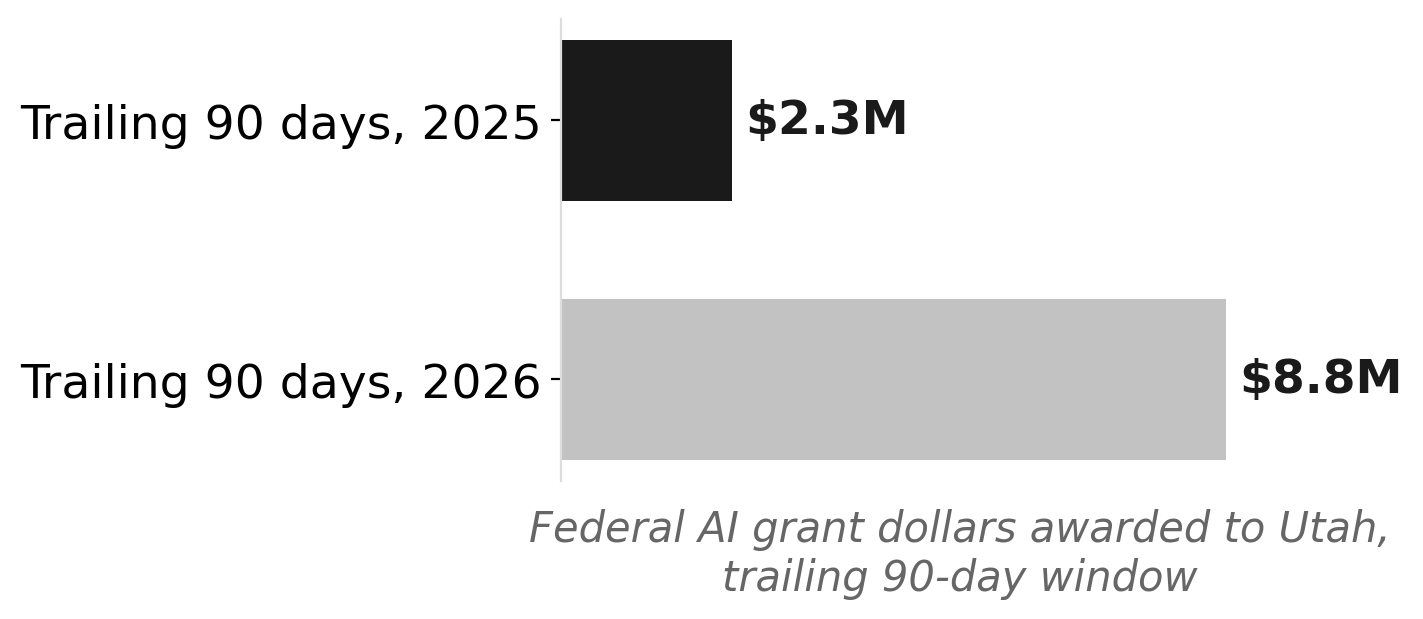
Source: NationGraph.
On the infrastructure side, the University of Utah announced a $50 million AI Factory in September 2025, a partnership with HPE and NVIDIA that provides the GPU backbone now supporting cancer modeling, climate research, and social science AI applications. The 2026 Utah Legislature then amplified that bet with HB2, a $33 million state appropriation that funds the Utah Health AI Vault, connecting the Utah Population Database with Huntsman Cancer Institute's computing resources, alongside a companion AI supercomputer at the university's Center for High Performance Computing. These are not the same program: HB2 is a direct state infrastructure investment, not a federal grant and not a match fund. It is the physical scaffolding that makes Utah competitive.
The match mechanism is a separate instrument. HB 373, also passed in 2026, created the $45 million Higher Education Research Funding Pilot, a state competitive grant program that explicitly lists AI as a priority area and is designed to use state awards as leverage for federal and private research funding. That is the direct policy pipeline: state dollars flow to universities, universities arrive at NSF and NIH with matching capacity already in hand, and federal reviewers see lower institutional risk. The $8.82 million now landing in Utah is, in part, the federal response to that mechanic working as designed.
The University of Utah's distinctive asset is the Utah Population Database, one of the largest linked genealogical and medical record systems in the world. Combined with Huntsman Cancer Institute, it gives the institution a nationally competitive position for AI-driven biomedical research that smaller research universities cannot easily replicate. The $2.34 million HHS cancer grant and several additional NIH awards in the current 90-day window flow directly from that positioning. Utah State University, meanwhile, anchors the state's longer-term federal portfolio with a $38.7 million NSF Engineering AI grant running through 2030, a commitment that signals sustained federal confidence in Utah's research infrastructure.
Utah's governance posture reinforces the credibility signal. The state created its Office of AI Policy under SB-149 in 2024, added high-risk interaction disclosure rules in 2025, and extended transparency and incident-reporting requirements under HB 286, effective May 2026. These are distinct from the funding programs: the regulatory sandbox and disclosure requirements do not move grant dollars, but they tell federal agencies that Utah is managing AI deployment seriously, which matters when large research awards carry reputational risk for the funding agency.
Governor Spencer Cox's $5 million AI Moonshot Program, launched in July 2026 with applications open through October 15, adds another layer aimed at applied projects in health care, autonomous technology, and natural resources. That program funds different work than the federal research grants and operates separately from both HB2 and HB 373, but its priority areas overlap almost exactly with the domains where new federal awards are landing.
In the Mountain West, Utah currently ranks fourth in trailing-90-day federal AI grant volume, behind Arizona, Colorado, and Nevada in raw dollars. But its 289% growth rate is the standout metric in the region, and it reflects a compounding dynamic: the more infrastructure Utah builds and the more match capacity its universities carry into federal competitions, the larger the share of NSF and NIH AI dollars they are positioned to absorb.
The next signal to watch is whether HB 373's first competitive awards, expected later in 2026, trigger a second wave of federal applications in the 2027 grant cycle. If the match-leverage mechanic performs as designed, the current surge may look modest by comparison.