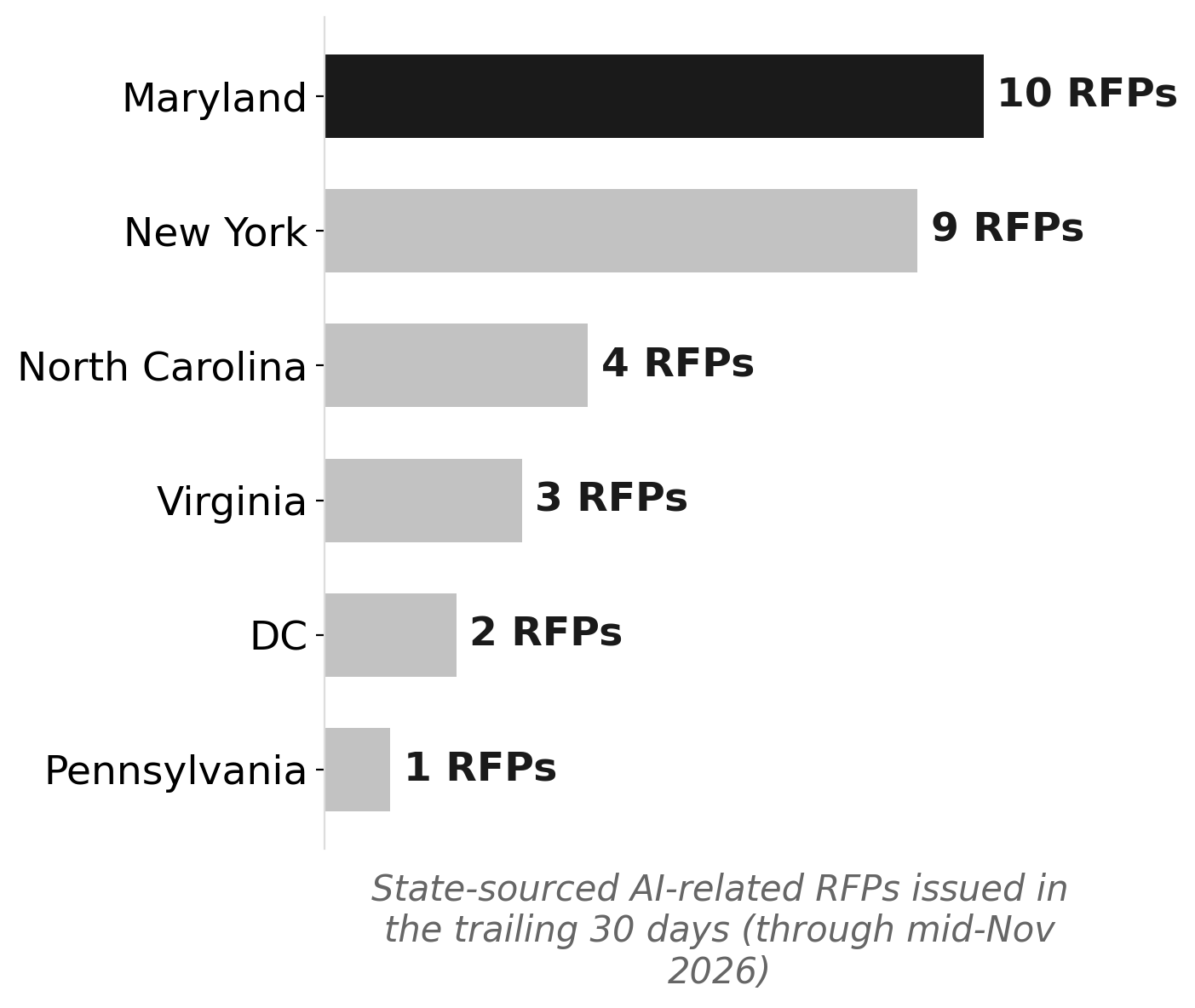
Maryland state agencies issued 10 AI-related RFPs in the trailing 30 days through mid-November 2026, against a 12-month monthly baseline of roughly one. That 10x surge is statistically unprecedented in the state's procurement record, and it did not emerge from enthusiasm alone. It emerged from a calendar.
The clock started on September 22, 2026, when Governor Wes Moore announced his statewide AI framework, explicitly citing federal inaction as part of his motivation. The framework directed the AI Subcabinet to develop legislative recommendations for the 2027 General Assembly session. That directive is not just a policy signal, it is a procurement deadline. Agencies now face a narrow window to demonstrate they are sourcing responsibly governed AI tools before new mandates arrive and potentially constrain what they can buy, and from whom.
October 2026 alone produced nine state-sourced AI RFPs, the single highest month in the dataset. The buying crosses every major sector of state government. The Maryland Department of Information Technology is seeking vendors for Zero Trust architecture paired with AI workforce training. The Maryland Department of Health issued an RFI explicitly seeking AI agents, large language models, and robotic process automation to transform Medicaid and public health operations. The Maryland Judiciary put out a solicitation for higher-education partners to research AI evidence admissibility. The Maryland Transit Administration is sourcing AI-enabled firearms detection. Charles County Public Schools is pursuing AI security cameras. The Maryland Transportation Authority is embedding AI into electronic toll collection systems.
Source: NationGraph.
This is not a single agency catching up. It is a whole-of-government procurement sprint, funded through individual agency state appropriations and shaped by two distinct policy instruments that must be understood separately. The Artificial Intelligence Governance Act of 2024 (SB 818) is a state statute that requires all agencies to inventory high-risk AI systems and conduct impact assessments overseen by the AI Subcabinet. It created the compliance floor. The September 22 framework is an executive policy document, not a statute, that directs the Subcabinet toward General Assembly recommendations and signals urgency at the agency level. The statute set the obligation; the framework set the clock. Neither instrument is an appropriation. The buying itself comes from each agency's own budget.
The Maryland Tech Council publicly criticized the framework as premature, arguing the Subcabinet's workgroup had not yet issued its recommendations. That criticism, whatever its merits, is itself evidence the acceleration is real and contested. When the state's largest tech trade association objects to the pace, it confirms something significant is moving.
The federal dimension adds pressure from the other direction. Federal Executive Order 14365, issued in December 2025, directed federal authorities to challenge state AI laws deemed inconsistent with national policy. Maryland's move to build out a governed AI procurement ecosystem before that preemption argument hardens gives the state's sprint an additional strategic logic: agencies that have already contracted for compliant AI tools are harder to dislodge than agencies still drafting RFPs.
Maryland's procurement environment was unusually prepared for this moment. The state codified the AI Subcabinet into law in 2024, published a statewide responsible-AI policy through the Department of Information Technology, and issued K-12 AI guidance in February 2026, all before the September framework. That layered policy infrastructure means agencies had compliance frameworks in place before they started buying, which is rare nationally. The University of Maryland's NSF-funded TRAILS Institute for Trustworthy AI in Law and Society (an $18.2 million active federal grant) and Johns Hopkins' AI research programs give the state a credentialed local ecosystem capable of absorbing procurement demand quickly. That ecosystem matters: vendors with existing state relationships and research track records will likely fill contracts faster than the Subcabinet's recommendation timeline.
On raw 30-day volume, Maryland now leads the DC-metro region: 10 RFPs against Virginia's 3, DC's 2, and Pennsylvania's 1. It edges out New York (9) on a straight count. That regional comparison matters for where AI vendors concentrate their state-government sales efforts, and Maryland is now the clearest signal in the mid-Atlantic.
The next thing to watch is what the AI Subcabinet actually recommends. When those recommendations reach the General Assembly in the 2027 session, they will define the regulatory environment that any contract signed today must eventually operate within. Agencies that have locked in vendor relationships and running systems before that moment will have more negotiating leverage over compliance timelines than those that have not. The procurement surge is, in that sense, less about deploying AI quickly and more about preserving optionality before the rules harden.