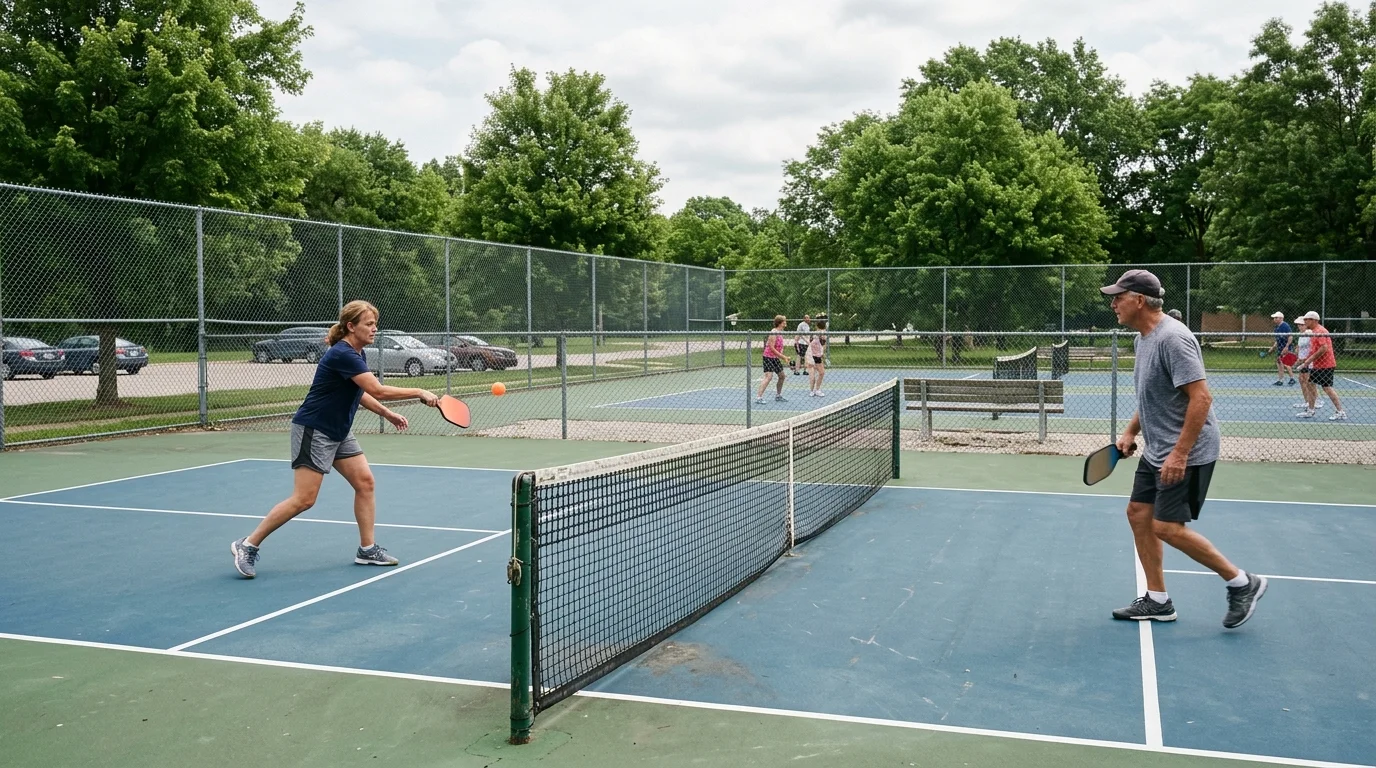
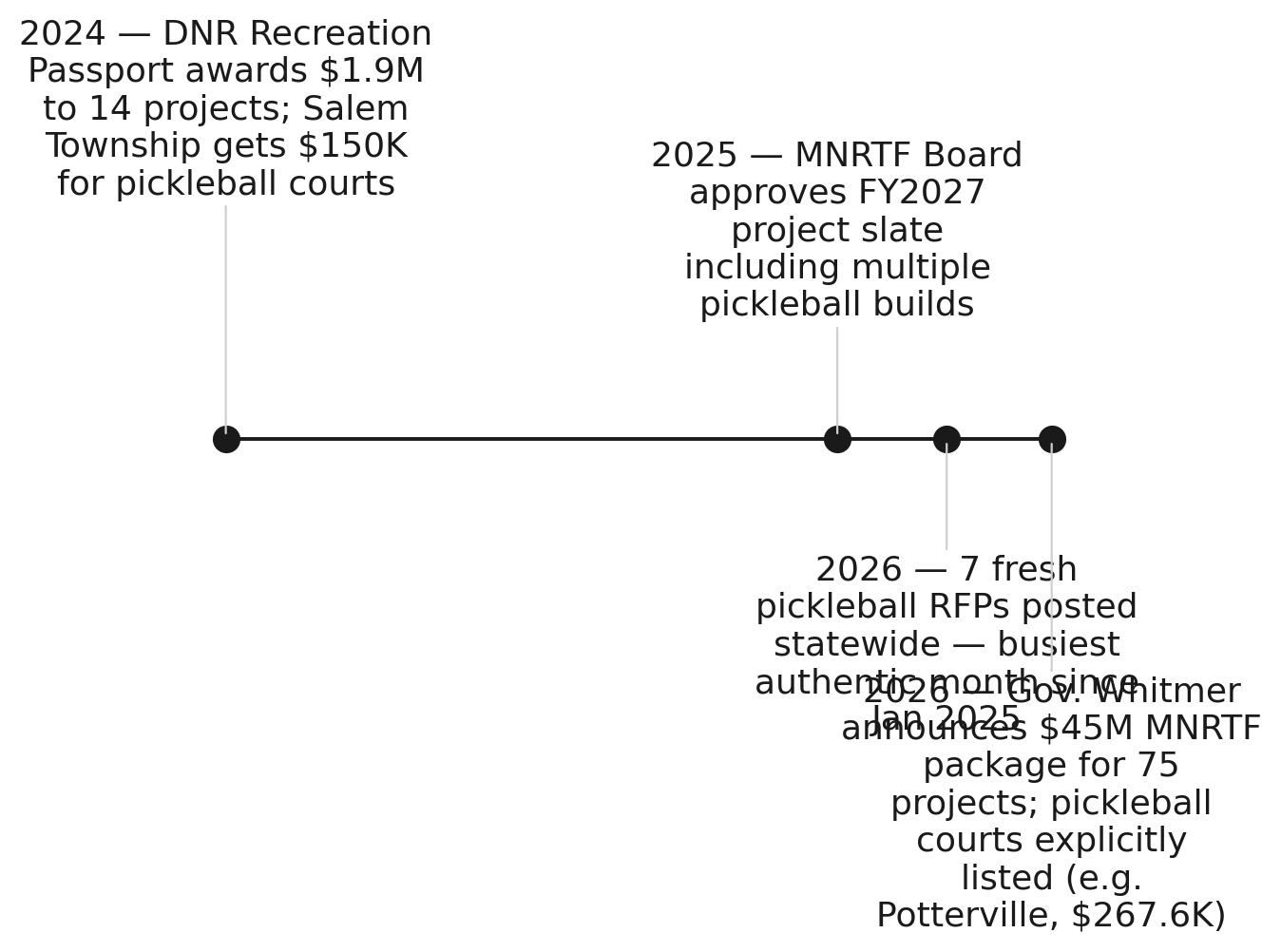
Since January 2025, Michigan municipalities have issued genuine pickleball facility solicitations every single month, with the busiest windows in April 2026 and August 2025 each producing seven fresh RFPs. The projects span Wayne, Oakland, Macomb, Muskegon, Kalamazoo, Leelanau, Saginaw, and Upper Peninsula counties. No single metro is driving this. What is driving it is a layered state grant ecosystem that has quietly made pickleball courts one of the easiest public infrastructure projects in Michigan to get funded.
The architecture of that ecosystem matters, because it is not one program doing one thing. Three separate DNR-linked funding streams are at work, each with its own appropriation, its own competitive cycle, and its own award ceiling. The Michigan Natural Resources Trust Fund, which Governor Whitmer's August 2026 announcement confirmed will distribute $45 million to 75 projects statewide in FY2027, sits at the top: a restricted state fund financed by oil, gas, and mineral royalties on state-owned land, with grants running up to $6.5 million per project for land acquisition and park development. The DNR Recreation Passport Grant Program, funded by 10 percent of vehicle Recreation Passport sales, operates at mid-scale, awarding nearly $1.9 million across 14 projects in its 2024 round, including $150,000 specifically to Salem Township for pickleball courts. At the base, CMF/DNR Spark Grants, routed through regional community foundations in partnership with the DNR, seed small-scale court builds in places like Gladwin, Osceola, Clare, Presque Isle, and Macomb counties.
The result is a grant ladder. A township with a modest parks budget can enter through Spark Grants, build one or two courts, demonstrate community use, and return to the Recreation Passport program for a larger upgrade. If the vision grows to a full recreation complex, the MNRTF is there for the heavy lift. All three programs share the DNR's application infrastructure and the same eligible-use category: public outdoor recreation. That common pathway means local parks directors have a well-worn route to court funding that peers in neighboring states lack.
Source: NationGraph.
The MNRTF is celebrating its 50th anniversary in 2026, having awarded nearly $1.4 billion since 1976. The DNR board approved the FY2027 project slate in December 2025, and Whitmer's FY2027 budget signature confirmed the awards in August 2026. When combined with required local matches, the MNRTF round alone represents $108.9 million in total investment in public land and outdoor recreation statewide. Pickleball courts are explicitly among the funded improvements: Potterville, for example, received $267,600 for trail and pickleball court work at Alliance Lake Park.
Two municipal examples illustrate how the pipeline is producing actual ground-level action. In New Baltimore, the city council voted 5-1 on March 23, 2026, to submit a DNR Trust Fund application for six pickleball courts at Festival Park. The application followed a public hearing before the parks commission and months of community input, and the city's parks director subsequently confirmed the application had been submitted with site and utility reviews underway. In Escanaba, in the Upper Peninsula, the city council authorized a DNR Trust Fund grant application for dedicated pickleball courts at Royce Park, seeking up to $400,000 with a $40,000 local match. These are not suburban amenity plays. They are small- and mid-sized cities running a process they have watched neighboring communities complete successfully.
The geographic spread matters for a reason beyond pickleball. Whitmer has consistently framed DNR investment through Michigan's outdoor recreation economy, which supports 126,000 jobs and more than $4.7 billion in wages annually. That framing gives the grant programs bipartisan durability: recreation infrastructure is jobs infrastructure in rural UP counties as much as in Metro Detroit suburbs. When Escanaba applies for the same type of DNR grant as New Baltimore, it is not a coincidence. It is the system working as designed.
For residents in communities that have not yet built dedicated courts, the signal to watch is a city council agenda item authorizing a DNR Trust Fund or Recreation Passport grant application. That vote is typically the last step before a formal solicitation goes out for construction services. The MNRTF runs competitive cycles, and projects approved in December 2025 will move through design and bidding into construction windows in 2026 and 2027. The next MNRTF board review cycle will shape which communities enter the queue for the following fiscal year. Parks directors who have not yet submitted applications are already preparing them.