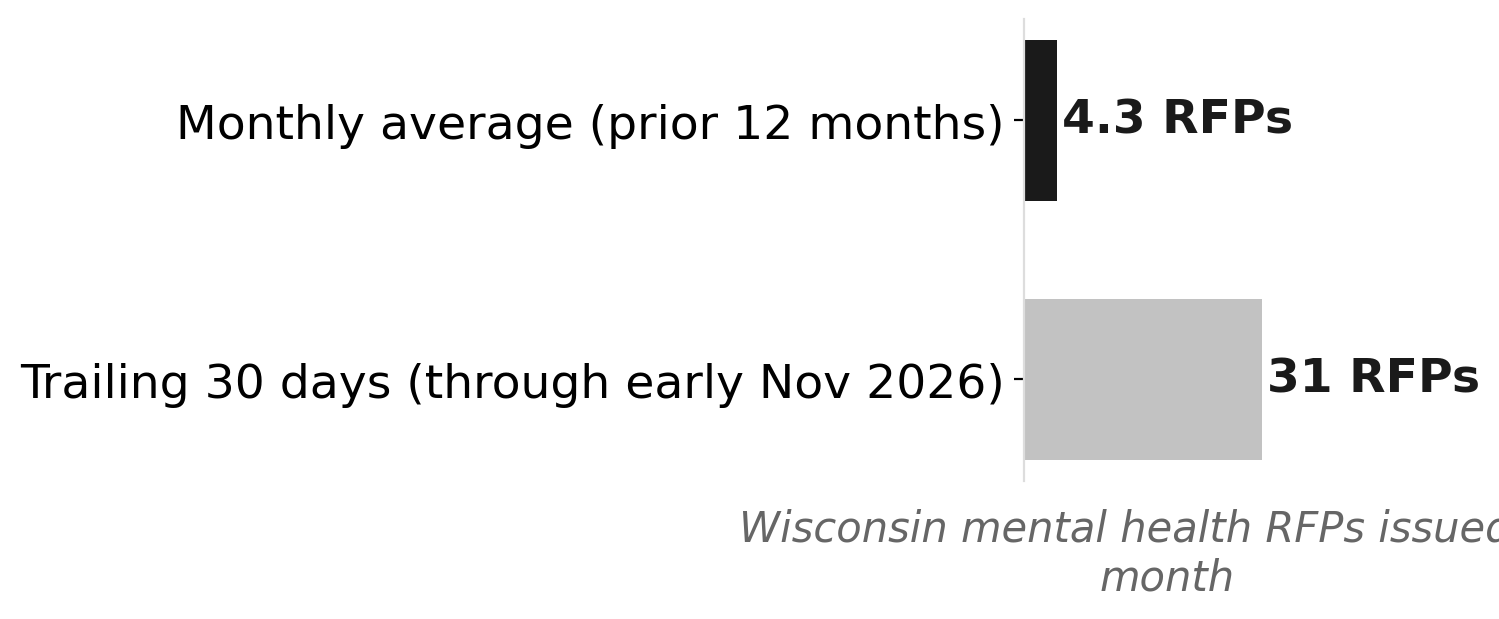
Wisconsin issued 31 mental health-related RFPs in the trailing 30 days through early November 2026, against a 12-month monthly average of about 4.3. That 7.2x spike is not a sudden policy shift. It is the bureaucratic machinery of a bipartisan state budget finally grinding into motion, four months after the money was signed into law and one week before a hard federal deadline forces the first round of contracts to close.
The budget in question is 2025 Wisconsin Act 15, signed by Governor Tony Evers on July 3, 2025. The legislation appropriated $30 million in state funds for school-based mental health services, $10 million in state grants for regional crisis urgent care and observation centers, $7 million in state appropriations for Wisconsin's 988 Suicide and Crisis Lifeline, and $15.8 million in state dollars to cover projected deficits at Mendota and Winnebago Mental Health Institutes. These are four distinct programs drawing on four distinct state appropriation streams, all entering FY2026 implementation simultaneously.
Layered on top of those state dollars are separate federal flows: a $15.5 million SAMHSA Community Mental Health Services Block Grant running through September 2027, and a $4.5 million federal 988 and Behavioral Health Crisis Services award that SAMHSA directed to Wisconsin DHS in September 2026. Neither of those federal block grants is part of Act 15. All of them, however, share one administrative chokepoint: the Wisconsin Department of Health Services, which must sub-grant and contract out the money before it lapses.
Source: NationGraph.
DHS led the October procurement wave with 12 RFPs of its own. Dane County followed with 7 combined across two procurement offices, and Columbia County issued 4. The themes cluster into three recognizable streams: adolescent and youth mental health, crisis and peer support services, and correctional mental health. That clustering is not coincidental. The Title V Maternal and Child Health Block Grant, a separate federal program administered by DHS's Division of Public Health, set November 9, 2026 as the application deadline for its adolescent mental health sub-awards. That single hard date pulled a significant share of the October volume forward, forcing county health agencies to file or forfeit.
The demand-side numbers explain why no one wanted to forfeit. Wisconsin's DHS notified the Joint Finance Committee that fee-for-service mental health and substance use disorder costs are running $76 million over budget in FY2026. Meanwhile, 40 of the state's 72 counties carry a federal mental health shortage area designation, and 35 of 45 non-metro counties lack adequate mental health professionals. The supply the state is now trying to build through competitive procurement exists against a backdrop of documented, widening unmet need.
The structure of Wisconsin's system amplifies how budget decisions translate into county-level contracting activity. DHS runs the two state psychiatric institutes directly and sub-grants most community-facing dollars through county human services departments. When a biennium opens with a substantially larger appropriation, the effect is not a smooth ramp, it is a procurement surge concentrated near the start of Year 1 as counties absorb new authority to spend and race to place contracts before the biennium clock ticks down.
What changes for someone living in a Wisconsin county that is currently shortlisted in one of these procurements: a successful bid can mean a new peer-run respite house, a school-based counseling expansion, or a youth crisis stabilization bed that did not previously exist in the county. The contracts being written now will shape what services are available in 2027 and whether the new state institutes funding keeps Mendota and Winnebago solvent through the end of the biennium.
The next signal to watch is how many of the 31 RFPs convert to signed contracts, and whether the November 9 Title V deadline produces a matching spike in awards. If DHS and county agencies move quickly, the sub-grant commitments made in November will determine whether the $30 million school-based mental health line and the $10 million crisis center grant program reach communities in shortage areas by FY2027, or whether unspent balances trigger the reappropriation fight that typically follows a slow-moving biennium.