Fifty housing-related RFPs have landed in Washington DC's procurement system in the last 30 days, more than three times the 12-month monthly average of 16, and nearly every one of them traces back to a single source: the DC Housing Authority. That concentration tells a story the permit numbers have already started to tell, DC's private development market has essentially shut down, and DCHA has become the city's last functioning engine of new housing supply.
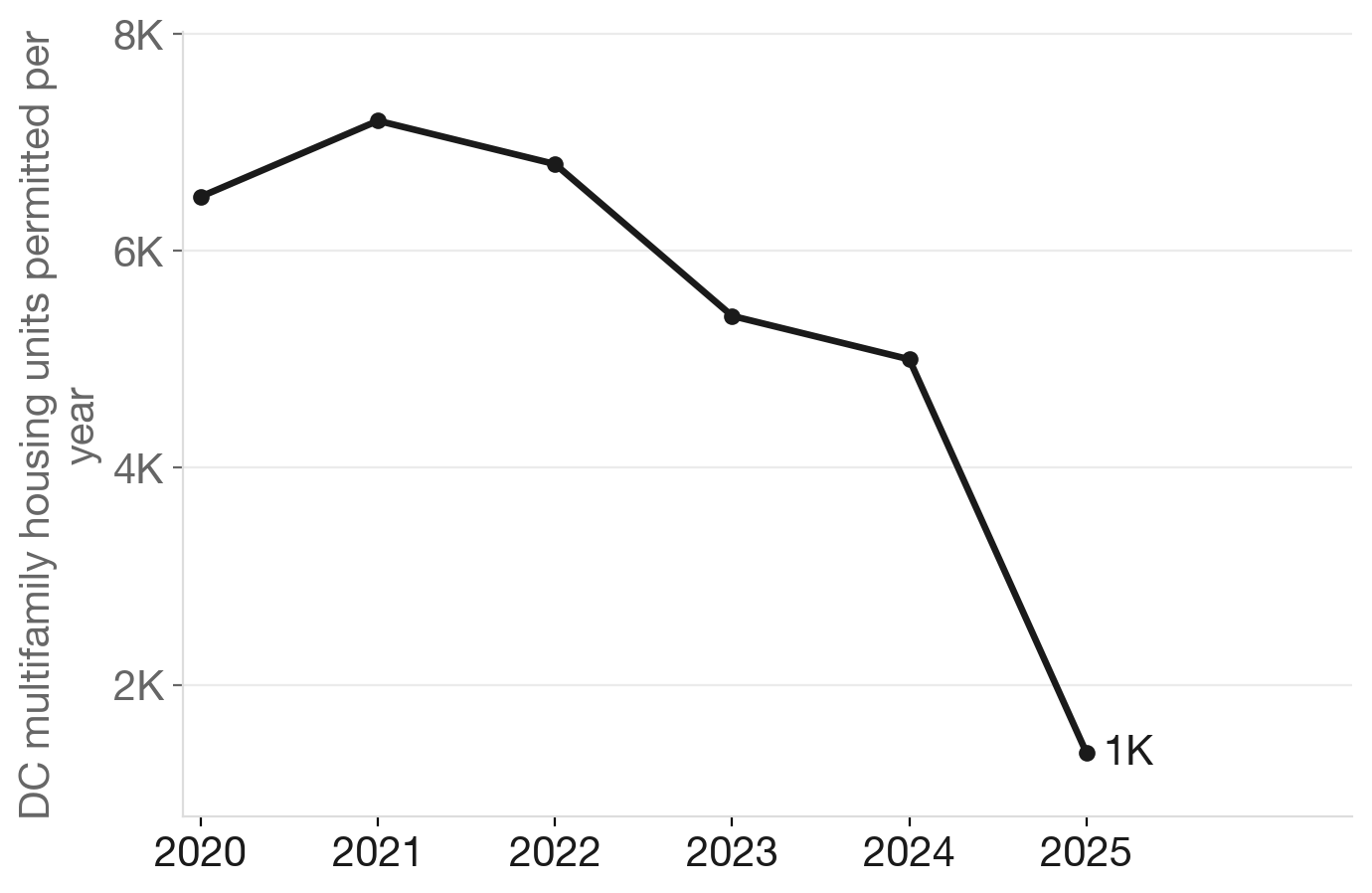
The collapse on the private side is not marginal. DC issued permits for 1,372 multifamily units in all of 2025, down from 5,000 to 8,000 per year in prior years. In January 2026, a single building pulled a permit for 30 units. High interest rates, rising construction costs, and what BrightMLS has described as ongoing uncertainty around the federal workforce have effectively frozen the projects that would normally supply the market. Into that vacuum, DCHA is moving.
The procurement surge reflects four simultaneous redevelopments advancing at once: Sursum Corda and Sibley Townhomes together account for 15 of the recent RFPs, Greenleaf and Lincoln Heights have generated 3 each, and a separate cluster of 14 solicitations covers HVAC and maintenance contracts across DCHA's existing portfolio. Some of these filings are historical solicitations being entered into the system now rather than brand-new contracts, so the spike signals administrative consolidation and project advancement as much as a clean wave of fresh spending. But the direction is unmistakable. DCHA's FY2026 Moving to Work Annual Plan, submitted to HUD in July 2025, formally commits the authority to redeveloping 14 of its 41 properties under HUD's Rental Assistance Demonstration and Section 18 disposition programs. Four of those 14 are now in active solicitation simultaneously.
Source: NationGraph.
The money making this possible comes primarily from Washington rather than from the District's own budget. HUD currently holds $391 million in active housing grants to DC across 271 individual grants. A $26.5 million Public Housing Capital Fund award issued in May 2025 runs through May 2029 and is underwriting much of the immediate work. DCHA operates under HUD's Moving to Work demonstration program, which gives it unusual latitude to waive federal statutes and design its own approaches, a flexibility that matters when you are trying to execute a build-first redevelopment strategy, as Greenleaf's plan requires, while keeping existing residents housed.
The urgency is real. Many of DCHA's 41 properties are in what the authority's own filings describe as extremely urgent need of repair, the legacy of deferred maintenance across decades. The communities being redeveloped now, including Greenleaf in Southwest DC, Sursum Corda in NoMa, and Lincoln Heights in the far northeast, collectively house thousands of low-income residents who depend on DCHA not just for affordable rents but for habitable units. The authority's bet is that full redevelopment into mixed-income communities, financed through federal programs and private equity drawn in by tax credits, is faster and cheaper than trying to repair what exists.
On the local funding side, the architecture is shifting too. DC Council Bill B26-0597, the Housing Production Omnibus Amendment Act introduced February 18, 2026 by Councilmembers Robert White and Brianne Nadeau, would dissolve the existing Housing Production Trust Fund and replace it with a unified Housing Opportunity Fund carrying dedicated sub-accounts for production, preservation, tenant purchase, and District acquisition. A public hearing was held March 30, and the DC Fiscal Policy Institute has noted that the Council already enacted a $30 million one-time preservation set-aside within the existing HPTF for FY2026. A separate ballot measure, Initiative No. 88, the Rent Control and Housing Eligibility Adjustment Amendment Act, was formalized by DCBOE in May 2026, adding electoral pressure to a supply debate that is already unavoidable. The February 2026 RFP surge, when 69 housing solicitations appeared in a single month, coincided almost exactly with the introduction of B26-0597.
For residents of the affected communities, the immediate question is sequencing. The build-first model at Greenleaf promises that new units will be ready before demolition of existing stock, but executing that across four sites at once, with a constrained contractor market and federal grant timelines, leaves little margin. For everyone else in DC, the more abstract question is how long the city can run its housing policy through a single public authority drawing on federal appropriations that are themselves subject to Washington's own budget pressures.
The next signal to watch is whether B26-0597 advances out of committee before the FY2027 budget cycle begins, which would determine whether the new Housing Opportunity Fund structure is in place in time to backstop any projects that outpace their federal financing.