Tennessee mental health RFPs hit five in the last 30 days, more than double the 12-month average of roughly 2.2 per month, and the timing is not a coincidence. On September 30, 2026, SAMHSA's FY2026 grant cycle closed with more than $5.7 million in new multi-year mental health commitments flowing into the state, and agencies are now racing to procure the services those dollars are supposed to fund.
The federal money arrived across four distinct programs, each with its own target population and mechanism. The Tennessee Department of Mental Health and Substance Abuse Services received a $3 million Children's Mental Health Initiative (CMHI) award for its FamilyLink Navigation and Support Initiative, a four-year wraparound coordination effort serving 745 youth across 10 counties. TDMHSAS also received two separate SAMHSA Center for Mental Health Services discretionary grants, $1.3 million over five years for a youth criminal-justice diversion network in Davidson County and $735,000 over five years for statewide youth suicide prevention. The City of Clarksville, partnering with Centerstone, Tennessee's largest nonprofit behavioral health system, received $750,000 over four years to stand up a behavioral health mobile crisis co-response team that pairs clinicians with law enforcement. A separate PATH formula block grant of $1.046 million, which began July 1, funds mental health transitions for Tennesseans experiencing homelessness. These are not interchangeable instruments: the CMHI is a competitive cooperative agreement, the CMHS awards are targeted innovation grants, and PATH is a formula-based block grant, but they arrived in the same fiscal window, producing a simultaneous procurement wave.
The RFP geography tells the story of where pressure is highest. Knox County issued four mental health RFPs in July alone, covering expanded direct services, a needs assessment, community partnerships, and professional services, a sequencing that suggests the county is buying the diagnostic scan before it contracts the treatment. Tennessee Technological University in Putnam County, in the Appalachian foothills, issued three RFPs in August and September for psychiatric mental health nurse practitioner (PMHNP) services and telehealth trauma treatment at its campus counseling center. TTU is not advertising these roles because it has leverage; it is advertising them because it cannot recruit full-time psychiatrists and is turning to contractors and telehealth as the next best option.
Source: NationGraph.
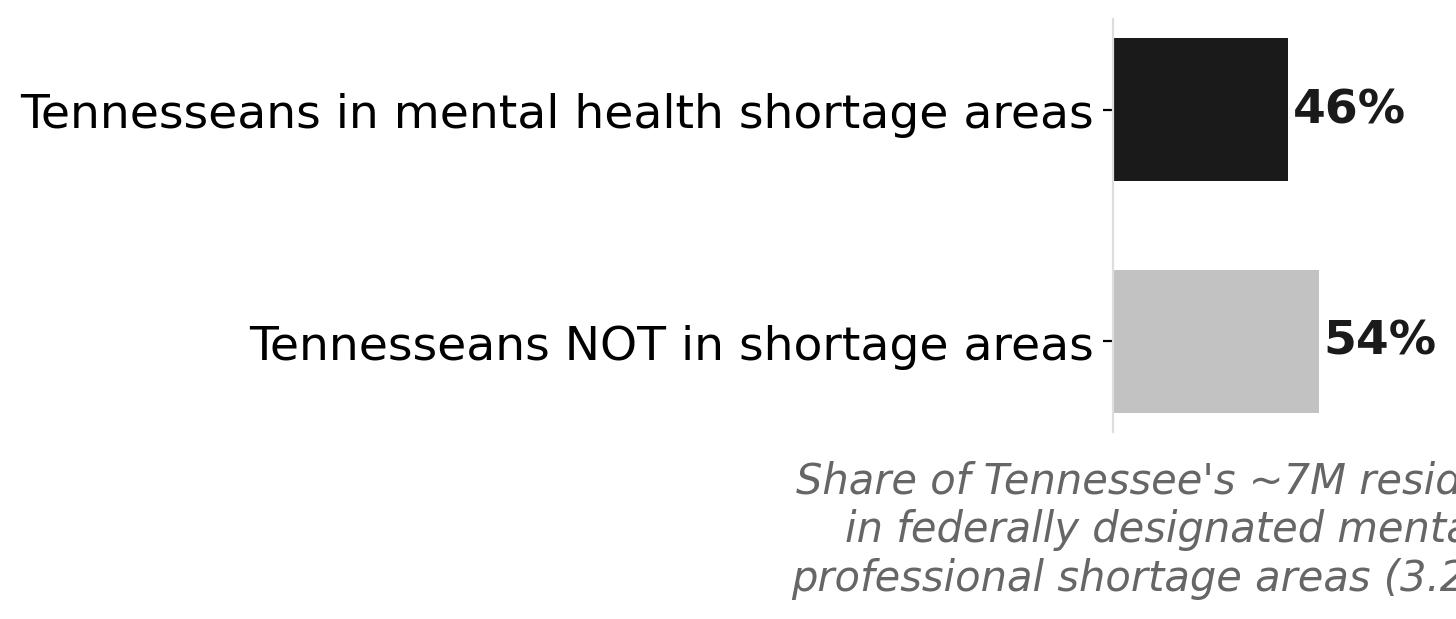
That is the central tension. According to a July 2026 HHS announcement, SAMHSA distributed $73.2 million nationally in CMHI, Zero Suicide, and related grants, with Tennessee's $3 million CMHI award representing the program ceiling, the most a single state can receive. Yet HRSA estimates that more than 137 million Americans now live in mental health professional shortage areas. Tennessee's exposure is acute: state data shows more than 3.2 million residents, roughly half the state's population, live in communities without adequate mental health providers, and the state faces an estimated shortfall of approximately 6,000 physicians by 2030.
The structural constraint runs deeper than raw numbers. Tennessee does not grant full practice authority to nurse practitioners without physician oversight, which narrows the labor pool that PMHNPs can operate in independently. The Tennessee Hospital Association has responded with a $20,000-per-year incentive specifically for PMHNP students, targeting the psychiatric gap in rural and medically underserved areas. The state has also relaunched a behavioral health scholarship program aimed at the same bottleneck. These are meaningful interventions, but they operate on a multi-year pipeline: a PMHNP student entering a program today does not become a billable provider until 2028 or later.
The Clarksville co-response award carries a different signal. Pairing Centerstone clinicians with law enforcement for crisis calls is a criminal-justice-diversion model that SAMHSA has prioritized nationally, and it is designed to move people away from emergency rooms and jail cells when the underlying problem is psychiatric. Clarksville is a mid-sized city with a large military-adjacent population, Fort Campbell sits on its western edge, and behavioral health demand there has historically outpaced civilian provider supply. The $750,000 award is a four-year commitment, not a one-time pilot.
For Tennesseans in the 10 counties targeted by FamilyLink, the CMHI award means a new layer of care coordination for children and youth with serious emotional disturbance, starting this fall. For families in Clarksville, it means a clinician may show up alongside a police officer during a mental health crisis, rather than a patrol car alone. For Tennessee Tech students in Cookeville, it means telehealth trauma services if the university can find a PMHNP contractor willing to take the work.
The open question is whether the procurement wave resolves into actual contracts, or whether RFPs close with too few qualified respondents. Knox County's needs-assessment-first approach suggests at least one major jurisdiction understands the workforce math and is trying to quantify the gap before committing to service levels it cannot staff. The next signal to watch is how many of these RFPs are re-issued, extended, or downscoped, which would indicate that the money arrived before the workforce did.