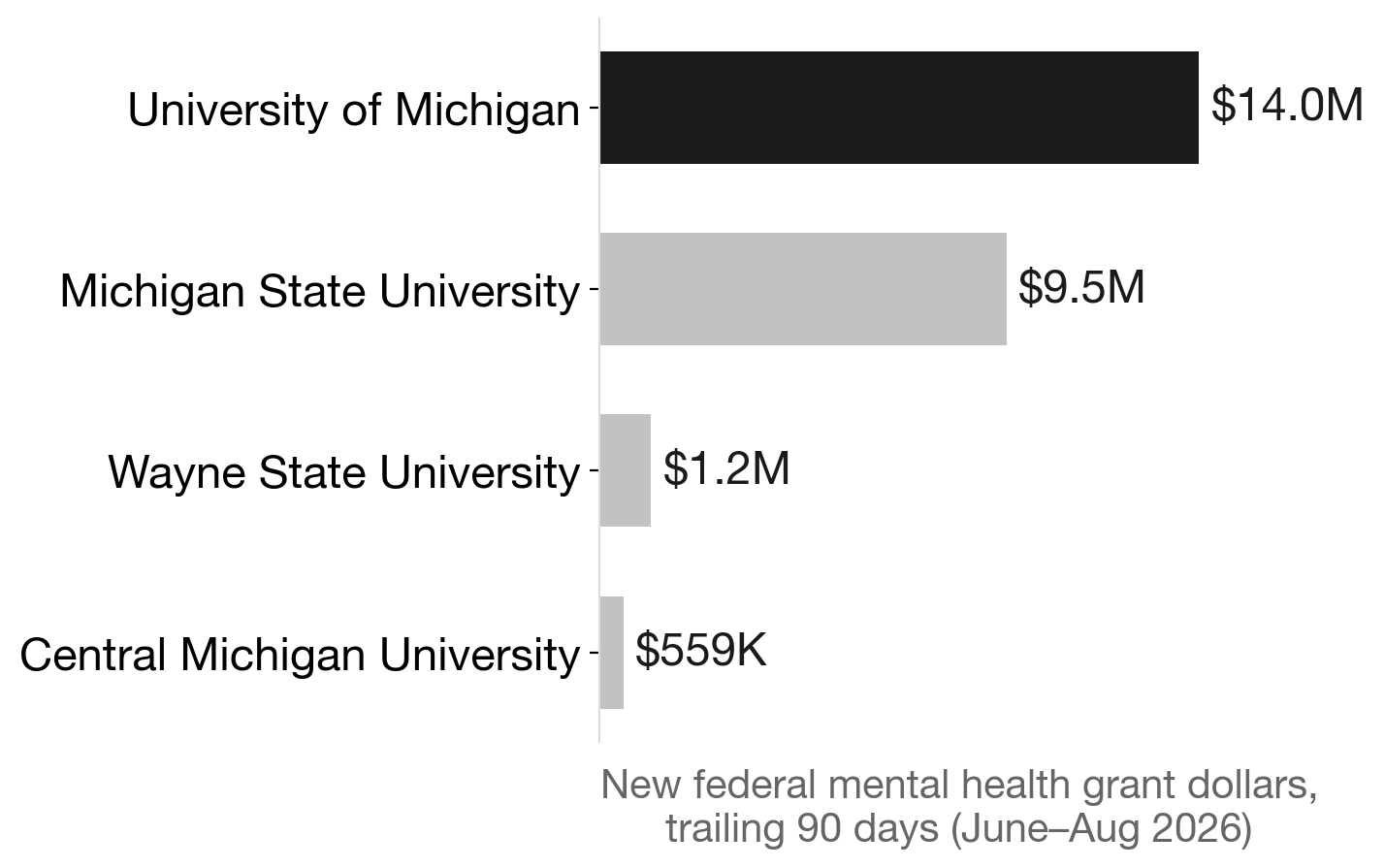
Federal mental health dollars flowing into Michigan have nearly doubled in a single quarter: $25.9 million in new grants committed in the trailing 90 days through August 2026, up 87% from $13.8 million in the same window a year ago. The surge sounds like relief for a state in genuine crisis. Most of it is going to a pair of research campuses in Ann Arbor and East Lansing.
The University of Michigan alone accounts for $14 million across 26 new grants, or 54 cents of every dollar in the current window. Michigan State University adds another $9.5 million across 10 grants. Wayne State and Central Michigan University together contribute less than $2 million. Every grant in this 90-day window flows from a single federal source: the Department of Health and Human Services, through NIH, NIMH, and NIDA. These are multi-year R-series research awards, the kind that fund laboratory scientists and clinical researchers for five years at a stretch. They are not block grants to county community mental health boards, not training stipends for rural social workers, not reimbursement enhancements for under-resourced clinics.
That distinction matters because Michigan's care-delivery system is deteriorating in measurable ways. A March 2026 report covered by WILX found the state is meeting roughly 40% of its mental health workforce needs, with high education costs and low wages cited as structural barriers. Sixty-eight of the state's 83 counties carry documented behavioral health provider shortages. More than 40% of Michigan's population lives in a federally designated Mental Health Health Professional Shortage Area. The state has roughly 19 inpatient psychiatric beds per 100,000 residents, well below the recommended floor of 30. These are not projections; they are current conditions.
Source: NationGraph.
The composition of the federal grant flow has shifted in ways that explain the dollar spike without resolving the shortage. A year ago, the baseline included HRSA Mental and Behavioral Health Education and Training grants to Oakland University, Ferris State, and the University of Detroit Mercy, smaller awards spread across institutions with stronger ties to regional workforce pipelines. Those training grants did not renew at comparable levels in the current window. In their place came a cluster of new NIH research awards to the flagship universities. The total rose sharply; the geographic reach contracted. In March 2026, Congressman Tom Barrett announced he had helped secure new HHS grants to MSU as part of the FY2026 NIH funding package, a legitimate legislative win for the university, though a different kind of investment than workforce development.
U of M's active mental health and addiction grant portfolio now stands at $242 million across 138 grants, one of the largest such concentrations at any public university in the Midwest. MSU holds $69 million across its active awards. The Michigan Department of Health and Human Services holds an $80 million active portfolio of its own, largely in service-delivery and Medicaid administration categories. The research infrastructure is real and nationally significant. Michigan ranks second among Midwest states for mental health grant volume in this window, behind Ohio's $60.7 million and ahead of Illinois and Wisconsin.
The tension is structural. NIH research grants are designed to produce knowledge: new treatments, validated interventions, published evidence. They are not designed to put a licensed counselor in Alpena County or reduce wait times at a community mental health authority in the Upper Peninsula. MDHHS is simultaneously rolling out its new Mental Health Framework for Medicaid behavioral health billing through FY2026, a phased overhaul that is adding administrative complexity for community providers already operating near capacity. The two tracks, more research funding and a harder billing environment for frontline providers, are running in parallel without obvious coordination.
Nationally, HRSA reported in December 2025 that 137 million Americans live in a mental health provider shortage area, up 15 million from the prior year, with only 26.4% of workforce needs being met in those areas. Michigan is not an outlier; it is a clear example of a national pattern in which research capacity and service capacity are funded through entirely separate pipelines, by separate agencies, on separate timelines.
The signal to watch in the next two quarters is whether HRSA training grants re-enter the Michigan picture. The MBET program, which sent smaller but more workforce-oriented dollars to regional universities in the prior-year window, operates on its own appropriations cycle. If those awards return and target the same shortage counties the NIH dollars are bypassing, the two streams could begin to complement each other. If they don't, the 87% spending increase will continue to look larger in the grant database than it feels on the ground in most of the state.