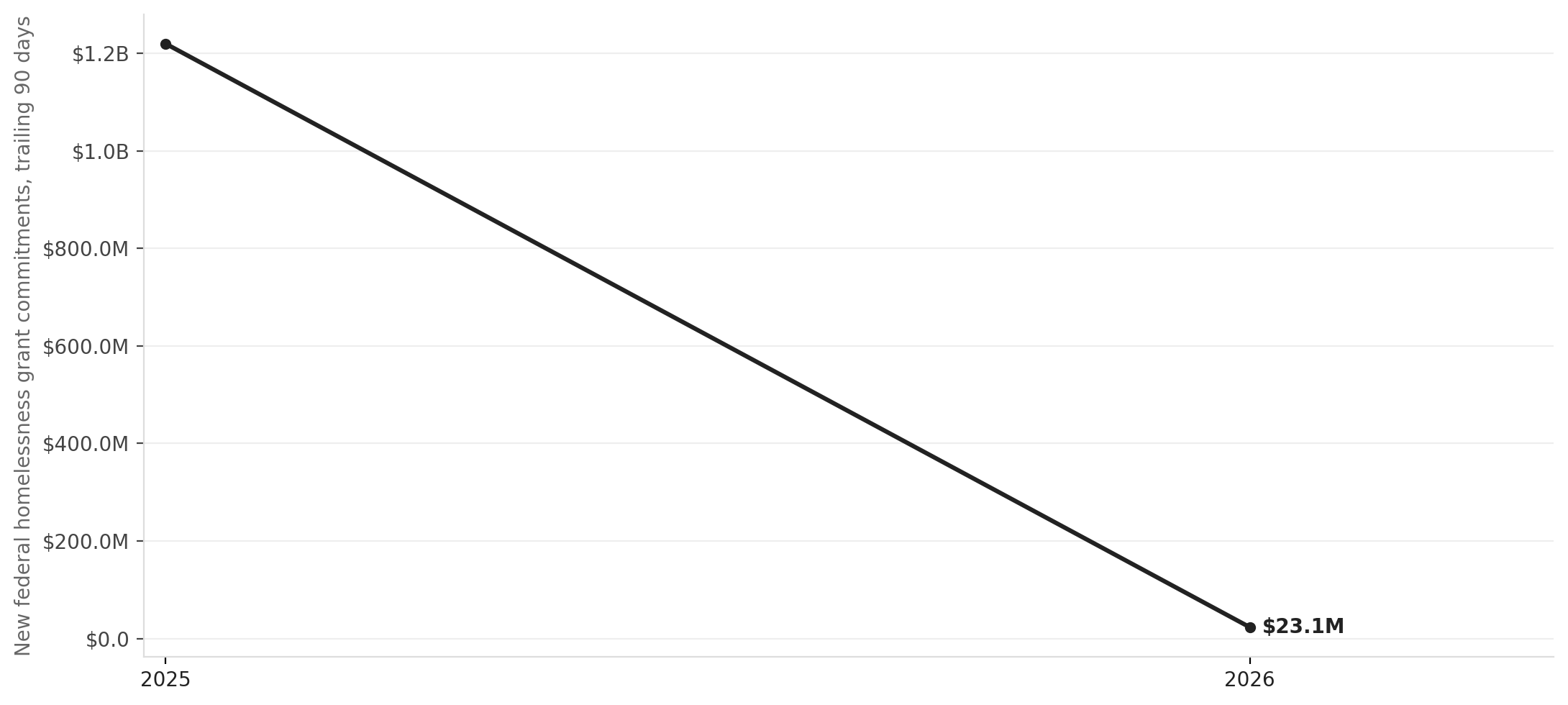
New federal homelessness grant commitments in New York have collapsed to $23.1 million over the trailing 90 days, down from $1.22 billion in the same window a year ago, a 98% drop that is not a sign of progress but a warning light on a funding cliff with a hard deadline.
The prior-year figure was dominated by enormous Housing Choice Voucher renewal tranches: NYCHA alone received a $509 million award starting January 1, 2026, and the Housing Trust Fund Corporation received $199 million in the same window. Those awards reflected the churn of short-duration continuing resolutions that Congress has used in place of a final FY2026 HUD appropriations bill. The current 90-day window shows only small month-to-month renewals, the largest is a $20.7 million HCV increment to NYCHA, and a single $113,000 Continuum of Care award to CARES of NY. The pipeline of new federal money being committed has, for practical purposes, stopped.
Three federal actions converged to produce this moment. HUD announced in March 2025 that the Emergency Housing Voucher program, funded by the 2021 American Rescue Plan and originally designed to run through 2030, would exhaust its money by December 31, 2026, ending roughly four years early. Simultaneously, the Trump administration's FY2026 budget proposed a $32.9 billion cut to HUD, including a $26.7 billion reduction in rental assistance and a restructuring of Section 8 into a state block grant. And Congress has passed no final appropriations bill, leaving HUD to operate on a series of continuing resolutions that delay or shrink the large quarterly voucher renewal awards that inflated last year's comparison window. The result is a federal housing finance system running on fumes while the bills come due.
Source: NationGraph.
No city in the country is more exposed than New York. Of the 70,000 Emergency Housing Vouchers issued nationally, New York City received 7,700, 11% of the national total, more than any other city. NYCHA administers roughly 5,200 of those vouchers; the city's Department of Housing Preservation and Development holds another 2,100. As Gothamist has reported, tenants have already been facing deadlines as the program winds down. NYCHA asked HUD for a waiver to transition EHV holders directly into the standard Section 8 program; HUD denied it. NYCHA has since halted new issuance to applicants on its general HCV waitlist in an attempt to absorb the EHV population, a triage decision that simply moves the displacement risk from one group to another.
The arithmetic of what comes next is difficult. The Bronx alone accounts for nearly half the city's EHV recipients. A one-bedroom apartment in the Bronx already tests the limits of current voucher payment standards in one of the most expensive rental markets in the world. When those 7,700 vouchers expire, the households holding them do not become less poor, they become unsubsidized in a market where unsubsidized means unhoused for many. ABC7 has reported that as many as 12,000 New Yorkers could face homelessness if the voucher gap is not closed.
The local safety nets are thin. Mayor Zohran Mamdani's administration is continuing a lawsuit that would block expansion of the CityFHEPS local voucher program, which had been the most plausible municipal backstop. State Sen. Brian Kavanagh has introduced legislation to open a state housing program to households losing federal subsidies, but it has not passed. The Center on Budget and Policy Priorities warns that the House HUD funding proposal, if enacted, could result in more than 400,000 fewer people receiving Section 8 vouchers nationally, a scale of displacement that would dwarf anything the shelter system could absorb.
This is not a New York anomaly. Across the five largest states, new homelessness grant starts in the second quarter of 2026 are a fraction of first-quarter levels. The Continuum of Care program was separately disrupted when HUD issued and then rescinded a new funding competition notice with drastically different terms, delaying awards that communities had expected in January. The federal housing finance machinery is stuttering at every level simultaneously.
What New York residents should watch for in the coming months: whether Congress passes a final FY2026 appropriations bill before the fiscal year ends in September, which would determine whether large voucher renewal tranches resume; whether HUD issues any new guidance on EHV transitions before the December 31 funding exhaustion date; and whether Albany acts on Kavanagh's legislation before the legislative session closes. Each of those is a binary gate. If all three close without action, the 98% funding gap visible in today's data becomes a homelessness surge visible in next year's shelter counts.