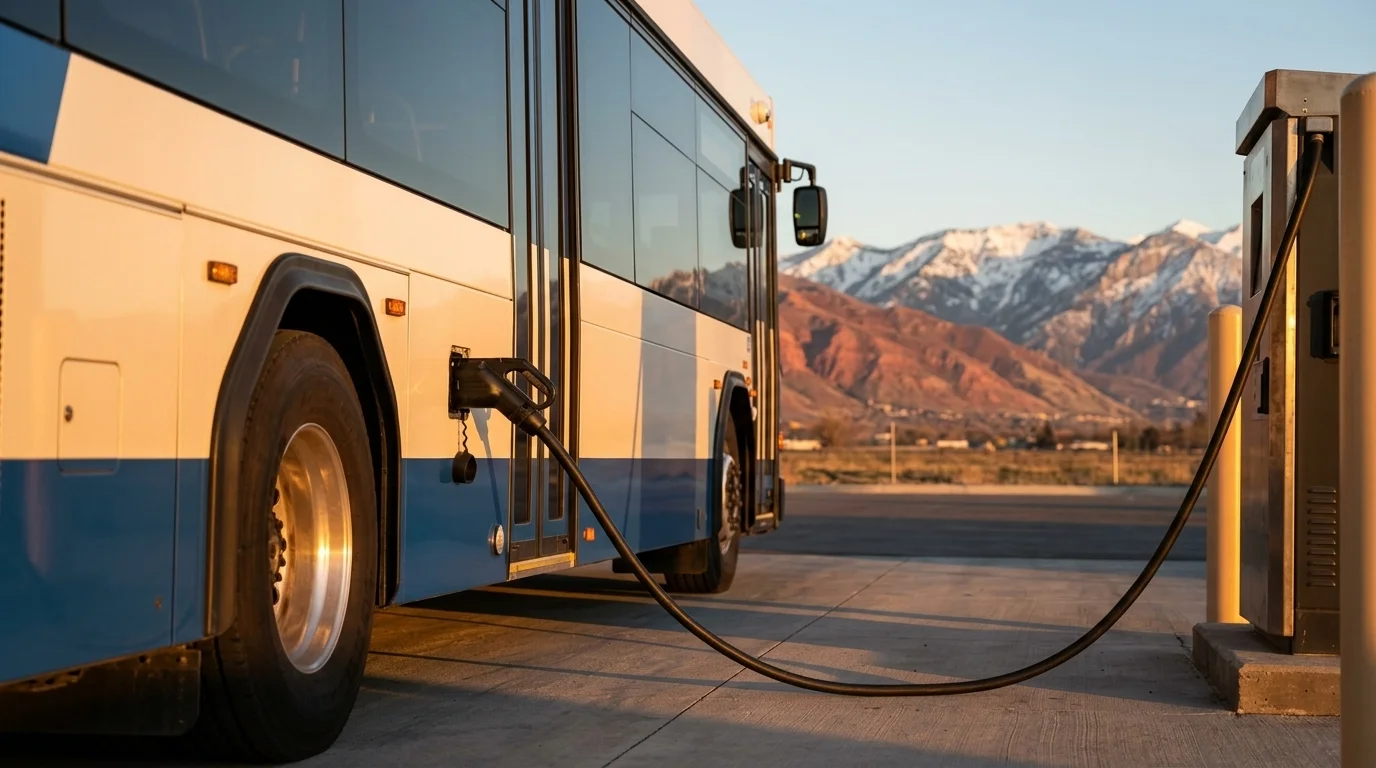
Federal grants for electric vehicles in Utah totaled $16.4 million in the last 90 days, up 5,734% from $281,000 in the same window a year ago. Nearly all of it is one grant: a $16.3 million Federal Transit Administration award obligated to the Utah Department of Transportation on July 24, 2026, to purchase ten battery-electric transit buses and the charging infrastructure to support them. Three days later, the federal government opened the next competitive round for bus grants and, for the first time, scored natural gas and hybrid buses above zero-emission electric vehicles.
The timing captures something larger than a single procurement. Utah spent the past 18 months moving faster than almost any of its neighbors on federal EV money, and that speed turned out to matter enormously. The state's full active federal EV grant portfolio now stands at $166 million across 16 grants, the largest in the Mountain West by a wide margin. Arizona has accumulated $61 million. Colorado has $22 million. Nevada sits at $14 million. Idaho has $1.4 million.
The surge traces back to two converging forces. The first was a federal court. The Trump administration froze the National Electric Vehicle Infrastructure program on February 6, 2025, halting roughly $885 million in FY2026 apportionments that states had already been promised under the 2021 Bipartisan Infrastructure Law. A coalition of states sued, and on January 23, 2026, Judge Tana Lin of the Western District of Washington entered a final judgment permanently barring the Department of Transportation from freezing or withdrawing NEVI funds. Within days, UDOT received five NEVI Phase 2 corridor awards totaling roughly $29 million, covering charging station buildout along Utah highways through 2035. Utah had been among 13 states that submitted their FY2026 NEVI deployment plans before the freeze was even lifted, which meant its paperwork was ready the moment the money was unblocked.
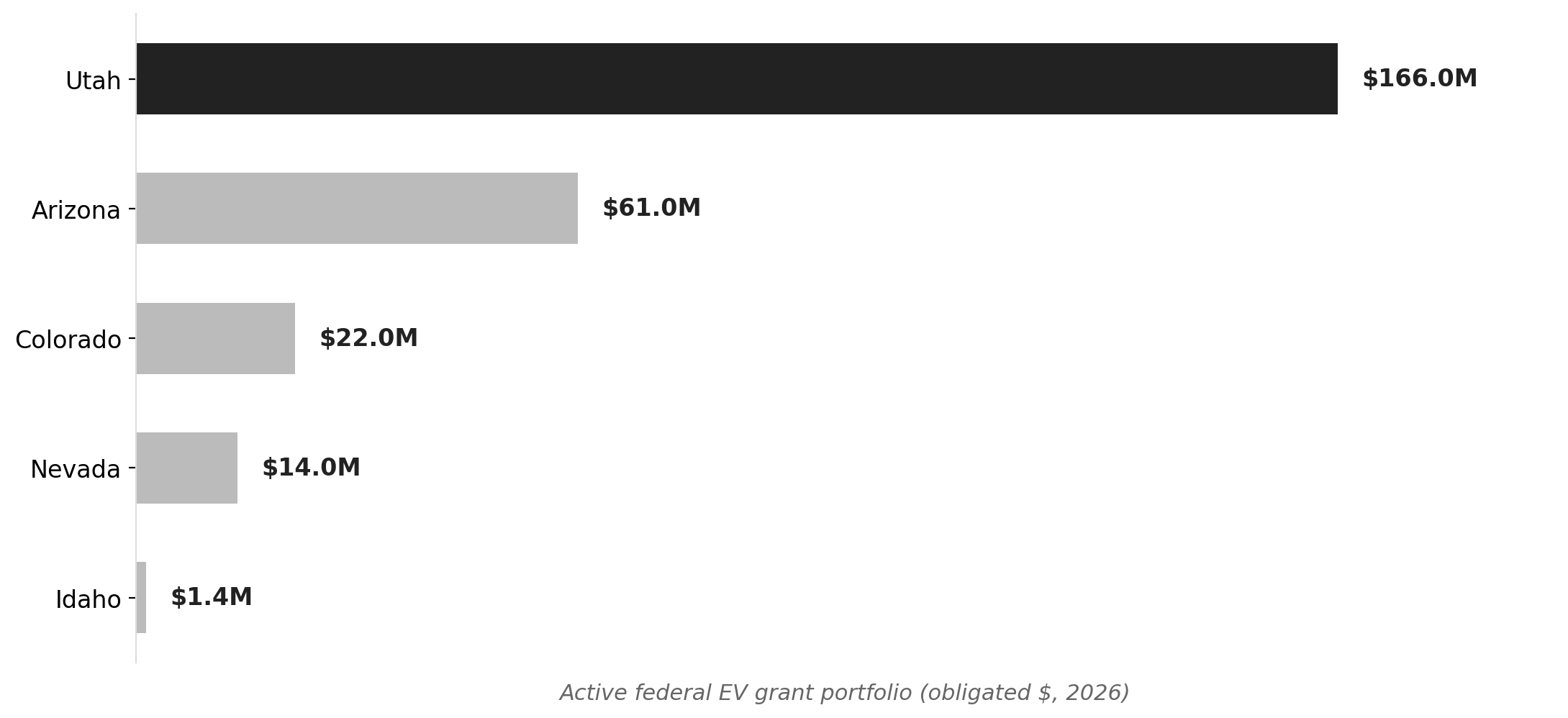
Source: NationGraph.
The second force was the FTA's combined FY2025-2026 Low or No Emission bus grant cycle, a $2 billion-plus national competition that had been working through its awards since November 2025. Utah's $16.3 million share landed in late July, covering five replacement buses and five expansion buses for a state transit fleet, along with the EV supply equipment to charge them. That award came from the final obligations of a program whose original mission was explicitly to accelerate zero-emission vehicles.
Then the rules changed. The FY2026 Notice of Funding Opportunity for the next $610 million bus round, opened July 27, 2026, inverted that mission. Under the new scoring criteria, natural gas, propane, and hybrid buses rank above battery-electric vehicles. An applicant proposing a diesel replacement with a compressed natural gas bus would score higher than one proposing the same replacement with a battery-electric bus. For any Utah transit agency looking to follow UDOT into the next round, the calculus has shifted.
The broader portfolio underscores how much unspent money is still in motion. Of the $166 million in active federal EV commitments to Utah, only about $28 million, roughly 17 percent, has actually been outlaid. The largest single item is a $74.7 million EPA Climate Pollution Reduction Grant awarded to Utah DEQ in October 2024, with only $433,000 spent so far and the grant running through October 2029. That figure reflects a multi-year build wave, not a completed one. Contracts are signed; construction and procurement are still ahead.
Utah's position at the top of the Mountain West ranking is not accidental. UDOT has been proactive on NEVI plan submissions since the program opened. Utah State University's NSF ASPIRE Engineering Research Center, carrying a $38 million active federal grant, has been developing roadway-electrification technology that gave Utah a research credibility advantage in competitive grant rounds. And Utah DEQ has pursued clean-fleet funding with unusual urgency for a Republican-controlled state, driven in part by Salt Lake City's persistent winter air-quality crisis. The Salt Lake Valley regularly ranks among the worst metro areas in the country for PM2.5 and ozone inversions, giving transit electrification a public-health rationale that crosses partisan lines.
The question now is what the next 18 months look like. The NEVI corridor money is obligated and largely protected by the court ruling, but the program's long-term reauthorization remains unsettled. The $74.7 million DEQ grant is intact for now but carries outlay risk if federal priorities shift further before 2029. And for the competitive bus program, the new scoring rules mean that the next Utah agency seeking FTA bus money will be writing a different kind of application than UDOT wrote last year.
The window that produced Utah's $166 million EV portfolio was narrow. The state caught most of what was available before the door closed. Whether it can hold what it caught, and spend it before political winds shift further, is the next thing to watch.