Arizona pulled in $10.2 million in new federal mental health grants over the past 90 days, a 12-fold increase over the $838,000 committed in the same window last year. Every dollar of it went to the University of Arizona and Arizona State University.
None of it went to a clinic.
The nine new awards, all from HHS, fund neuroscience, addiction, aging, and infectious disease research programs at the state's two flagship research universities. They represent genuine competitive wins, the kind of multi-year NIH obligations that build departmental capacity, fund graduate researchers, and put Arizona on the map in behavioral health science. What they do not do, at least not immediately, is put a psychiatrist in Yuma or a crisis counselor in a Navajo Nation health center.
Source: NationGraph.
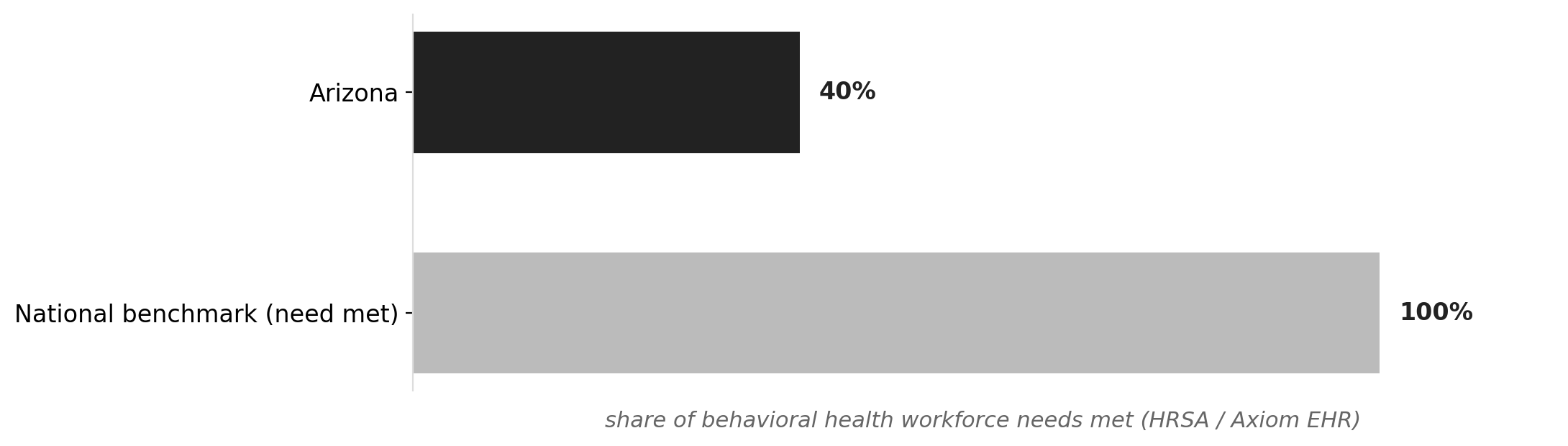
That distinction matters because Arizona's clinical system is in acute shortage. The state meets roughly 40 percent of its behavioral health workforce needs, ranking 47th nationally among all states, according to HRSA workforce data. University of Arizona psychiatry department chairs traveled to Washington in September 2024 to lobby Congress directly on the crisis, citing projections of 14,000 to 31,000 missing psychiatrists nationally. Arizona's rural counties and tribal lands, home to 22 federally recognized tribes, face the sharpest deficits.
The research surge and the workforce gap are both real, and they are now developing on parallel tracks that do not yet connect.
A second federal wave is coming that runs in the opposite direction. On June 17, 2026, HHS Secretary Kennedy announced more than $700 million in new SAMHSA behavioral health funding under the Great American Recovery Initiative. The package includes $223.1 million for Certified Community Behavioral Health Clinics, $238.6 million for the 988 Suicide and Crisis Lifeline, and a new $96 million STREETS program aimed at homeless individuals with serious mental illness. This money is built for delivery, not research, and Arizona's existing infrastructure is structurally well-suited to absorb it.
The state's Medicaid agency, AHCCCS, already routes federal behavioral health block grants through a network of regional behavioral health agreements called ACC-RBHAs, along with Tribal Behavioral Health Authority intergovernmental agreements covering tribal partners statewide. That architecture is essentially pre-wired for CCBHC Medicaid demonstration expansion, which would unlock enhanced federal reimbursement for certified community clinics. Whether Arizona will formally pursue CCBHC certification has not been publicly announced, but the plumbing exists.
Below the headline grant numbers sits a substantial active portfolio: Arizona holds more than $304 million in federally obligated mental health funding across HHS, DOJ, HUD, and Education, with $112 million already disbursed. HUD Continuum of Care awards anchor behavioral health services for homeless populations in Phoenix and Tucson. DOJ grants fund diversion and re-entry programs. The system is large and layered. The new NIH research awards represent the leading edge of a knowledge-production investment; the SAMHSA community dollars represent the leading edge of a service-delivery investment. Both are accelerating at the same moment.
On the ground, local governments are already signaling that they expect the service-delivery side to grow. Arizona counties and cities have issued at least 10 behavioral health and mental health RFPs since January 2026. Yavapai County posted a general behavioral health services solicitation. The City of Tempe issued an RFP for mental health crisis response. Prescott is seeking first-responder mental health support. These procurements reflect local systems trying to get ahead of anticipated funding, not react to it after the fact.
The structural question Arizona faces is whether the two tracks will converge fast enough to matter. Research universities producing new knowledge about addiction neuroscience or aging-related psychiatric conditions are not the same institutions staffing rural clinics. The workforce pipeline that would connect a new NIH grant at ASU to a licensed counselor in Kingman runs through graduate programs, residency slots, licensure, and recruitment into underserved areas, a sequence that takes years under ideal conditions. Arizona is not operating under ideal conditions.
The more immediate signal to watch is whether AHCCCS moves toward CCBHC certification. If it does, the $223 million in new SAMHSA clinic funding announced last week becomes directly accessible at enhanced reimbursement rates, potentially the fastest mechanism to expand clinical capacity the state has seen in years. If it doesn't, Arizona will have won the research race and still be waiting on the treatment infrastructure to catch up.