New federal Section 8 housing voucher commitments flowing to Pennsylvania housing authorities have fallen to $8.3 million over the past 90 days, down 98 percent from $342.9 million in the same window a year ago. The money has not been redirected. It has not been delayed. For the families sitting on waiting lists at 55 housing authorities across the state, it has largely stopped arriving.
The collapse is not a bookkeeping anomaly. A year ago, the Philadelphia Housing Authority received $92.9 million in a single June tranche. Pittsburgh and Allegheny County followed with $26.8 million and $20.2 million, respectively. Those bulk quarterly disbursements are how the Section 8 pipeline was designed to work: large, predictable grants that let housing authorities issue vouchers, sign contracts with landlords, and manage caseloads. In the current trailing 90-day window, the largest single new commitment across all of Pennsylvania is Bucks County Housing Authority at $2.6 million.
The proximate cause is Washington. The Trump administration's FY2026 budget proposes cutting $32.9 billion from HUD, including a $26.7 billion reduction to federal rental assistance that analysts at Multifamily Dive describe as effectively restructuring Section 8 out of existence in its current form. DOGE compounded the uncertainty in February 2025 by announcing it had de-obligated $1.9 billion in HUD funds previously earmarked under the Biden administration. The result is that housing authorities, uncertain about what future tranches will look like or whether they will arrive at all, are receiving smaller and shorter-term grant awards rather than the large quarterly blocks that previously anchored their planning.
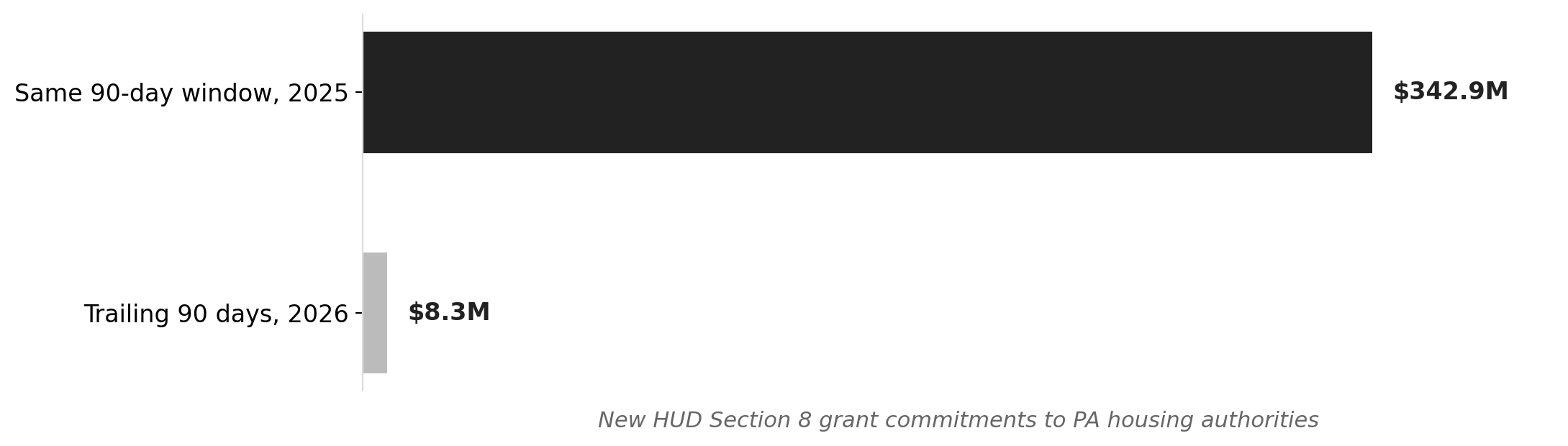
Source: NationGraph.
The numbers expose a critical distinction between commitments on paper and money that actually moves. Pennsylvania's 55 housing authorities carry $36.7 million in total obligations under currently active Section 8 grants. Of that, only $7 million has been outlayed, a disbursement rate of 19 percent. Zoom out to the full 2026 calendar year and the gap widens further: Pennsylvania has $555 million in Section 8 grants committed on paper for 2026, but only $5.7 million, roughly one percent, has actually been disbursed. Families approved for vouchers are waiting on money that exists in federal databases but has not left the Treasury.
The Center on Budget and Policy Priorities estimates that even the more moderate House version of the HUD cuts, which freezes Section 8 at FY2025 funding levels rather than slashing it outright, could strip vouchers from more than 400,000 households nationally. The Senate version, by the coalition's projection, would eliminate roughly 250,000 vouchers. Pennsylvania, with one of the larger federally assisted rental populations on the East Coast, would absorb a disproportionate share of any national contraction. Neighboring states are showing the same suppression: New York logged $23.7 million in new Section 8 grant starts over the same 90-day window; New Jersey recorded $596,000.
The disruption is arriving at a moment of acute fiscal strain for Pennsylvania specifically. A Commonwealth Court ruling found the state's public school funding system unconstitutional, triggering a court-mandated $5.1 billion investment over seven years. The state legislature is simultaneously deadlocked over a separate school voucher bill, the PASS program under SB 10, that would redirect public dollars to private school tuition. The competing demands on both federal and state resources mean that the people most likely to lose ground are the same low-income families who depend on housing vouchers and underfunded public schools simultaneously.
The pattern is not unique to Pennsylvania. Los Angeles paused new Section 8 applications in 2025 citing funding uncertainty, and effective August 1, 2025, the Housing Authority of the City of Los Angeles reduced subsidy levels for all new rental agreements. What is visible in Pennsylvania's numbers is the same national contraction made legible at the state level: a pipeline that moved hundreds of millions per quarter is now moving millions per quarter, and the adjustment is falling entirely on waiting-list families rather than on the institutions doing the waiting.
The next signal to watch is whether Congress passes a full FY2026 appropriations bill or continues operating under a continuing resolution. The National Low Income Housing Coalition projects a net loss of roughly 32,000 vouchers nationally under a continuing resolution scenario. For Pennsylvania's housing authorities, the more immediate question is whether the large quarterly disbursements that defined Section 8 administration for decades will resume at any scale before the end of the fiscal year, or whether the trickle of the past 90 days is the new baseline.