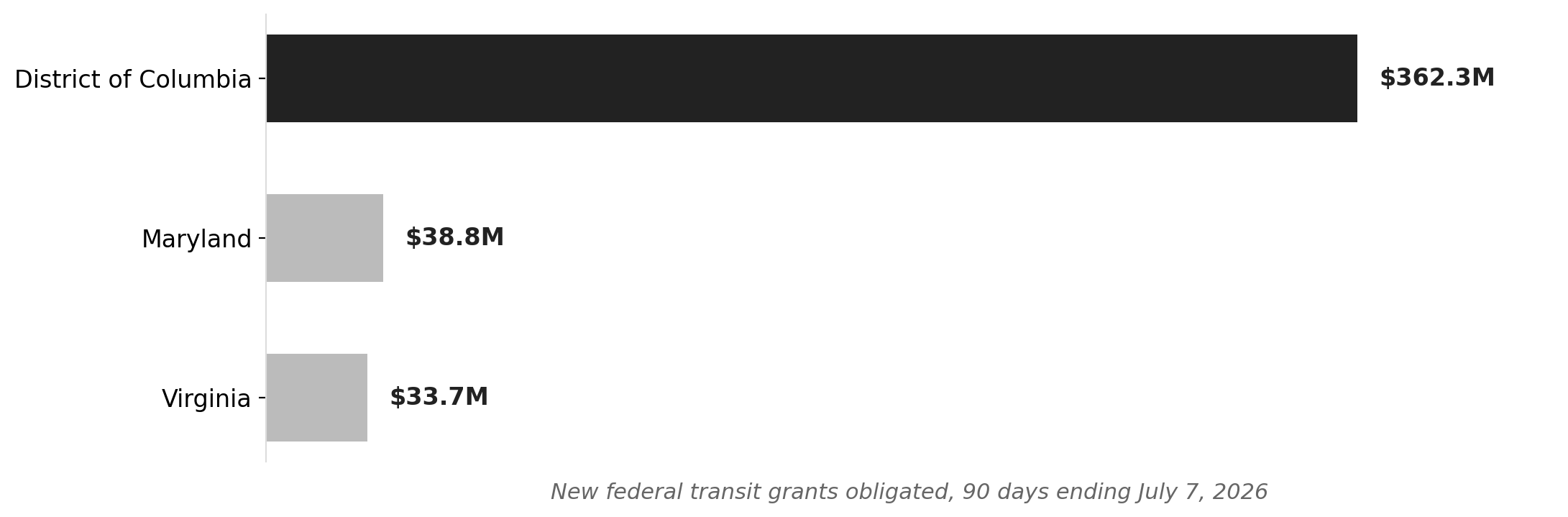
Federal transit grants flowing to the District of Columbia hit $362.3 million in the trailing 90 days ending July 7, 2026, a 2,013% jump over the $17.1 million obligated in the same window a year earlier, and one of the sharpest single-quarter surges any transit agency has recorded under the Infrastructure Investment and Jobs Act.
Three grants to the Washington Metropolitan Area Transit Authority account for virtually the entire figure. The Federal Transit Administration obligated a $191.96 million State of Good Repair award on June 24, running through 2031. A $174.4 million Federal Transit Formula grant followed in March. Two Bus and Bus Facilities grants totaling $154.3 million were obligated in early June. The combined total dwarfs what neighboring jurisdictions received in the same window: Maryland took in $38.8 million in new transit obligations, Virginia $33.7 million. DC's 90-day haul is roughly nine times Maryland's and eleven times Virginia's.
The why-now is a two-part federal calendar collision. The Consolidated Appropriations Act, 2026 (H.R. 7148, signed February 3) ended a partial government shutdown and authorized $21.1 billion in public transit spending for FY2026. The Federal Transit Administration posted full-year apportionment tables on March 31, releasing close to $14.6 billion in formula grants nationally, and WMATA's grant officers moved quickly to formalize commitments. At the same time, the IIJA's authorizations expire September 30, 2026, the same day as current appropriations authority. Formula funds not obligated by fiscal year-end will not carry over under the same terms. For an agency with WMATA's backlog of deferred maintenance, the window is short and the stakes are high.
Source: NationGraph.
The obligation surge is real. The disbursement picture is not, yet. WMATA's total active DOT grant portfolio now stands at approximately $1.15 billion in obligated funds, but only $186.7 million of that, about 16 cents on the dollar, has actually been paid out. Obligations are legal commitments; outlays are cash in hand for contractors and crews. The gap between the two is where transit capital programs live or stall, as the Bipartisan Policy Center has detailed in its analysis of IIJA's funding structure. WMATA has invested $1.32 billion of its $2.1 billion FY2026 capital budget through the third quarter of the fiscal year, according to the agency's Q3 Capital Improvement Program progress report, a strong execution pace, but one that will need to accelerate if federal outlays are to match the new obligation levels before the law changes.
DC's position in this dynamic is structurally unusual. WMATA is the only major U.S. transit agency that receives a dedicated annual federal appropriation on top of formula grants, a legacy of Congress recognizing the national capital's dependence on the system and the jurisdictional constraints that limit DC's ability to raise local revenue independently. WMATA also spans DC, Maryland, and Virginia under an interstate compact, making the District the nominal federal grant recipient for a system serving 3.5 million regional residents. When federal transit dollars spike, DC's ledger registers it first and largest.
The maintenance case for the spending is not abstract. WMATA has logged a nearly 30% decline in escalator failures as capital investment has ramped up in recent years, a number the agency cites as evidence that state-of-good-repair dollars translate into measurable system performance. The $191.96 million State of Good Repair grant, running to 2031, targets the structural backlog that accumulated over decades of deferred investment in rail infrastructure. The bus facility grants address a parallel problem on the surface system, where aging facilities constrain the agency's ability to operate and maintain its fleet.
What happens after September 30 is the open question. A surface transportation reauthorization bill, H.R. 8870, was introduced in May 2026 but has not been enacted. The Congressional Budget Office projects the Highway Trust Fund could sustain FTA obligations only through the second quarter of FY2027 without new legislation. If Congress does not pass a reauthorization by the end of the fiscal year, agencies like WMATA could face a gap between the current commitment pipeline and the next funding framework, and the terms of any successor bill remain unresolved.
For Metro riders and the federal workers, tourists, and residents who depend on the system, the near-term signal to watch is not the grant totals but the project pipeline: how fast WMATA converts obligated dollars into contracted work before the fiscal calendar resets. The obligation surge has already happened. The spending race starts now.