On March 12, 2026, the Michigan Department of Transportation obligated $50.6 million in federal electric vehicle infrastructure grants in a single day, a 6,384% increase over the $780,443 the state received in the same 90-day window a year earlier. The number looks like a policy triumph. The backstory is more complicated.
The money is real, and the chargers will be built. But the surge is not the product of a new administration priority or a state budget decision. It is the direct result of a federal court ordering the Trump administration to unfreeze funds it had blocked for nearly a year, followed by MDOT racing to obligate every available dollar before a statutory deadline and a Congress that may yet move the goalposts.
The legal trigger came on January 23, 2026, when U.S. District Judge Tana Lin of the Western District of Washington issued a summary judgment in Washington v. U.S. DOT, ruling that the Trump administration's February 2025 freeze of National Electric Vehicle Infrastructure program funds violated the Administrative Procedure Act. The administration had paused NEVI disbursements under Executive Order 14154, which directed the Federal Highway Administration to rescind all prior program guidance. Seventeen states sued. Michigan was a named plaintiff, with Attorney General Dana Nessel among the signatories. The court found the freeze arbitrary and capricious, and FHWA did not appeal.
Source: NationGraph.
Seven weeks later, MDOT moved all four grants at once. The two largest are twin NEVI tranches of $23.44 million each; a third tranche added $3.47 million, and a corridor-specific award contributed another $242,000. All four share the same start date. All run through 2039, committing this money to infrastructure timelines that extend well past any single administration.
The speed reflects something structural about Michigan that most states cannot replicate. The state coordinates EV infrastructure across MDOT, the Office of Future Mobility and Electrification, the Department of Environment, Great Lakes and Energy, and the Michigan Public Service Commission. That administrative depth, built in part because Michigan is home to Ford, GM, and Stellantis and has set a target of two million EVs on state roads by 2030, meant MDOT had the capacity to execute a $50 million obligation in a single action rather than spread it across months of individual project reviews.
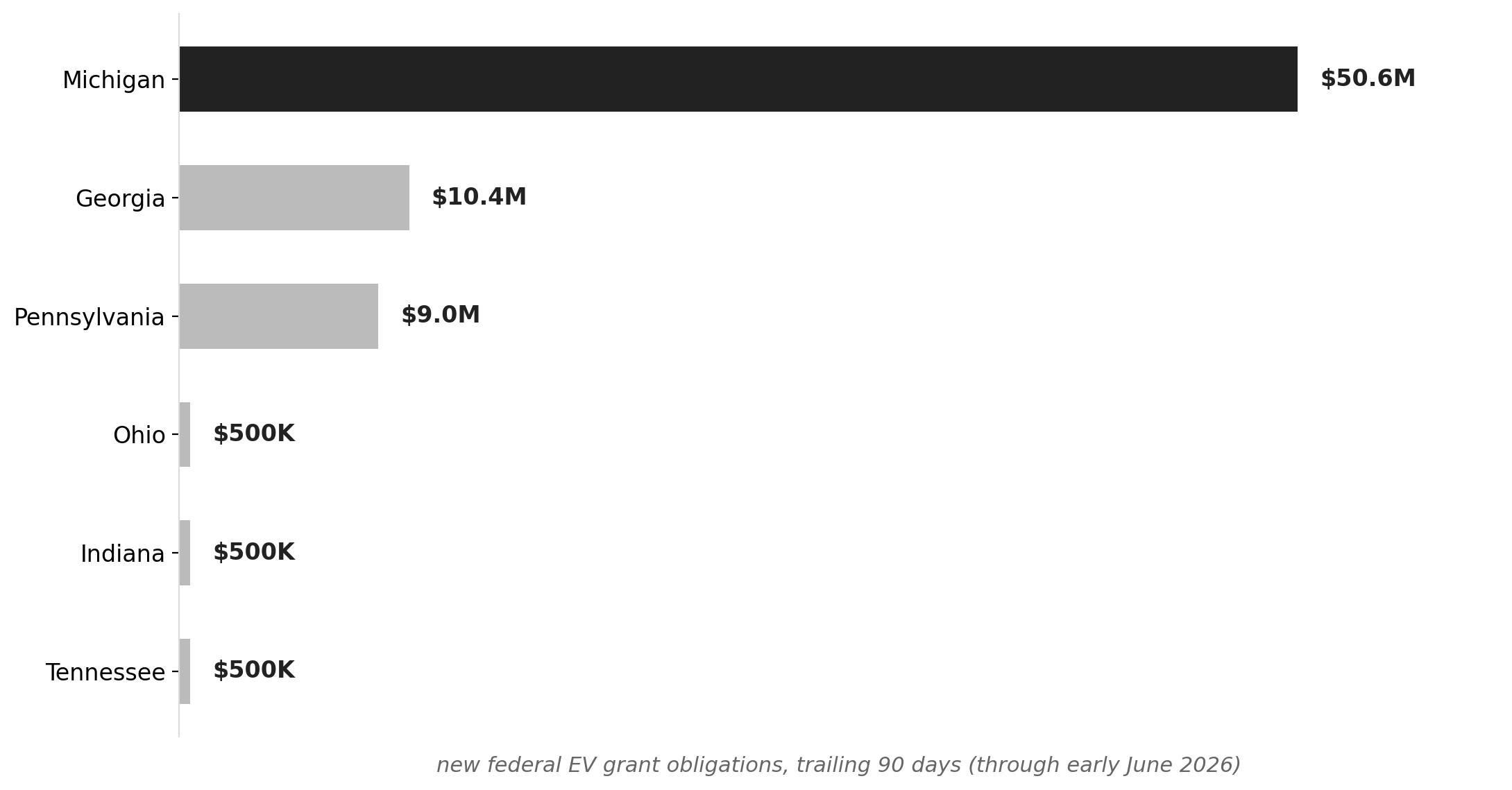
The results are visible in the peer comparison. Michigan's April 2026 FHWA approval of its FY2026 EV Infrastructure Deployment Plan and its "fully built out" corridor certification, meaning required highway-corridor charger siting is complete, unlocked an additional $51 million for gap-filling and fleet charging beyond highway corridors. Georgia, the second-ranked auto-industry peer state in the trailing 90 days, obligated $10.4 million. Pennsylvania came third at $9 million. Ohio, Indiana, and Tennessee show negligible new NEVI activity in the same window.
Michigan's total active federal EV grant portfolio now exceeds $200 million across DOT, DOE, and EPA programs running through 2039. The NEVI piece alone accounts for roughly $106 million of the state's total allocation under the Infrastructure Investment and Jobs Act.
For Michigan drivers and businesses, the practical effect is a faster buildout of highway-corridor charging and, now that the corridor certification is complete, new investment in urban gaps and fleet infrastructure. MDOT's first NEVI-funded station was already operational before the freeze; the new tranche accelerates what comes next.
But the sprint has a hard stop. MDOT must obligate all NEVI funds before the end of federal fiscal year 2026, September 30. And a separate risk is moving through Congress: a pending FY2026 appropriations proposal would transfer up to $879 million in NEVI formula funds into general FHWA highway programs, effectively converting dedicated EV infrastructure money into flexible road spending. Industry analysts have flagged that legislative threat as the more consequential pressure on the program's long-term trajectory, regardless of what any court has ruled.
Michigan's $50.6 million March spike, then, is best understood as a compressed release of pressure that built for more than a year. The state litigated to restore the funds, won in court, and then moved faster than any peer to capture them. Whether that speed translates into durable infrastructure depends on two clocks running simultaneously: the FY2026 obligation deadline and whatever Congress decides to do with the broader NEVI formula before September 30.