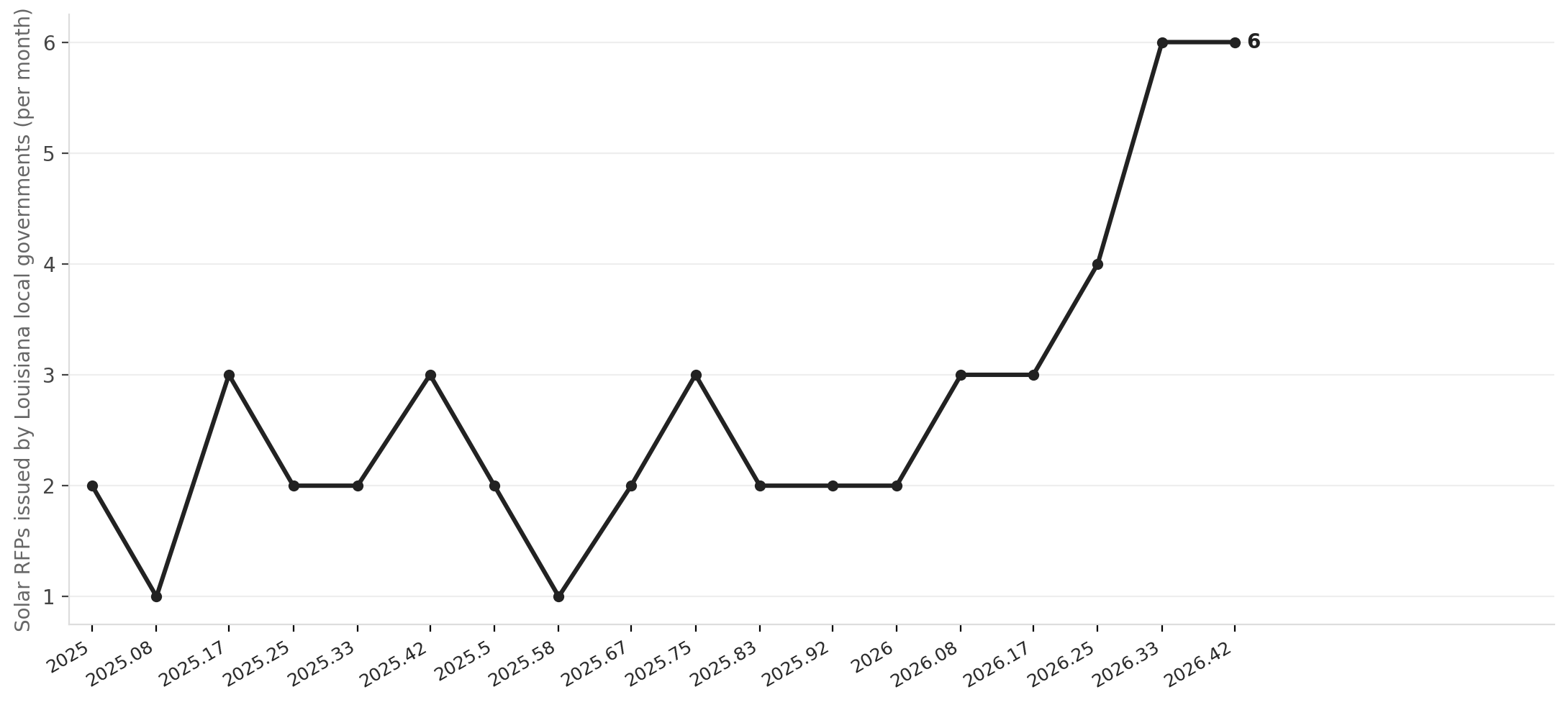
Louisiana local governments issued 6 solar RFPs in the last 30 days, against a monthly average of roughly 2.3 over the prior year. That 2.6x spike is not a green-energy awakening in a fossil-fuel state. It is a procurement deadline disguised as momentum.
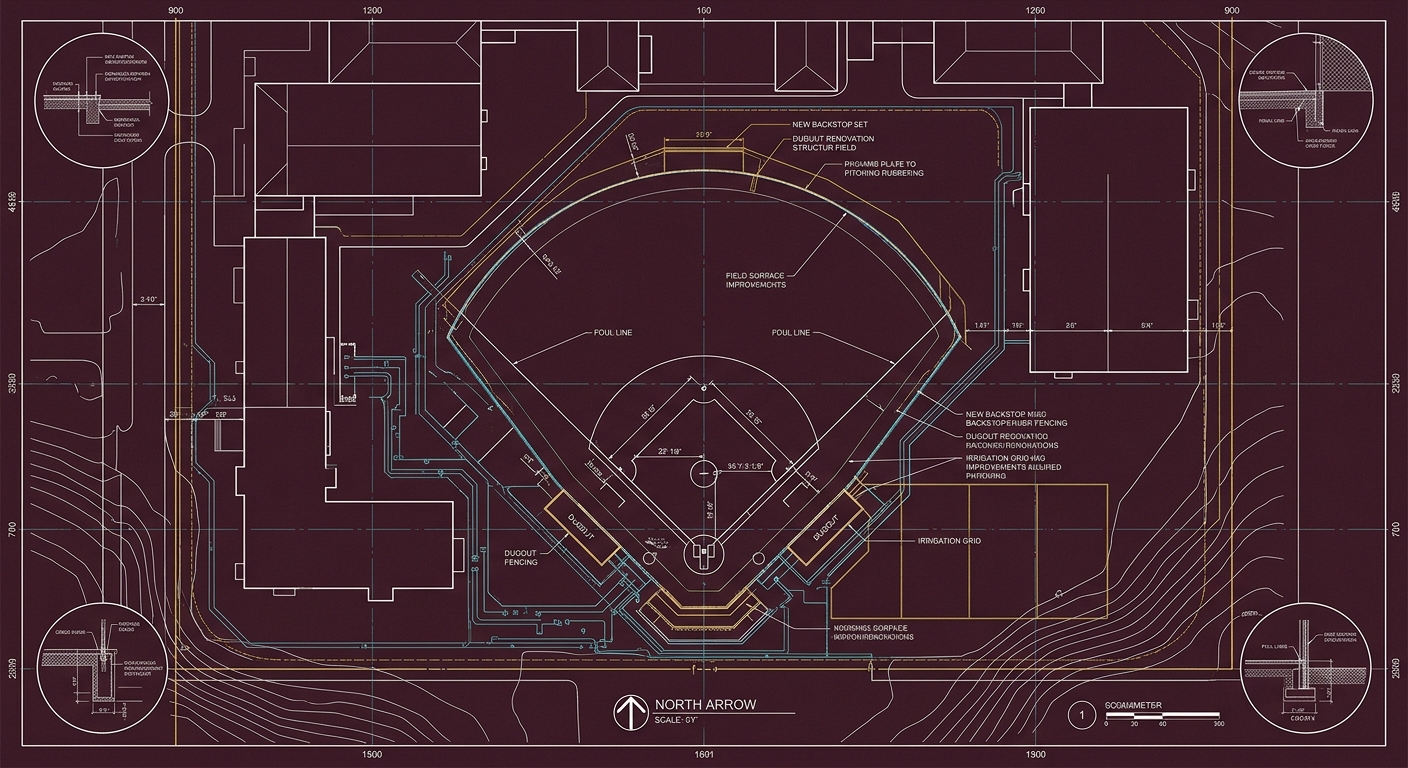
The anchor driving this activity is a $49.97 million EPA Climate Pollution Reduction Grant awarded to the City of New Orleans in July 2024 under the Inflation Reduction Act. According to the EPA grant announcement, the grant's performance period began January 2025, with rooftop solar installation and urban microgrid development among its explicit deliverables. Solar and battery deployments were expected to begin in 2026. That timeline is now. The Joe Brown Park solar-battery-generator microgrid, one of the grant's flagship projects, went through a re-bid in March 2026, a sign the city is pushing hard through procurement friction to get contracts signed.
The spending pressure is real. IRA implementation grants carry multi-year performance windows, but the broader federal budget environment has put municipalities on notice that obligating dollars now is safer than waiting. New Orleans was one of only 25 cities nationally to receive a competitive CPRG implementation grant at this scale. Losing the ability to spend it would mean losing a infrastructure investment that state appropriations have never come close to matching.
Source: NationGraph.
The ripple from New Orleans extends across parish lines. Kenner, in Jefferson Parish, has issued at least four solar RFPs since February 2026 alone, covering street lighting and off-grid park systems. St. Tammany Parish has moved on solar pedestrian activation systems for the Tammany Trace trail. Iberville Parish has gone to market for solar radar speed signs. These are not utility-scale projects. They are exactly the kind of distributed, municipal-infrastructure deployments that federal resilience and energy-efficiency grants are designed to fund, and that local governments can procure, permit, and install within a single budget cycle.
A separate community-led effort adds to the picture. The Together New Orleans coalition, backed by the Alliance for Affordable Energy, is targeting a $30 million virtual power plant built on solar-and-battery installations, also timed for 2026 deployment. That initiative traces its origins to Hurricane Ida in 2021, which framed grid resilience, not emissions reduction, as the political rationale for solar in Louisiana. Resilience is bipartisan in a state that gets hit by storms. Carbon is not.
The state-level picture is more complicated. Gov. Jeff Landry signed HB 459 (Act 279) in July 2025, creating new LDENR permitting requirements for any solar facility covering 75 acres or more. The law added a state-level siting review layer that did not previously exist for utility-scale projects, with final implementing rules due from LDENR by August 31, 2026, a deadline now weeks away. The effect is a regulatory ceiling on large-scale commercial solar at the same moment federal dollars are pushing municipal-scale solar from the bottom up. The two forces are not in direct conflict: the IRA-funded projects are all well below the 75-acre threshold. But they illustrate a state pulling in opposite directions depending on who is doing the building.
The regional context is worth noting. MISO, the grid operator covering Louisiana, recorded 2,474 GWh of solar generation in April 2025, more than double the 1,101 GWh from April 2024. The Solar Energy Industries Association has projected Louisiana's installed solar capacity will grow more than tenfold over the coming years, a figure cited in bipartisan Louisiana legislative resolutions. The procurement spike visible in the RFP data reflects that trajectory arriving at the local government level, compressed by a grant-spending clock.
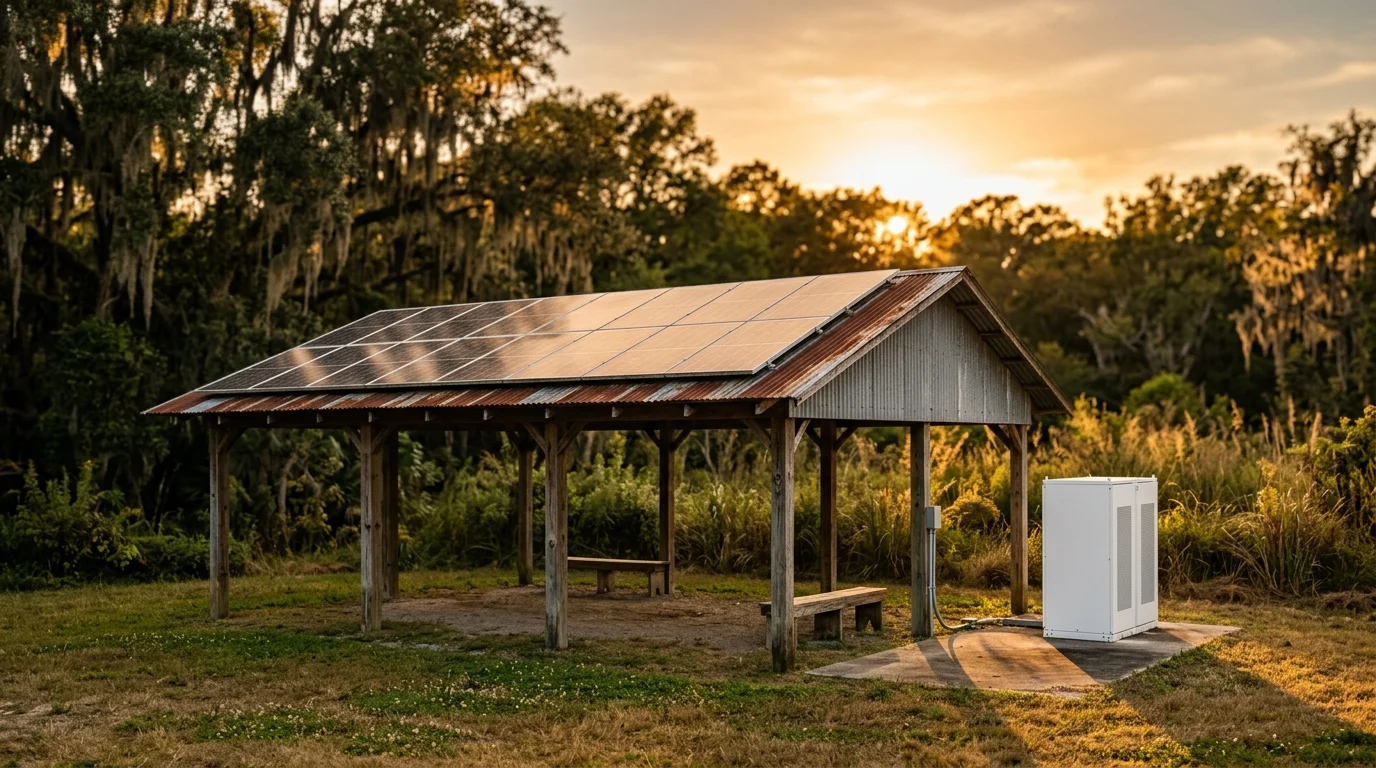
For residents of Orleans, Jefferson, St. Tammany, and Iberville parishes, the near-term result is visible infrastructure: solar panels on park shelters, battery backup at community facilities, smart lighting on trails and streets. Whether that pace holds past 2026 depends on two things that remain unsettled: whether Congress leaves IRA grant authority intact in the next budget cycle, and whether LDENR's August 31 rulemaking deadline produces implementing rules that utilities and developers can actually work with. Both questions will have answers before the end of the year.