Mississippi issued five flood-control procurement solicitations in the last 30 days, against a 12-month average of roughly 1.3 per month. That 3.8x spike is not a one-month anomaly. RFPs have been climbing steadily since February 2026, and the acceleration reflects something structural: the state is simultaneously spending down a years-old federal disaster recovery cycle and absorbing the opening of a brand-new one.
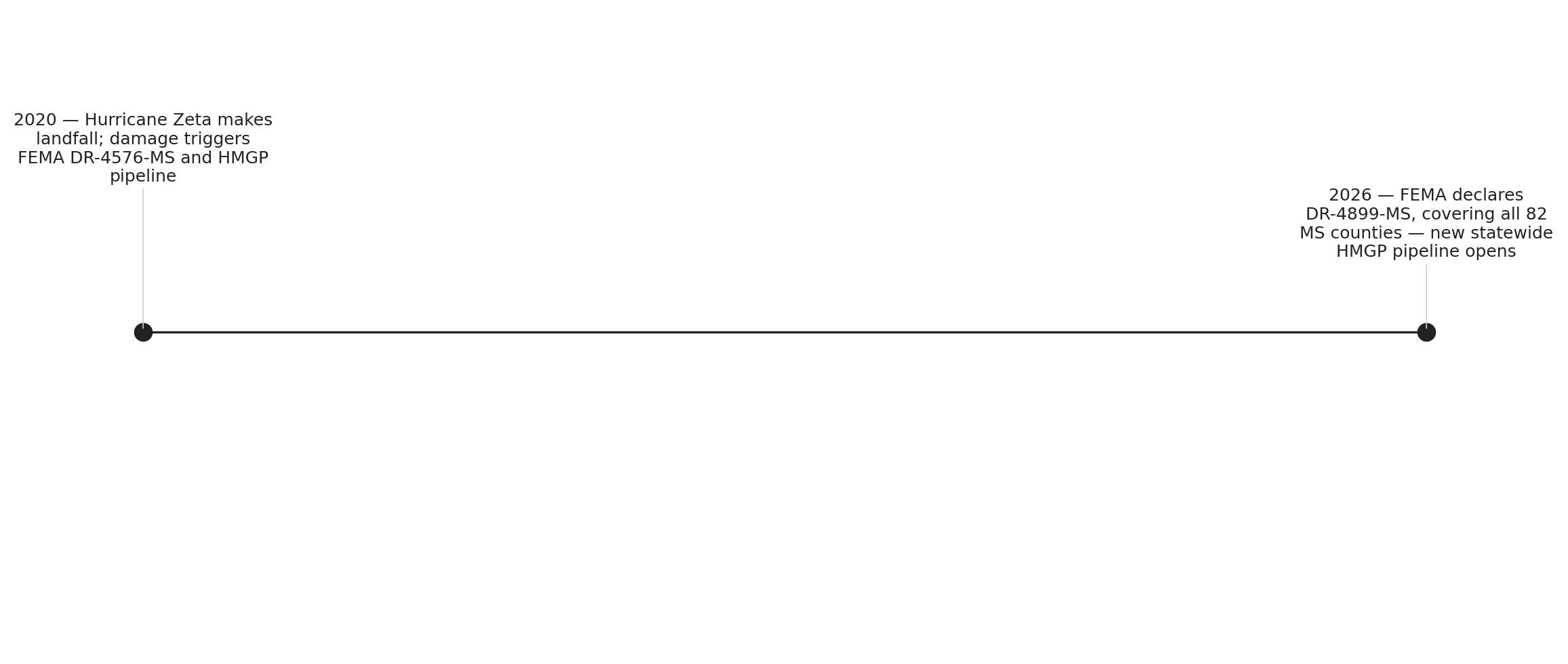
The clearest single illustration is Oxford, Mississippi. The city is currently procuring a real-time Flood Threat Recognition System, complete with six stream monitoring stations, telemetry infrastructure, and automated alert capabilities. The funding source is FEMA's Hazard Mitigation Grant Program under project DR-4576-0030-F, a grant tied to Hurricane Zeta's 2020 disaster declaration. Oxford is only now reaching the contract stage because that is how the pipeline works: FEMA obligates HMGP funds, states process applications, municipalities complete environmental review and design work, and procurement follows last. For a state as chronically underfunded as Mississippi, where municipalities often lack the staff capacity to front-run federal reimbursement cycles, the lag from declaration to signed contract routinely runs four to six years.
That lag would be unremarkable if Mississippi were simply finishing one cycle. The problem is that a second cycle started before the first one closed.
Source: NationGraph.
On February 6, 2026, President Trump approved a Major Disaster Declaration for Mississippi covering the January 23-27 severe winter storm. The declaration, DR-4899-MS, covered all 82 Mississippi counties for Public Assistance and 36 counties for Individual Assistance. Under federal statute, a major disaster declaration automatically activates HMGP statewide. That means Mississippi Emergency Management Agency is now at the front end of a new mitigation grant cohort, coordinating applications that will generate their own round of procurement activity over the next 12 to 18 months.
Layered on top of that is a set of near-term federal deadlines that are compressing the timeline further. FEMA announced more than $235 million in Flood Mitigation Assistance awards on April 22, 2026, with Mississippi named among recipients and roughly $8 million available for state projects. A separate FEMA program, the $1 billion Building Resilient Infrastructure and Communities grant (BRIC, covering combined FY2024-FY2025 funds), opened in March 2026 with a July 23 application deadline. MEMA is the pass-through applicant coordinating local subapplicants under that competitive clock. FEMA also approved $4.7 million in June 2026 for 11 Mississippi community recovery projects tied to both the January winter storm and March 2025 severe storms.
The result is a procurement calendar that has no clean break between recovery phases. Mississippi's active federal flood grant portfolio already totals approximately $28.8 million across 14 running grants, led by USDA Watershed Protection and Flood Prevention awards of $17.6 million running through 2028 to 2030. New HMGP and FMA awards are stacking on that baseline rather than replacing it.
Vicksburg offers a different kind of signal. The city's recent RFP covers grass-cutting services for flood buyout properties, a detail that locates Vicksburg in a later phase of the mitigation lifecycle. A buyout program has already completed: the city acquired flood-prone properties, relocated residents, and converted land to open space. The current procurement is operational maintenance of that completed program. It is a reminder that mitigation spending does not end when the construction phase finishes; municipalities carry ongoing costs for managed-retreat parcels indefinitely.
For residents across Mississippi, the practical consequence of this compression is that local governments are managing competing federal application deadlines while simultaneously executing contracts under older awards. That is a significant administrative load for municipalities that routinely operate lean planning and procurement offices. The BRIC July 23 deadline and the FMA July 22 deadline fall within 24 hours of each other, meaning the same MEMA staff coordinating subapplicants for one program is simultaneously supporting the other.
What to watch: whether Mississippi subapplicants meet the BRIC and FMA deadlines this month will determine how large the next procurement wave becomes. If MEMA and its municipal partners successfully submit competitive applications under both programs, the current RFP ramp will look modest by comparison. The January 2026 disaster declaration alone covers all 82 counties, and HMGP historically allocates 15 percent of estimated total disaster costs to mitigation grants. With a winter storm that caused damage across the full state, that calculation could produce a substantial new award pool clearing the pipeline sometime in 2027 to 2028, right as the current Zeta-era contracts are closing out.