Georgia transit agencies issued 58 procurement solicitations in the past 30 days, more than double the trailing monthly average of 27, and the acceleration started before the ink was dry on a law that restructures the entire governance architecture the state's transit systems operate under.
Governor Kemp signed HB 297 on May 12, 2026, abolishing the Georgia Regional Transportation Authority (GRTA) and restructuring the Atlanta-region Transit Link Authority (ATL) into a new body: the Georgia Transportation Efficiency Authority, or GTEA. Two days later, the Georgia Department of Administrative Services issued a Statewide Transit Plan Update RFP, the most direct procurement signal yet that state agencies understand the old framework is gone and the new one needs to be built from scratch.
The GTEA will be governed by a 13-member board appointed by the Governor, Lieutenant Governor, and Speaker of the House. It inherits all assets, obligations, liabilities, and employees of both predecessor agencies, and takes over the Governor's delegated powers as the designated recipient of federal transit funds statewide. That last point matters enormously: Georgia's active federal transit grant portfolio exceeds $600 million, led by MARTA's $322 million, GDOT's $157 million, and ATL's $32 million. Every one of those grant relationships now flows through an authority whose board has not yet been fully constituted.
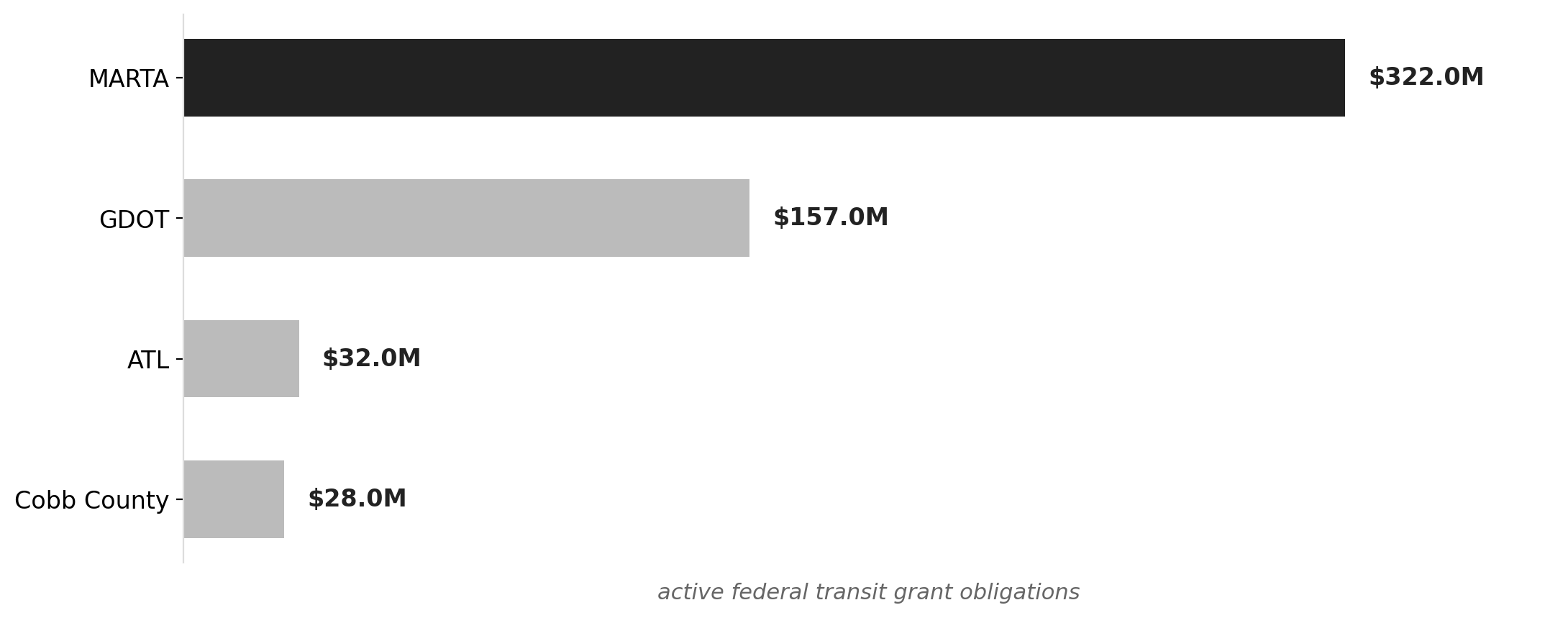
Source: NationGraph.
The procurement surge reflects agencies trying to get ahead of that uncertainty. Greene County is seeking a third-party transit operator. Hinesville/Liberty Transit is re-procuring its operator contract. Augusta Transit is moving on capital equipment. None of these agencies are waiting to see how the GTEA board shakes out; they are issuing solicitations now, under whatever authority they currently have, before the transition creates additional procedural friction.
A note on the raw numbers: roughly 40 of the 58 RFPs in the 30-day count represent a bulk archival ingestion of Hall County microtransit feasibility documents from 2018 to 2020, not new activity. Strip those out and the genuine new-solicitation count is closer to 18, still meaningfully elevated, and concentrated in the days immediately following the May 12 signing. The May 2026 month-to-date total and a February 2026 spike of 59 are the two highest monthly readings in 18 months of data, suggesting this is not a one-week anomaly.
The law arrives at a complicated moment for Georgia's largest transit operator. MARTA, which serves only Fulton, DeKalb, and Clayton counties despite Atlanta being the ninth-largest metro in the country, is simultaneously managing the delayed rollout of the Rapid A-Line BRT (its first new transit line in two decades), a March 2026 launch of its MARTA Reach microtransit service, and an April 2026 groundbreaking on SR 400 BRT. A 2024 city audit also found that $70 million in More MARTA capital funds had been redirected to operations, a finding that adds institutional pressure at exactly the moment MARTA needs to align its capital program with the new GTEA structure.
Federal dollars are also in motion. The FTA announced more than $2 billion in Buses and Bus Facilities and Low-No Emission grants nationally in January 2026, with Georgia recipients including MARTA ($25 million) and ATL ($11 million) for fleet electrification. Those grants were awarded to entities that no longer exist in the same legal form. The mechanics of how GTEA absorbs those obligations, and how FTA treats the transition for grant compliance purposes, remain open questions.
Critics of the restructuring have argued it weakens Atlanta-focused transit advocacy by diluting the regional voice that the ATL was specifically designed to provide. SaportaReport characterized earlier versions of the bill as legislators stepping back in time on regional transit coordination. Supporters counter that consolidating GRTA and the ATL eliminates redundancy and gives the state a single point of accountability for federal fund stewardship.
What the procurement data shows, independent of that debate, is that the transition is already generating real friction costs. Agencies that might otherwise have waited for a stable governance picture are issuing RFPs now. Consultants who would ordinarily compete on a known procurement calendar are pricing bids against an uncertain regulatory baseline. And the GDAS statewide plan update, the most consequential solicitation in the batch, will almost certainly be running in parallel with the GTEA board's own effort to define what it wants that plan to say.
The next signal to watch is the GTEA board's first formal meeting, which has not yet been publicly scheduled. Until that board convenes and issues guidance on how existing grant relationships and operator contracts will be treated during the transition, agencies around the state are effectively planning for two possible futures at once.