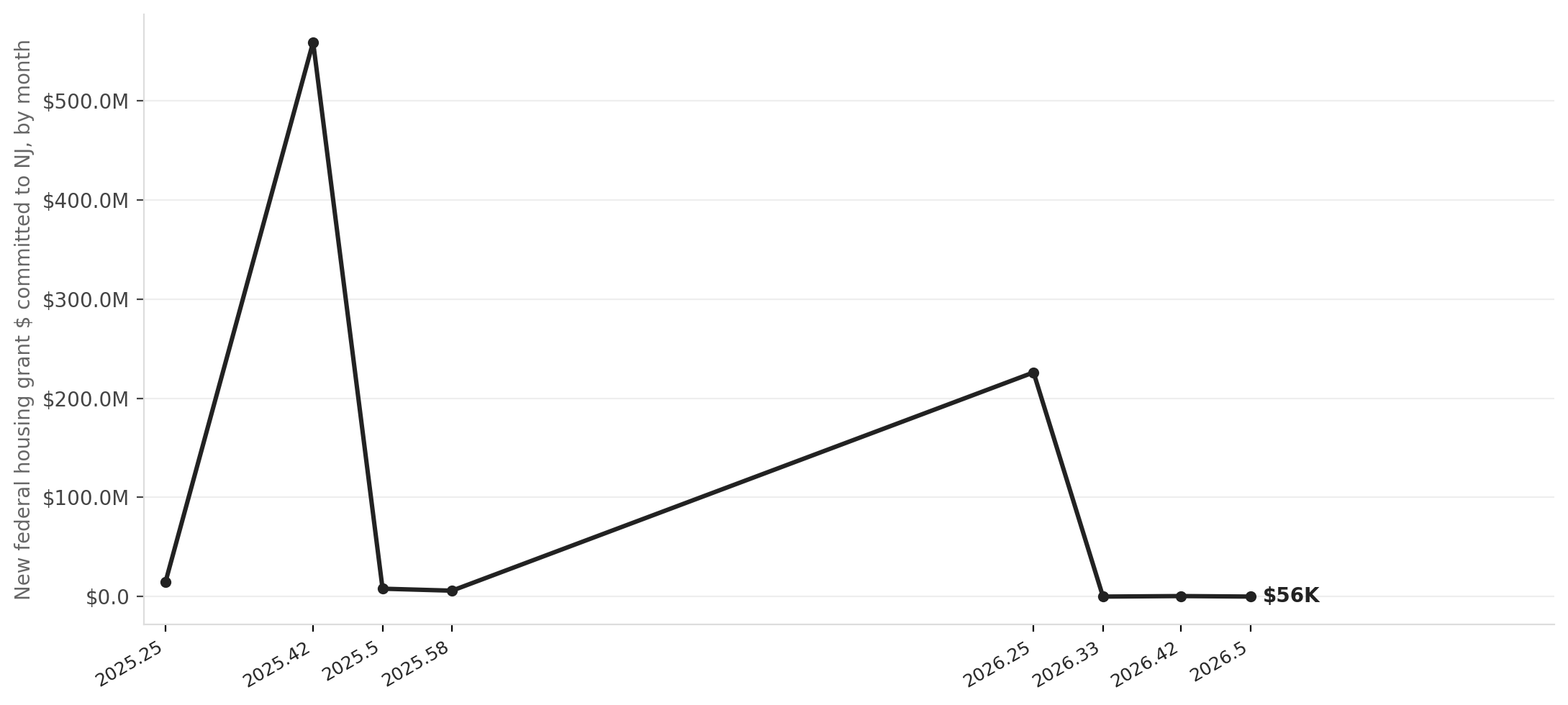
New Jersey received $7.5 million in new federally committed housing grants over the 90 days ending July 31, 2026, compared to $559 million in the same window a year ago. That 99% drop is real in the spreadsheet. It is also, in significant part, a mirage. But the thing hiding underneath it is not.
The prior-year figure was dominated by a single-day wave of Housing Choice Voucher renewals on June 1, 2025: Newark Housing Authority received $30 million, Bergen County's housing authority $23 million, Jersey City's $21.9 million. In 2026, the equivalent batch arrived earlier: $226 million across 207 awards landed on April 1, 2026, just before the 90-day window closes. The New Jersey Department of Community Affairs alone received $62.6 million that day, with Newark at $18.8 million and Jersey City at $15.4 million. HUD's grant calendar shifted because Congress did not pass a full appropriations bill until late in the fiscal year, running on a continuing resolution through March 2026. The renewals moved; the money did not vanish.
What has vanished is everything that comes after April.
Source: NationGraph.
From May through July 2026, new housing grant commitments to New Jersey totaled roughly $644,000: about $37,000 in May, $551,000 in June (mostly minor Section 8 contract adjustments), and $56,000 in July in small Habitat for Humanity rural grants. In a state with one of the most voucher-dependent affordable housing ecosystems in the Northeast, that is effectively nothing. The pipeline has gone silent at precisely the moment it cannot afford to.
Two forces are converging to create that silence. The first is administrative: HUD published its FY2026 Housing Choice Voucher Renewal Funding Inflation Factors in the Federal Register only on July 6, 2026, meaning mid-year renewal awards are delayed but not necessarily canceled. Some of what looks like a gap may yet close in the fall. The second force is structural, and harder to wait out.
DOGE-led restructuring at HUD has proposed cutting 50% of staff in the office that administers vouchers and public housing, programs that serve 7 million people nationally. A federal funding freeze attempted in January 2026 was halted by courts, but the institutional disruption it created persists. According to the Center on Budget and Policy Priorities, the House FY2026 HUD proposal could result in more than 400,000 fewer people receiving Section 8 vouchers nationwide. For New Jersey, those numbers are not abstract: housing authorities in Newark, Jersey City, Paterson, Bergen County, and Elizabeth collectively serve tens of thousands of low-income renters in one of the most expensive rental markets in the country.
The program most immediately at risk is the Emergency Housing Voucher initiative, which HUD has announced will wind down by the end of 2026. EHVs were created after the pandemic to house people experiencing homelessness, survivors of domestic violence, and others in acute need. In neighboring New York, NYCHA has already reported that it cannot transition EHV holders to standard Housing Choice Vouchers because standard HCV funding is insufficient to absorb them. New Jersey faced a significant post-pandemic homelessness surge, and the EHV wind-down arrives without a visible bridge.
Compounding that is the landlord participation problem. Voucher programs depend on private landlords choosing to accept them. When payment timelines grow uncertain, and HUD's administrative disruptions have made them uncertain, landlords in high-demand markets like the New York metro corridor have an easy exit: rent to someone without a voucher. New Jersey's high cost-of-living environment makes this dynamic more acute than in lower-rent states. A voucher that arrives late or under review is, for practical purposes, a voucher that does not work.
None of this is visible in the active grant portfolio. New Jersey still holds more than $705 million in currently running HUD housing grants, and a $22.9 million Newark Public Housing Capital Fund runs through May 2029. The state is not in immediate crisis. But active grants are yesterday's commitments. The question for housing authorities planning budgets into 2027 is what new commitments are coming, and right now the answer is nearly nothing.
The next signal to watch is whether HUD issues a second round of HCV renewals before the end of the federal fiscal year in September 2026. If that batch arrives on schedule, the calendar-shift explanation holds and the gap is narrower than it looks. If it does not, the quiet since April will have been something more than a timing artifact. Housing authority directors across the state are watching the same deadline.