Flood-control solicitations in Colorado are running at 2.8 times their 12-month monthly average, seven in the last 30 days against a baseline of roughly 2.5 per month, and the acceleration has almost nothing to do with FEMA. It has everything to do with a locked door in Washington and the programs local governments found when they went looking for another way in.
The door closed twice. FEMA denied Governor Jared Polis's Major Disaster Declaration requests on December 20, 2025, covering both the October 2025 western Colorado floods and the August 2025 Lee/Elk fires. When Polis, Senator Michael Bennet, and Senator John Hickenlooper appealed jointly in January 2026, the administration denied them again in April. Communities in La Plata, Archuleta, and Mineral counties, where October flooding damaged more than 60 miles of roads and drainage infrastructure, have been rebuilding without a federal disaster designation in place.
What they found instead was the USDA Natural Resources Conservation Service's Emergency Watershed Protection program. The EWP's defining feature, per NRCS, is that it does not require a presidential disaster declaration for assistance to begin, the State Conservationist can declare a local watershed emergency unilaterally. The program covers up to 75 percent of eligible construction costs, rising to 90 percent in limited-resource areas, with local sponsors covering the remainder in cash or in-kind services. That structure made it the most accessible federal tool available the moment FEMA's door closed.
Source: NationGraph.
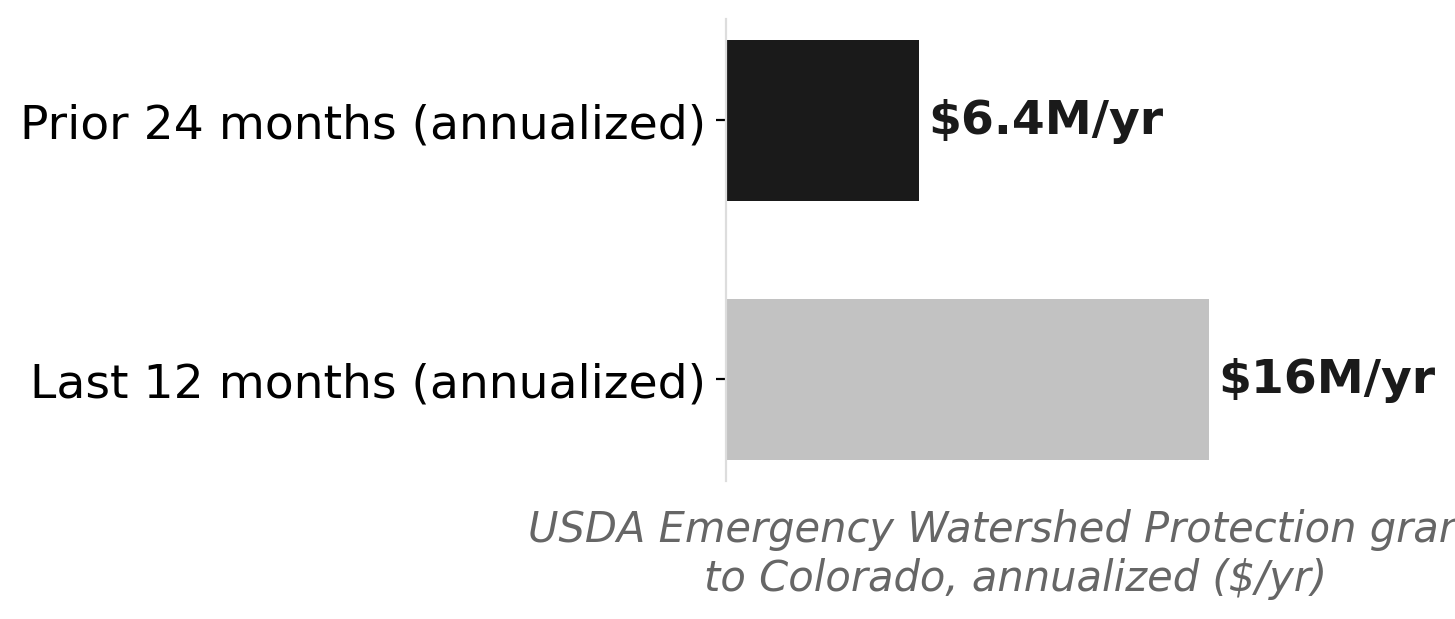
The numbers show how fast Colorado moved toward it. The state received $16 million in EWP grants over the past 12 months, compared with $12.8 million across the entire prior 24-month period, a 2.5-times acceleration in annual EWP dollars. The largest awards went to the hardest-hit corners of the state: Rio Blanco County received $6.2 million, the Upper Pine River Fire Protection District $4.4 million, the Town of Ridgway $3.7 million, and the Town of Pagosa Springs $3.3 million. As the Colorado Sun documented in March 2026, Rio Blanco County, politically conservative and hardly a natural ally of the Polis administration, absorbed an estimated $27.5 million in combined fire and flood damage with no FEMA relief in sight, making EWP the only federal lifeline available regardless of local politics.
State funding filled a different layer. Polis's Executive Order D-2025-021, issued following a verbal disaster declaration on October 12, 2025, unlocked $6 million in state emergency bridge funding to cover immediate response costs while federal relief was still being sought. That money served a distinct purpose from EWP: it was emergency stabilization funding, not a construction program. Separately, the Colorado Water Conservation Board opened a rolling watershed restoration grant application window on February 13, 2026, with approximately $37.7 million in Water Plan grants anticipated for this cycle. Where EWP funds emergency physical repair, debris removal, streambank stabilization, drainage reconstruction, CWCB grants fund the longer-horizon work: stream management plans, fluvial hazard zone mapping, and mitigation engineering. The two programs are complementary by design, administered by different agencies and aimed at different project phases.
The RFP activity is now moving eastward, which suggests the procurement wave has shifted from emergency response in rural southwestern Colorado toward hardening and mitigation on the Front Range. The Town of Erie and Rocky Mountain Arsenal issued a joint solicitation for Coal Creek Channel Restoration and Flood Control construction management services in Weld and Adams counties, with responses due October 15, 2026. A separate flood repair construction contract for the Park Lane corridor went out in Centennial, in Arapahoe County. Neither project is a direct product of the 2025 disasters, both reflect pre-existing infrastructure vulnerability, but they are moving through procurement now, in part because the state's parallel funding mechanisms have created a template local governments are increasingly comfortable using.
For residents in the affected communities, the practical consequence is that physical work is underway: channels are being cleared, streambanks stabilized, culverts replaced. The gap is in coverage. EWP and CWCB grants together cannot replicate the breadth of a FEMA major disaster declaration, which also activates housing assistance, small business loans, and individual relief programs. The communities receiving EWP funds are getting their watersheds repaired; they are not getting the full suite of recovery tools that a declaration unlocks.
The next signal to watch is whether the CWCB's February grant window produces awards at the anticipated $37.7 million scale, and whether NRCS continues to expand EWP obligations into the Front Range counties now entering the procurement pipeline. If the RFP rate holds through the fall, Colorado will have effectively built an alternative federal-state recovery architecture, one assembled under pressure, from programs designed as supplements, because the primary mechanism was unavailable.