Connecticut municipalities posted eight school-safety-related RFPs in the last 30 days, against a monthly baseline of roughly two, a 4.6-times spike concentrated almost entirely in stop-arm camera enforcement, as towns scramble to comply with a state law that took full effect July 1 and face a back-to-school deadline that will not move.
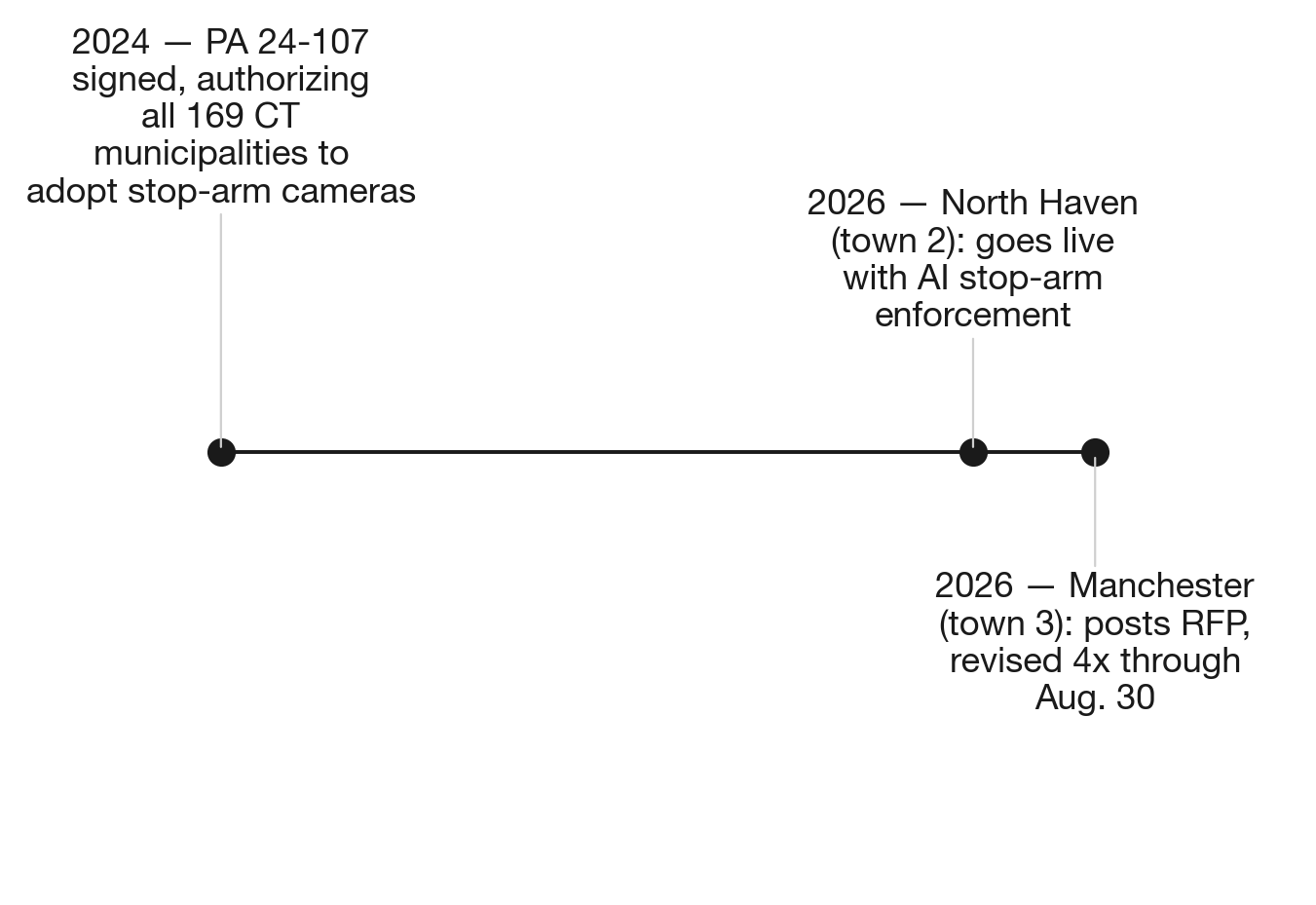
The legal trigger is Public Act 24-107, which the General Assembly passed in 2024 and which overhauled Connecticut's stop-arm camera framework by sunsetting all prior municipal camera authority on July 1, 2026 and replacing it with a new ordinance model. Under that model, each of Connecticut's 169 municipalities must independently adopt a local ordinance and execute its own vendor contract before cameras can go live. The state sets the fine, $250 per violation, civil, revenue directed to public safety or vendor costs, but does none of the buying. That is left to 169 separate procurement offices, each working against the same August calendar.
The clearest single signal in the procurement data is Manchester Police Department's RFP for "School Bus Stop Arm Enforcement Equipment and Services," posted August 2 and updated four times through August 30, with responses due September 16. The repeated amendments, each one narrowing specs or adjusting vendor requirements, read like a procurement office in a hurry, tightening a contract it needs awarded before buses start rolling. Manchester sits in Hartford County, the state's most populous, and its procurement timeline is close to the edge: a September 16 bid deadline leaves almost no room for contract execution before the school year is fully underway.
Source: NationGraph.
Manchester is not an outlier. North Haven launched AI-powered stop-arm camera enforcement on April 13, 2026, making it one of the first towns to clear the full ordinance-to-deployment pipeline under the new law. Shelton equipped 68 buses with BusPatrol AI cameras in fall 2025, ahead of the July statutory changeover. Enfield's Town Council was scheduled August 25 to vote on setting a public hearing for September 9 on its own ordinance, meaning Enfield would still be in the public-comment phase after school has already started. As CT News Junkie reported in April, the rollout looks coordinated from a distance but is playing out town by town, at each town's own pace and procurement capacity.
The urgency is real. Bridgeport Mayor Joe Ganim has cited nearly 10,000 illegal bus passes captured in six months as the rationale for the city's camera deployment. That figure, from a single mid-sized city, underscores why the legislature attached enforcement teeth beyond the civil fine. A separate bill passed during the 2026 session, championed by Senator Jeff Gordon with bipartisan support, adds driver's-license suspension for repeat stop-arm violators, layering a DMV consequence on top of the camera-generated fine.
The 2026 session also passed PA 26-1, signed March 3, which addresses a different dimension of school safety: crisis-response drill standardization. That law directs the CT Center for School Safety at Western Connecticut State University to develop statewide protocols in collaboration with the Department of Emergency Services. The two legislative threads, camera enforcement and emergency preparedness, are moving simultaneously, which partly explains why school-safety procurement activity is elevated across multiple categories even as the stop-arm camera wave dominates the volume.
Nationally, the Connecticut model sits inside a broader diffusion. Vendor analyses place up to 30 states as having authorized stop-arm camera enforcement as of 2026, with AI-assisted review becoming the default because it reduces the per-violation cost of human adjudication. Connecticut's decentralized, municipality-by-municipality implementation is more administratively demanding than state-run models used elsewhere, but it also means the procurement market is open to smaller regional vendors, not just national players.
For Connecticut residents, the practical effect depends entirely on where they live. Drivers in North Haven and Shelton are already being fined. Drivers in Enfield may not face camera enforcement until late fall, if the September 9 hearing leads to a prompt ordinance vote and a fast vendor contract. Drivers in towns that have not yet begun the ordinance process face no automated enforcement this school year at all. The law created a uniform fine and a uniform legal framework; it did not create a uniform rollout.
The next signal to watch is the Manchester RFP's September 16 close date. If the city awards a contract quickly, it becomes a procurement template other Hartford County towns can follow. If the timeline slips, it will illustrate the friction built into a state law that delegates implementation to 169 jurisdictions simultaneously, each one starting from scratch.