Connecticut obligated nearly $50 million in federal electric vehicle charging grants in a single day, January 30, 2026, placing the state fourth in the country for NEVI funds committed since 2025, behind only California, North Carolina, and Michigan. That single-day sprint was not an accident. It was a calculated move to outrun Washington.
The five grants, each awarded to the Connecticut Department of Transportation and running through terms as long as 2040, represent the bulk of the state's $52.5 million, five-year apportionment under the NEVI Formula Program, authorized in the 2021 Bipartisan Infrastructure Law. CTDOT had spent the preceding months laying the groundwork: the agency's FY2026 NEVI plan received FHWA approval in late September 2025, unlocking the final-year tranche of the allocation. Within weeks of that approval, Congress passed a transportation bill rescinding more than $500 million from the NEVI program nationally, with the Trump administration directing the money toward road and bridge repairs instead.
CTDOT's window was real and it was closing. States that had not yet obligated their NEVI funds were most exposed to the rescission. Connecticut, having already moved Phase 1A corridor-charger grants earlier in the program, was relatively insulated, but roughly $24.3 million in uncommitted funds remained on the table as of February 2026. CTDOT spokesperson Josh Morgan told reporters the agency was monitoring potential clawbacks, noting officials had "not heard from the Federal Highway Administration on final adjustments." Corrigan Salerno of Transportation for America put it more bluntly, warning the rescission was "undermining confidence in a system" that states had spent years building plans around.
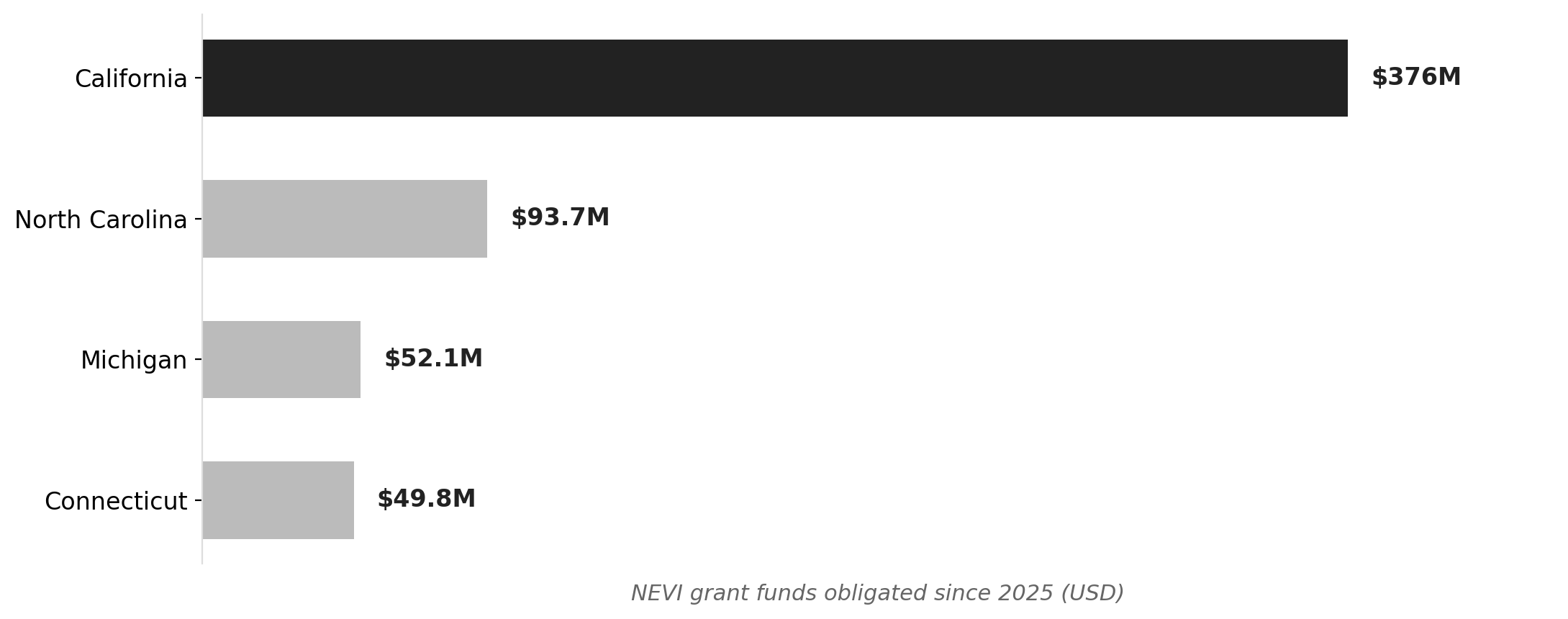
Source: NationGraph.
The phase structure of NEVI shapes what gets built and where. Phase 1 chargers must be located along Connecticut's federally designated Alternative Fuel Corridors: I-91, I-95, I-84, I-395, and Route 7. Only after those highway-corridor installations are substantially complete can Phase 2 funding flow to community charging in underserved areas. By obligating January's grants, CTDOT preserved the possibility of that second phase. Without them, the community-charging component would have been effectively deferred indefinitely.
The EV infrastructure push extends beyond highway corridors. A $6.3 million EPA Clean Heavy-Duty Vehicles grant landed in January 2025 for the Branford Board of Education to electrify its school bus fleet, a quieter but significant piece of the state's overall zero-emission transition. Governor Lamont's Executive Order 21-3 mandates converting the entire state transit bus fleet to zero-emission by 2035, giving CTDOT a state-level policy mandate that aligned with the urgency to draw down federal dollars while they were still available. The CTfastrak corridor, which received a separate $38.9 million federal grant for electric bus and charger conversion, illustrates how the state is layering transit electrification on top of highway charging investments.
The broader portfolio matters here. Connecticut's active EV-tagged federal grant commitments total roughly $380 million when transit formula grants with EV components are included, a figure that would have seemed implausible against the $400,000 in comparable federal EV grants the state received in the same 90-day window a year earlier. That 70,000-percent year-over-year surge is partly a measurement artifact: a large FTA Section 5307 omnibus transit grant, covering everything from Waterbury Branch station upgrades to Walk Bridge repairs, carried an EV keyword and dominates the raw count. But the underlying NEVI commitment is real and durable: those five January grants are legally obligated federal dollars, not promises.
Connecticut's position as a small, densely populated commuter state without highway tolls makes federal formula grants the dominant lever for transportation capital. Its $52.5 million NEVI apportionment is modest in absolute terms but substantial per capita, and the state participates in the multi-state zero-emission vehicle memorandum of understanding with California, New York, and Massachusetts, a political arrangement that creates ongoing pressure to demonstrate deployment progress even when federal support is uncertain. More than 59,000 EVs were registered in Connecticut at the end of 2024, up roughly 8,300 from the prior year, meaning the charging infrastructure being built now will serve a fleet that is already growing faster than the national average.
The open question is what happens to the $24.3 million that had not yet been obligated as of February. If FHWA formally adjusts Connecticut's NEVI apportionment downward under the rescission, Phase 2 community charging, the part of the program targeting underserved areas, faces the sharpest cuts. CTDOT's next public signal will come when FHWA communicates its final accounting to states, a notification that had not arrived as of the most recent reporting.