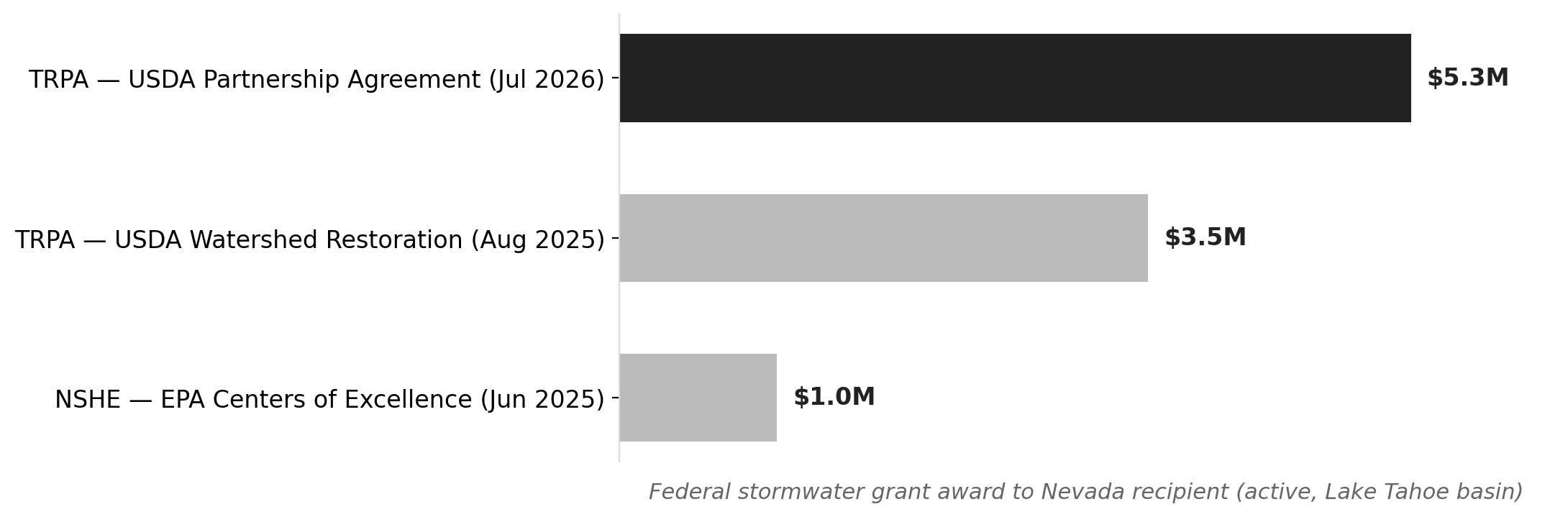
Federal stormwater grants flowing into Nevada hit $5,281,168 in the past 90 days, up 344% from $1,189,219 in the same window a year ago. The entire increase traces to a single award: a USDA Partnership Agreement granted to the Tahoe Regional Planning Agency on July 8, 2026, covering a five-year performance window through 2031. No adjacent western state received a comparable new stormwater grant start in the same period. California's nearest equivalent was $2 million.
The jump is not a broad infrastructure boom. It is a concentrated bet on one lake's water clarity, and it reflects a funding emergency as much as a restoration strategy.
The Lake Tahoe Restoration Act, the primary federal authorization underpinning the lake's multi-decade Environmental Improvement Program, had delivered only about 30% of its $415 million authorization as of September 2025, with expiration looming. That gap is the engine behind the surge. TRPA and its federal partners are using USDA partnership agreements to front-load restoration before congressional authorization lapses, pulling down as much committed funding as possible in a narrow window. TRPA's deputy director testified before Congress in February 2026, at the invitation of Sen. Catherine Cortez Masto, to press for continued federal support for the lake's public lands and restoration programs.
Source: NationGraph.
The new $5.28 million award sits on top of a $3.53 million companion USDA Watershed Restoration and Enhancement Agreement that TRPA received in August 2025, also running through 2030. Together the two USDA tranches account for nearly $9 million of Nevada's roughly $10 million active federal stormwater portfolio. Both flow through the Environmental Improvement Program, a coalition of more than 80 organizations targeting erosion control, stream restoration, and road runoff across the basin.
The reason road runoff keeps commanding this level of attention is blunt: approximately 72% of the pollutants degrading Lake Tahoe's famous water clarity enter the lake through stormwater, most of it shed from roads and developed parcels. The basin has binding Total Maximum Daily Load obligations under the Clean Water Act, which require measurable load reductions from road runoff regardless of broader federal budget pressures. That regulatory backstop makes stormwater investment non-discretionary in a way that most federal grant categories are not. As the USDA Forest Service's Lake Tahoe Basin Management Unit has documented, the Restoration Act has produced measurable clarity gains where projects have been completed, but the pace of delivery has consistently lagged authorization.
A second, parallel federal pipeline is also now active in Nevada, aimed at turning the basin's stormwater science into exportable solutions. The EPA's Bipartisan Infrastructure Law-funded Centers of Excellence for Stormwater Control Infrastructure Technologies program awarded $1,049,719 to the Nevada System of Higher Education in June 2025, making NSHE the home of the Southwest Stormwater Center, one of four national research hubs. The center covers Nevada, California, Arizona, Utah, and New Mexico, providing technical assistance and best-practices guidance to local governments across the arid West. That award was the anchor of Nevada's prior-year comparison figure, meaning it was already in the ledger before TRPA's new USDA tranche arrived.
On-the-ground procurement confirms that the grant activity is translating into contracts. The Nevada Tahoe Conservation District issued an RFP in early July 2026 for the Hogan Court Drainage Improvement Project, and Washoe County issued a separate stormwater RFP in April 2026 for the Upper Third and Rosewood Creeks Water Quality Improvement Project. Both procurements are consistent with TRPA's project pipeline for reducing fine sediment loads from residential road systems in the basin.
For Nevada residents outside the Tahoe basin, the direct effect is limited. Nearly 80% of the basin's land is federally managed by the USDA Forest Service, which makes federal grants, not state appropriations, the primary funding channel for restoration work there. The Southwest Stormwater Center at NSHE is the exception: its mandate extends to urban and arid-region stormwater challenges across five states, so the research Nevada is hosting has implications for Reno, Las Vegas, and a dozen other western cities working through their own Clean Water Act compliance plans.
The next signal to watch is congressional action on the Lake Tahoe Restoration Act reauthorization. If the Act lapses without a successor, the USDA partnership agreement structure that produced July's $5.28 million award remains available, but the scale and frequency of new tranches would likely shrink. TRPA's five-year performance window runs through 2031 regardless, but the funding pipeline behind it depends on whether Congress moves before the authorization clock runs out.