Federal school safety grants flowing into North Carolina reached $15.3 million in the trailing 90 days, up from $603,000 in the same window a year ago, a 2,432% increase driven by two simultaneous and largely unrelated federal mechanisms that happen to be paying out at the same moment.
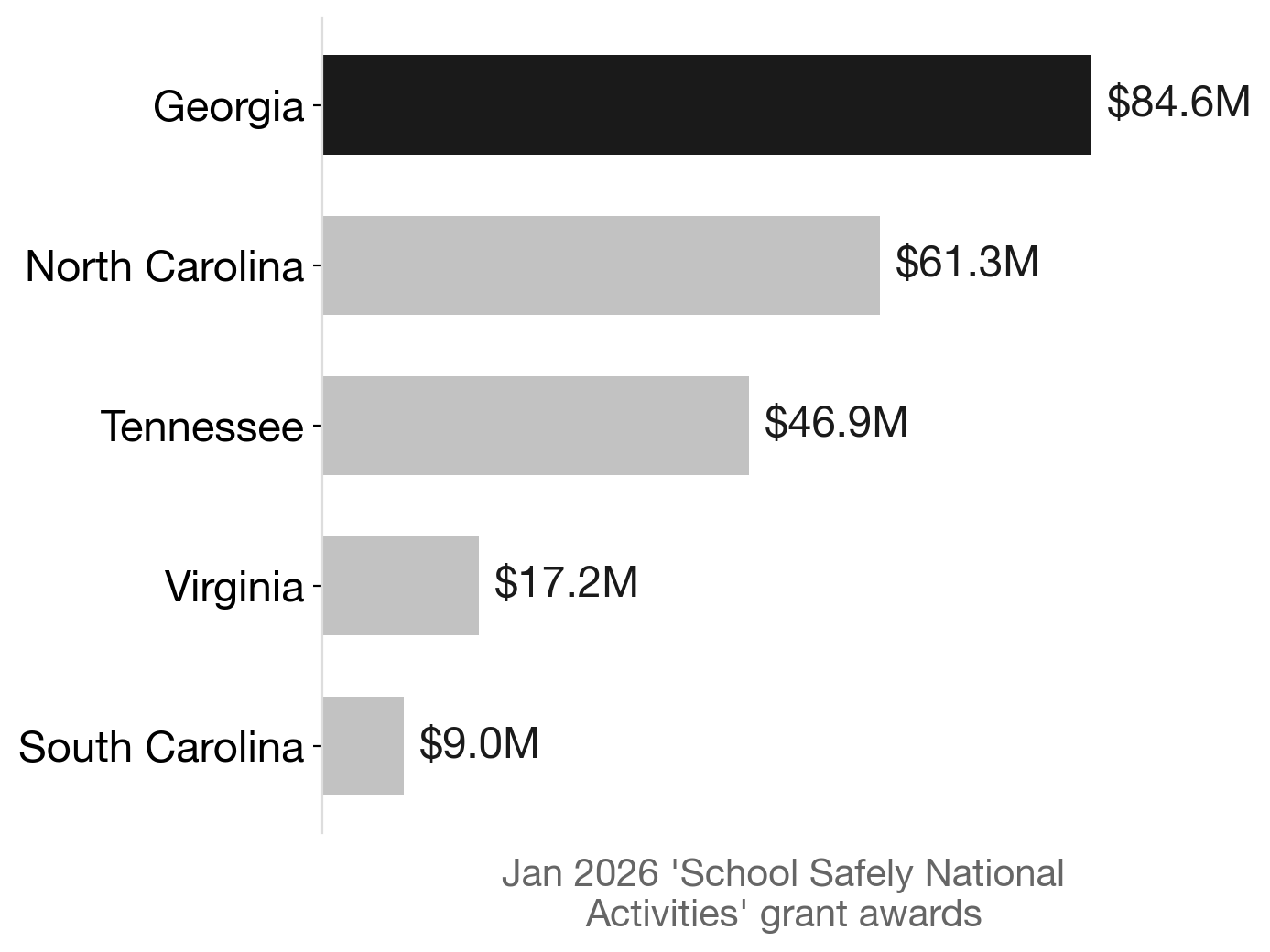
The larger of the two is a January 2026 cohort of competitive grants under the Bipartisan Safer Communities Act, which Congress passed in June 2022 following the Uvalde massacre and which allocated $100 million annually for school mental health staffing. Eleven North Carolina entities received awards totaling $61.3 million in that single cohort. Iredell-Statesville Schools landed the largest at $12.8 million for a program called RESOLVE, which will place school-based mental health providers across the district. NC's Department of Public Instruction received $11.9 million for a statewide School-Based Mental Health Services expansion and has already drawn $5.76 million of it. McDowell County Board of Education received $6.8 million, Surry County Schools $5.5 million, and Cumberland County $5.1 million, all districts carrying significant concentrations of low-income students and documented shortages of counselors and psychologists. Among southeastern states, North Carolina's haul from that cohort trails only Georgia's $84.6 million and exceeds Tennessee's $46.9 million, Virginia's $17.2 million, and South Carolina's $9.0 million.
The second mechanism runs in parallel but draws from a different emergency authority. Beginning in May 2025, the Department of Education began disbursing Project SERV grants, School Emergency Response to Violence funding, a program designed for acute trauma recovery, to more than 15 western North Carolina school districts and colleges devastated by Hurricane Helene, which killed more than 100 people in the region in September 2024 and caused an estimated $59.6 billion in statewide damages. Individual Project SERV awards ranged from $100,000 to $1.25 million each, reaching districts in Watauga, Ashe, Madison, Avery, Henderson, Buncombe, Haywood, Yancey, and neighboring counties. Governor Josh Stein's administration supplemented those grants through the WNC Thrive initiative, committing $3.75 million for post-disaster mental health support across 22 Helene-affected counties.
Source: NationGraph.
The BSCA grants, notably, nearly did not arrive. The Trump administration halted nearly $1 billion in school mental health grants in April 2025. A federal court in the Western District of Washington issued a preliminary injunction on October 27, 2025, blocking that cancellation and forcing the Department of Education to restart the competition. The replacement round, valued at roughly $208 million nationally, produced the January 2026 awards from which North Carolina's cohort flows. Without that ruling, the state's $61.3 million would have remained frozen. The BSCA's school mental health authorization runs only through FY2026, making this cohort the final major competitive distribution under the law.
That expiration is the detail that gives the current surge its particular urgency. Districts receiving multi-year awards will need to hire counselors, psychologists, and social workers they may not be able to retain once grant funding runs out. NC DPI's $11.9 million award is structured to seed a statewide infrastructure, but the federal dollars underwriting it do not automatically renew. Surry County, which has already drawn $2.3 million of its $5.5 million award, and Scotland County, which has drawn $2.2 million, are already staffing up. The question those districts will face within two to three years is whether state appropriations or local budgets can absorb the recurring cost of positions funded under a one-time federal authorization.
For the western mountain counties, the calculus is more acute. Project SERV is explicitly an emergency program, not a long-term infrastructure grant. Watauga and Yancey counties are still in early-stage recovery from a storm that disrupted the 2024-2025 school year entirely in some communities. The NC DPI blog on the one-year Helene anniversary documented continued needs in student attendance and staff retention that emergency mental health funds alone cannot resolve.
The convergence of these two pipelines, post-Uvalde school safety policy and post-Helene disaster response, has produced what state education officials have not yet publicly framed as a single coherent story. The grants are administered through different federal programs with different reporting requirements, different timelines, and different eligible uses. But the classrooms receiving them often overlap: rural, high-poverty, trauma-affected districts in communities that were already underserved before the storm.
The next signal to watch is the FY2027 federal education budget. If Congress does not reauthorize the BSCA mental health supplement or create a successor program, the largest single infusion of school mental health dollars in North Carolina's modern history will end precisely when the Helene recovery cohort of western NC students moves into middle and high school, the years when untreated childhood trauma typically surfaces in academic and behavioral outcomes.