New Jersey counties issued 34 homelessness-response RFPs in the last 30 days, against a 12-month monthly average of roughly 6.6, a 5.2x spike that spans 17 distinct agencies across 12 counties and signals something broader than a single procurement cycle.
The force behind it is a collision of three distinct pressures arriving at the same moment. Federal Continuum of Care funding, which covers roughly 40 percent of shelter and housing budgets for most NJ counties, was thrown into genuine competitive uncertainty in June when HUD released a restructured FY2026 NOFO that cut guaranteed renewal funding from roughly 90–95 percent of Annual Renewal Demand down to 60 percent, making a larger share of the program's money fully competitive for the first time. A federal court injunction paused the NOFO on August 7, before the application deadline, leaving NJ county CoC applicants in limbo about an estimated $22 million. Simultaneously, Governor Mikie Sherrill's FY2026 budget included a $25 million state appropriation for imminent homelessness risk programs. And a June 2026 Rutgers Bloustein School study found that NJ spends only $13,556 per unhoused resident annually, second-to-last among six comparable states, well behind Massachusetts and Connecticut at roughly $26,000 each, giving the governor and legislature a sharp political reason to act.
The result is a statewide contracting push that is not one program but several parallel responses running at once.
NJ DCA's Office of Homelessness Prevention is running competitive RFPs for two separate state-funded streams: HPRP2 (Homelessness Prevention and Rapid Re-Housing 2), which funds temporary rental assistance and stabilization services, and the new OEHP (Omnibus Eviction and Homelessness Prevention Program), which consolidates eviction defense and prevention funding into a single grant model. Both are funded through state appropriations, not federal money, and both are issuing independent solicitations to county and municipal agencies statewide. Because New Jersey's homelessness system is unusually county-driven, each of the state's 21 counties contracts separately with service providers, a single state funding cycle produces dozens of parallel procurement actions, amplifying the apparent volume.
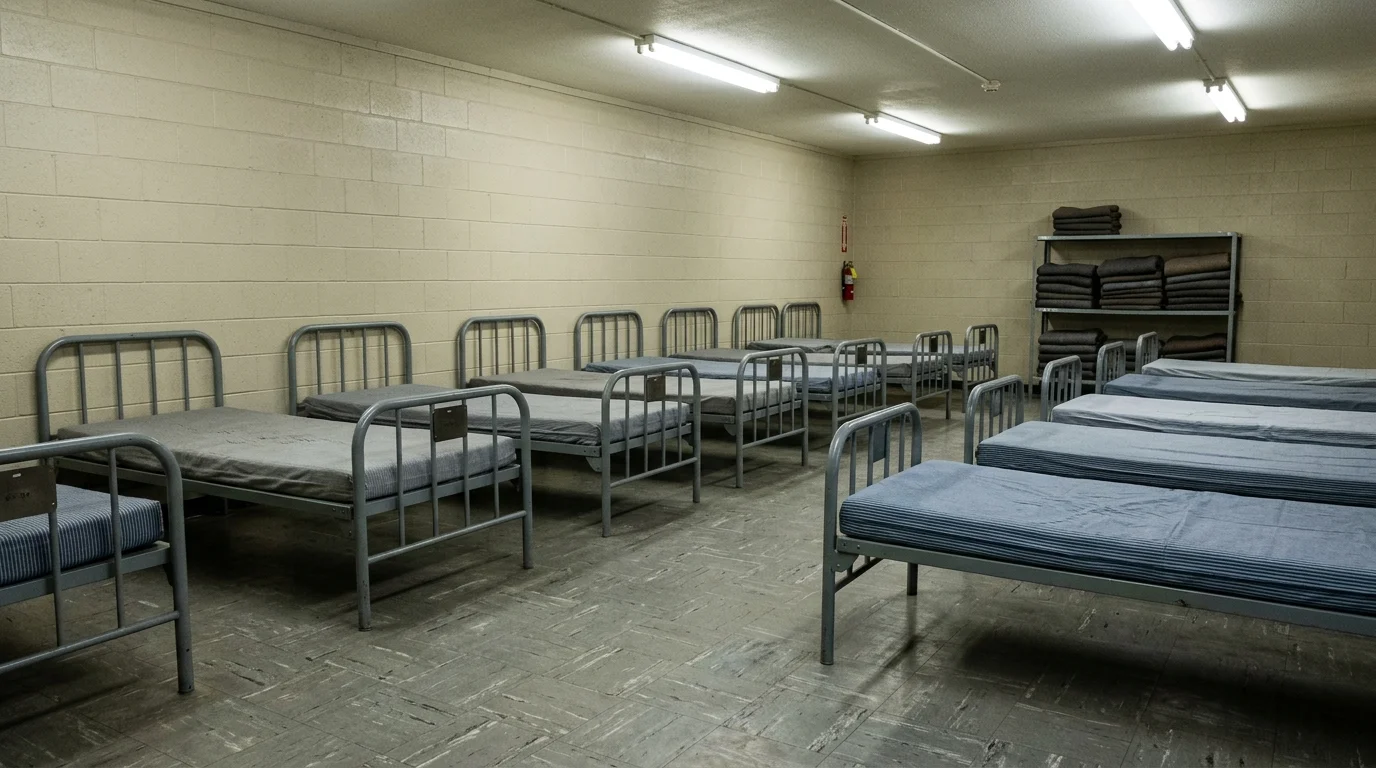
Camden County accounts for eight of the 34 RFPs and is the clearest single catalyst. On October 22, the county opened the $25 million Martin McKernan Supportive Housing Center in Blackwood, a 60-unit transitional facility built with expiring federal ARPA dollars and county bonds, a capital infrastructure bet made entirely outside the federal CoC system. The center's opening triggered immediate contracting for Code Blue emergency services, mobile outreach, and reentry programming, as the county moves from construction to operations. The McKernan Center is a county capital project; its ongoing $2 million-plus annual operating costs will be partially offset by grants, and Camden's current RFP wave reflects the scramble to assemble that funding patchwork before federal renewal dollars resolve.
The legislative layer adds another variable. Senate bill S4251, introduced May 14, 2026, would create a $10 million state cost-sharing program reimbursing municipalities that provide emergency shelter to non-resident homeless individuals, with a mandatory HMIS participation requirement. The bill has not passed, but its introduction signals that Trenton is treating municipal shelter capacity as a fiscal problem that the state may need to absorb, a posture that encourages counties to get contracts in place now rather than wait.
In raw volume, NJ's 34 RFPs in 30 days outpaced Pennsylvania's 15 and Connecticut's 4 over the same window, though it trailed New York's 51. The comparison is imperfect, state procurement architectures differ, but it suggests NJ's county-fragmented structure is producing visible activity even before the federal picture resolves.
One caveat on the headline number: 27 of the 36 October RFPs entered the procurement database on October 25–28 with already-past due dates, a batch-ingestion artifact also visible in prior monthly spikes. The genuine signal is breadth, not raw count. Burlington, Essex, Hudson, Mercer, Middlesex, Ocean, Passaic, Salem, Somerset, Union, and Gloucester counties all had homelessness RFPs enter the system this month alongside Camden, a geographic spread that reflects statewide annual contracting cycles triggered by the state funding calendar, not a single coordinated event.
For residents and service providers, what this means practically is a window of unusual procurement activity that will close quickly. State-funded programs like HPRP2 and OEHP are on fixed competitive cycles. The CoC injunction will not last indefinitely; when it lifts, counties will face a compressed application timeline under a more competitive framework than anything they have navigated before. The contracts being solicited now are, in many cases, the bridge that agencies need to stay operational while that federal process resolves.
The next signal to watch is the federal court's decision on the CoC injunction. If the restructured NOFO survives legal challenge, counties that have not already diversified toward state funding will face a harder renewal competition than any in recent memory, and the agencies that locked in state contracts this fall will be better positioned to absorb the loss.