Illinois municipalities have issued flood and stormwater solicitations at roughly twice the normal monthly rate over the past several months, and the force behind that acceleration is not a single federal announcement or a single storm. It is a state-administered loan program that has quietly more than doubled in capacity since FY2022 and is now large enough to give long-waiting communities a realistic shot at funding, for the first time in years.
Governor Pritzker's FY2027 budget, signed June 16, 2026, provides $1.3 billion in new appropriations for IEPA water infrastructure loans. The Illinois EPA's Water Pollution Control Loan Program alone carries $602 million in loan capacity for the current fiscal year, capitalized by a combination of federal IIJA Clean Water State Revolving Fund grants and $100 million in new Rebuild Illinois state bond funding that serves as the required 20 percent match. As CMAP's FY2027 budget analysis notes, even at that scale the agency can fund only 20 to 25 percent of annual project requests. That gap is exactly what produces the RFP surge: each new budget cycle is a competitive event, and municipalities that have been sitting on engineering studies and cost estimates start moving the moment they see a funding signal worth responding to.
The active solicitations of the past 90 days show how broadly that signal has landed. The Village of Niles is procuring Stage 2 improvements to the Lawrencewood Garden stormwater system in Cook County. Watseka is advertising Phase XXIII of its flood mitigation demolition program in Iroquois County, a long-running effort to remove repetitive-loss structures. Lockport Township is rehabilitating the Fairmont stormwater system in Will County. The Metropolitan Water Reclamation District is moving on a stormwater detention basin in Harvey. These are not projects that appeared in response to a single event. They reflect communities that had plans in place and were waiting for the funding environment to justify the procurement cost.
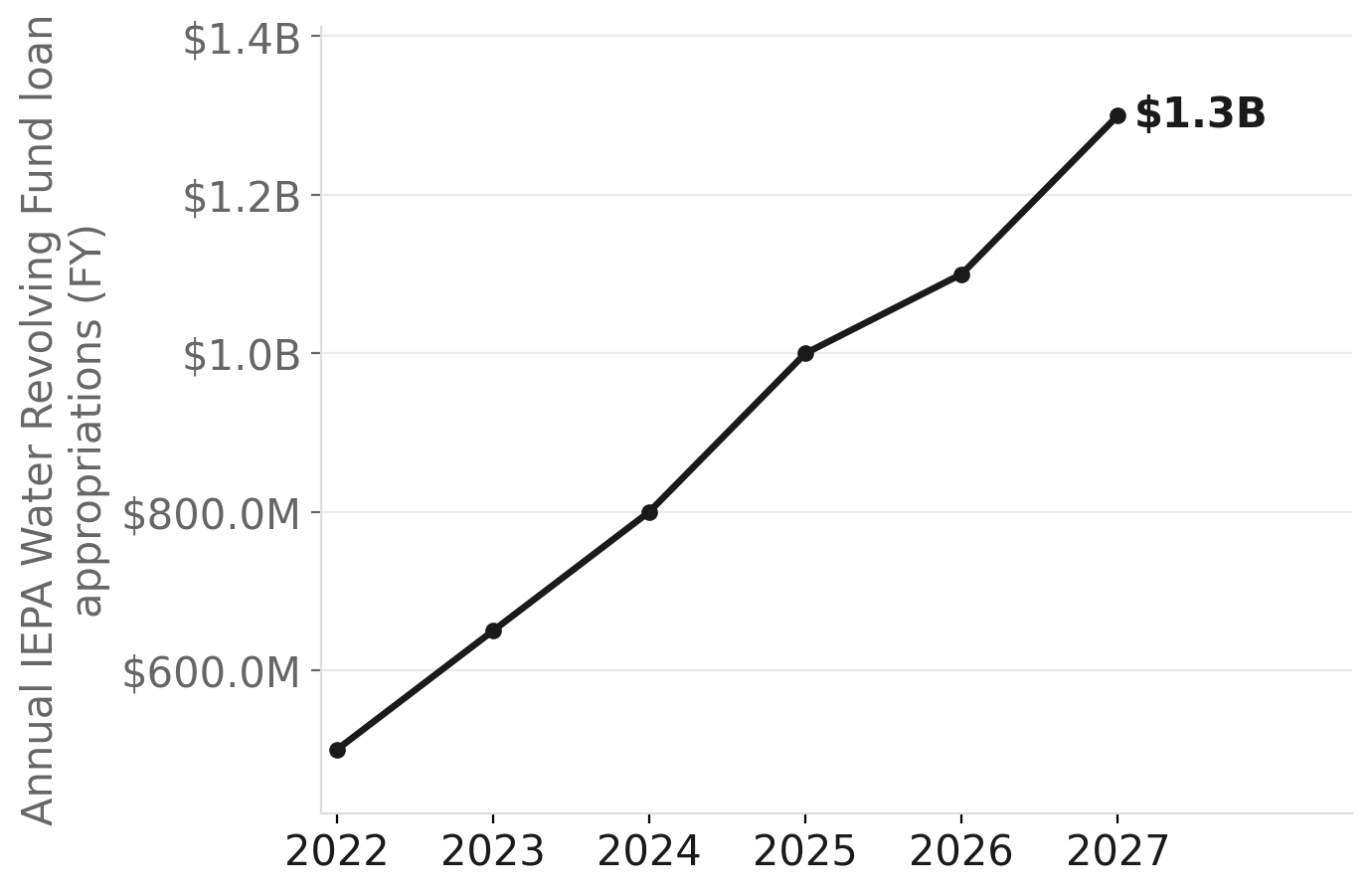
Source: NationGraph.
Lake County illustrates what happens when the funding environment is favorable for an extended period. Its Stormwater Management Commission has been executing a $122 million capital improvement program funded by a separate state DCEO appropriation since 2022. A second $30 million tranche, received in 2024, is currently funding 16 projects with deadlines in fall 2026, keeping construction crews active across the county at a pace that would not have been possible under earlier funding levels. The DCEO stormwater capital program and the IEPA revolving loan fund are distinct mechanisms, the former a direct state grant to county-level commissions, the latter a low-interest loan program municipalities apply to individually, but both are flowing at higher volumes simultaneously, reinforcing the overall procurement uptick.
Federal grants are a real but much smaller part of the picture. FEMA designated $2.25 million in Pre-Disaster Mitigation funds for Illinois in June 2026, split between a Rockford creek greenway and a DuPage County project. That is useful money for discrete mitigation sites, but it is not what is moving the procurement queue. The state loan mechanism is doing the heavy lifting.
The political pressure behind the projects is genuine. FEMA Major Disaster DR-4728-IL generated more than $326 million in individual assistance for Cook County following July 2023 storms. An SBA disaster declaration followed flash flooding across Cook, Calhoun, and Jersey Counties in July 2025. An August 2026 derecho that originated in Illinois before crossing into Indiana produced major flood stage river readings across the region. Those events did not create the infrastructure backlog, but they have made it politically difficult for any municipality with an unsubmitted project to keep sitting on it.
Illinois also has a structural complication that concentrates pressure into IEPA's annual cycles: only 16 of the state's 102 counties hold state-delegated stormwater authority. That means most flood investments in the other 86 counties cannot flow through a county-managed program and must instead pass through the IEPA loan application process, making the agency's Intended Use Plan a bottleneck that municipalities track closely each year.
The next signal to watch is IEPA's FY2027 project priority list, which will determine which of the municipalities now issuing RFPs actually secure loan commitments. Communities that complete procurement and have construction-ready contracts in hand will be better positioned to move up the list. Those that wait will face the same competition in FY2028, with no guarantee the funding floor holds at current levels.