Federal dollars tagged to school safety in West Virginia jumped to $9.2 million over the past 90 days, a 404% increase over the same window a year ago. The number is real. The story behind it is more complicated, and more interesting, than the headline suggests.
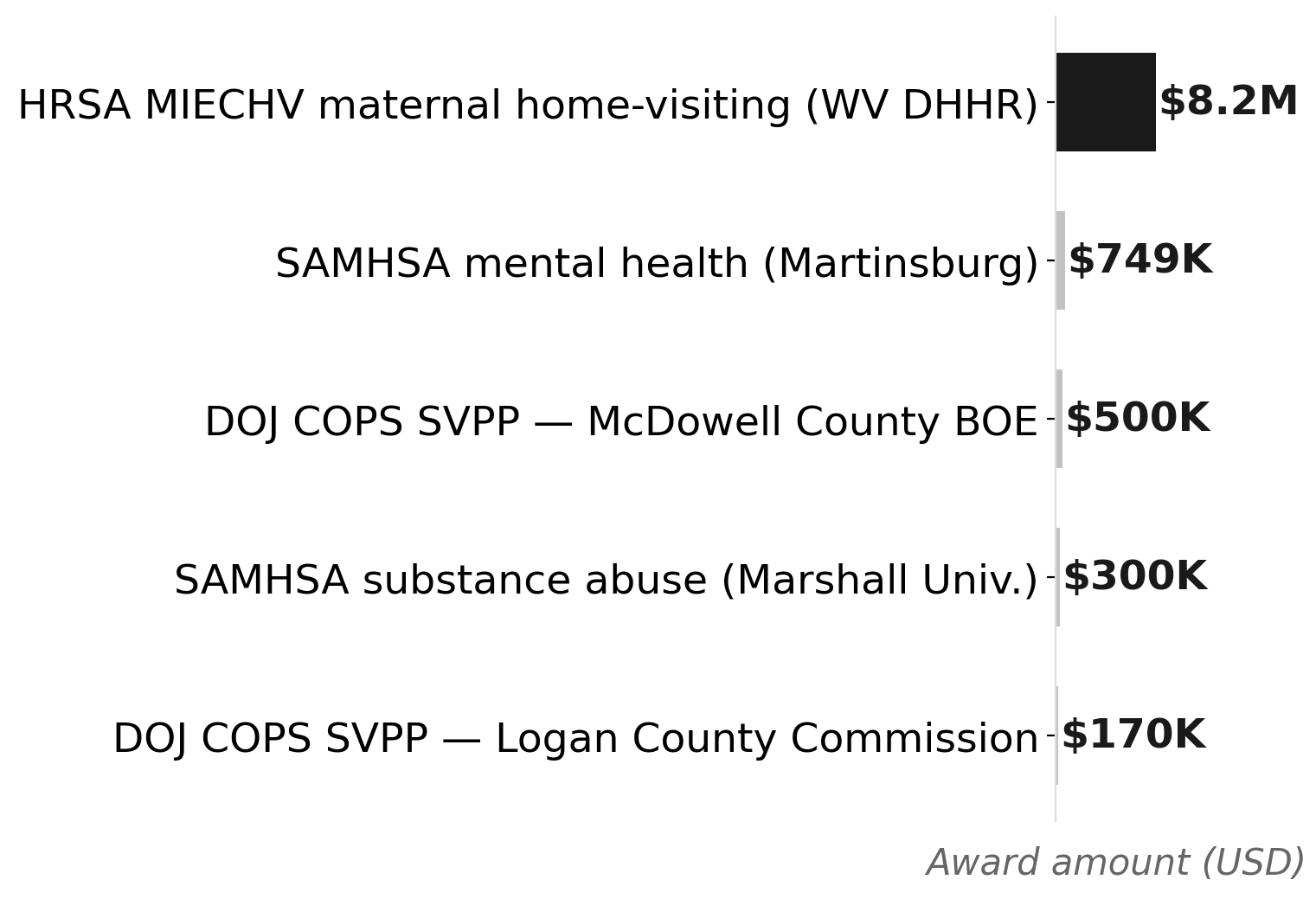
The dominant driver of that spike is not a school security program. An $8.15 million HRSA grant, disbursed to the West Virginia Department of Health and Human Resources on September 30, 2026, funds the Maternal, Infant, and Early Childhood Home Visiting program, a voluntary, evidence-based service that sends nurses and social workers into at-risk households from pregnancy through kindergarten. MIECHV reaches the keyword threshold for "school safety" through its school-readiness benchmarks, but it is administered by the Department of Health and Human Services, not the Department of Education or DOJ, and its purpose is maternal and infant health. West Virginia's award is part of a record $525 million-plus national disbursement, which HRSA has described as the largest investment in the program's history. The remaining $1 million in the trailing-90-day total includes a $749,000 SAMHSA mental health grant to the City of Martinsburg and a $300,000 substance abuse treatment award to Marshall University Research Corp, behavioral health investments adjacent to schools, but not school-security spending.
Strip those out, and the genuine school violence portfolio is smaller and more targeted. The clearest signal comes from the DOJ COPS Office's FY2025 School Violence Prevention Program, which sent $500,000 to the McDowell County Board of Education and $170,500 to the Logan County Commission, both starting October 1, 2025. These grants fund physical security improvements and evidence-based safety programs at K-12 schools, the kind of work the headline metric implies. The COPS SVPP award list placed these two WV awards within a $74.8 million national round covering 211 recipients. That McDowell and Logan received them is notable: McDowell is among the poorest counties east of the Mississippi, with chronic population decline and a tax base too thin to finance capital improvements locally, and Logan has faced persistent economic distress since the coal sector contraction. Federal grants are not a supplement to local school safety budgets in these counties; they are the budget.
Source: NationGraph.
The third stream, and arguably the one with the widest footprint, is the $5.75 million West Virginia received through the Bipartisan Safer Communities Act's Stronger Connections Grant. That program, administered by the Department of Education, funds school climate, behavioral supports, and safe-learning-environment initiatives, a distinct statutory purpose from either MIECHV or the COPS SVPP, and one that has helped create conditions for the procurement activity now showing up across the state.
What that procurement activity looks like in practice: at least eight West Virginia county school districts, Upshur, Grant, Wayne, Clay, Hardy, Doddridge, Raleigh, and Mason, issued requests for proposals for secure-entrance construction or school safety mapping in 2026. These RFPs represent the actual physical hardening of school buildings, a capital-intensive process that moves slowly from federal award to architectural spec to construction contract. The volume of simultaneous procurements suggests districts absorbed earlier federal dollars and are now moving through the spending pipeline together, likely in part on the strength of the Stronger Connections funding.
These are four distinct federal mechanisms, HRSA MIECHV, DOJ COPS SVPP, the Bipartisan Safer Communities Act Stronger Connections Grant, and SAMHSA community mental health funding, with different authorizing statutes, different administering agencies, and different definitions of what "safe" means for children. Collapsing them into a single school safety surge misreads what the federal government is actually doing, and for whom.
For West Virginia residents, the distinction matters for a practical reason: the MIECHV dollars flow through the state health department and reach families before a child ever enrolls in school, targeting the prenatal and early-childhood conditions that correlate with later educational and safety outcomes. The COPS SVPP dollars go directly to school boards and county commissions for metal detectors, secured vestibules, and camera systems. The Stronger Connections money funds counselors and climate programs. A family in McDowell County might benefit from all three streams at different stages, through different agencies, without any of them being the same program.
The next federal opportunity in this space is the BJA STOP School Violence Program, with applications open through November 6, 2026. Whether any West Virginia district has submitted, or whether the counties that received COPS SVPP money in 2025 are positioned to layer in additional awards, will be the clearest signal of how aggressively the state is pursuing this funding cycle before it closes.