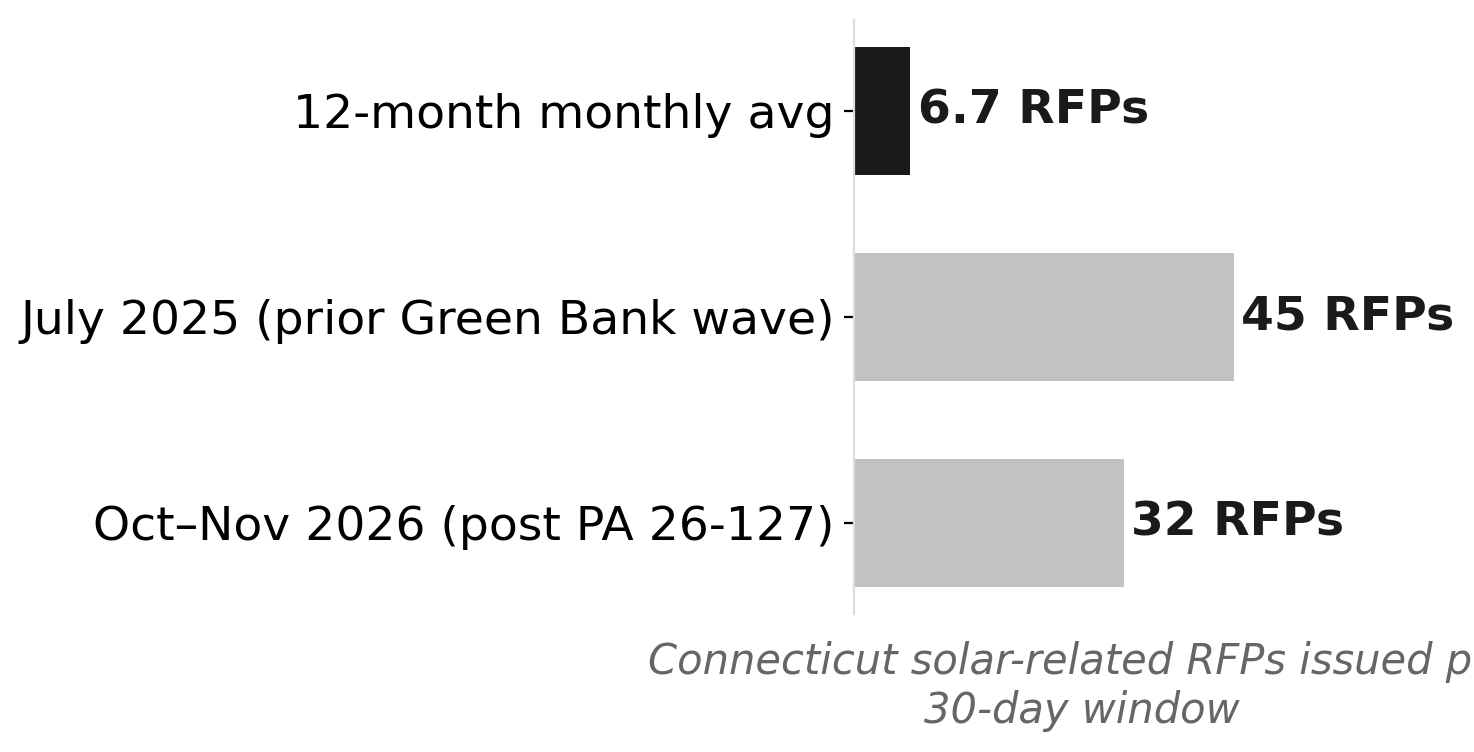
Connecticut issued 32 solar-related procurement solicitations in the trailing 30 days through mid-November 2026, against a 12-month monthly average of roughly 6.7. That is a 4.8x surge, and it did not happen by accident.
Two clocks started running at nearly the same moment, and the state is now racing both of them. Public Act 26-127, signed by Governor Ned Lamont on June 4, 2026 and effective October 1, took a sweeping set of solar mandates off the legislative shelf and made them live obligations: an extended suite of ratepayer-funded solar tariff programs running through 2035, a new community solar successor program, and a mandate for automated residential permitting. The day the law took effect, procurement timelines became real. Then there is the second clock, running in the opposite direction. In August 2025, EPA Administrator Lee Zeldin cancelled Connecticut's $62.45 million Solar for All grant, known as Project SunBridge, as CT Mirror reported at the time. Of that award, $35,577 had been outlayed before cancellation. The rest disappeared. The low-income residential solar pipeline that grant was meant to fund now has to be rebuilt using state institutions, on a state timeline.
The result is a procurement wave that cuts across two distinct actors working in parallel. The Connecticut Green Bank accounts for 10 of the 32 RFPs, covering Engineering-Procurement-Construction services at state facilities, solar-and-storage development technical assistance, preventive maintenance for existing PV portfolios, and clean energy regulatory consulting. These solicitations run through the Green Bank's Solar MAP+ program, which aggregates demand across state agencies, municipalities, affordable housing providers, and school districts and finances projects through power purchase agreements and its own balance sheet, without a single annual appropriation. The remaining 22 RFPs come from municipalities and school districts acting independently under the same law: Stamford issued four, Danbury two, Regional School District #16 two, and 14 additional towns each entered the market in the same 30-day window.
Source: NationGraph.
That municipal co-participation is what distinguishes this wave from prior cycles. A Green Bank-driven spike in July 2025 produced 45 RFPs, but it was largely an institutional affair. The October 2026 surge is broader, suggesting that Public Act 26-127's provisions landed with enough clarity that local governments began issuing solicitations the moment the law went effective, rather than waiting for state agencies to lead.
The law itself created three sequenced deadlines that are now doing the work. Connecticut's public utility regulator, PURA, was required to file a community solar procurement plan by August 1, 2026, a deadline that has already passed and is generating follow-on contracting activity. Balcony solar rules took effect October 1, making Connecticut the sixth U.S. state to legalize plug-in residential solar units. An automated smart solar permitting platform is due by July 1, 2028. Each deadline is a procurement trigger in its own right.
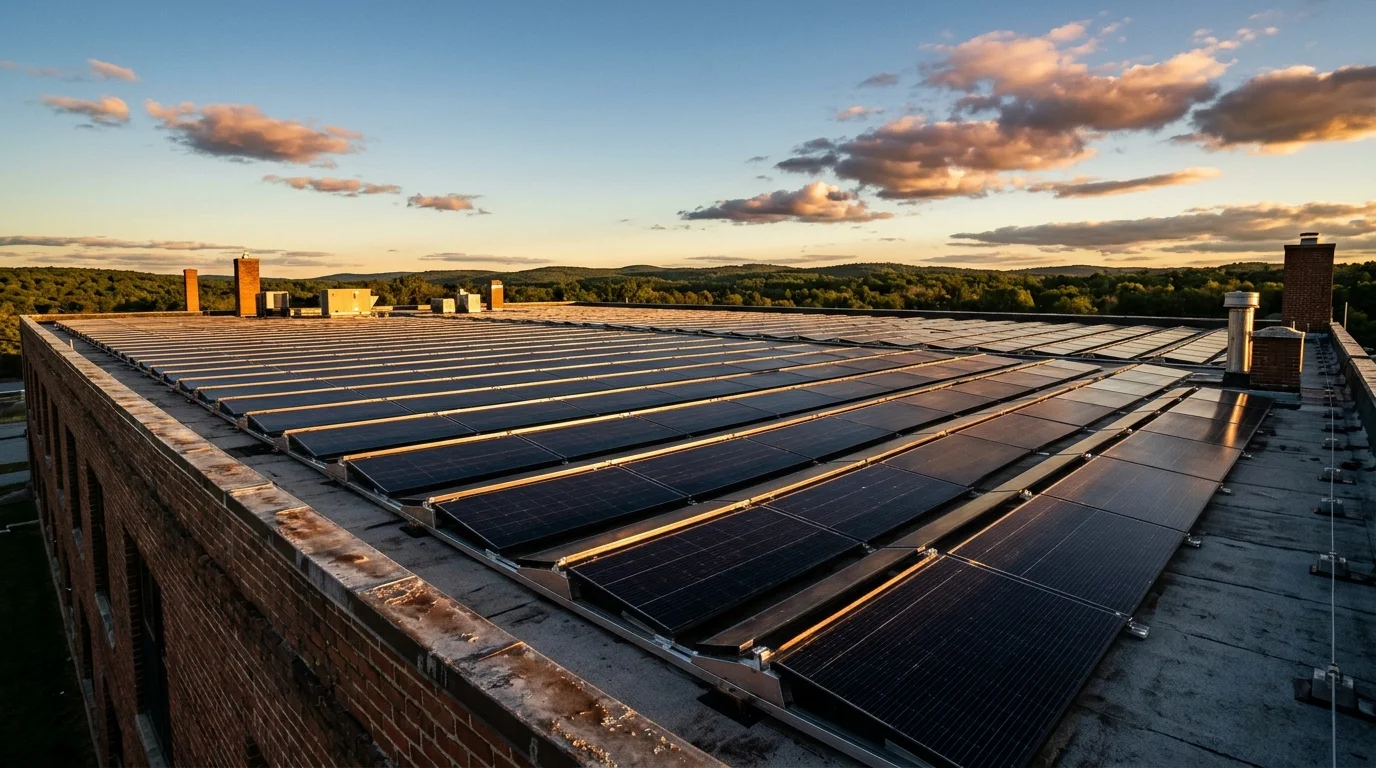
The Green Bank is also moving on the supply side. In November 2026, it completed a 1.4 MW installation at the Connecticut Veterans Affairs campus in Rocky Hill, a Solar MAP+ project that required the same EPC-contract infrastructure now being replicated across dozens of sites. Separately, CT DEEP and four New England state partners announced in September 2026 the selection of 102.4 MW of solar across the region, with Connecticut procuring 63.4 MW across three projects under a multistate competitive RFP issued in February 2026. That procurement is a state appropriation mechanism, legally distinct from the Green Bank's Solar MAP+ and from the ratepayer-backed tariff programs extended by Public Act 26-127.
All three of these mechanisms are running simultaneously, and they are not interchangeable. Public Act 26-127 extends and reforms tariff programs. Solar MAP+ finances specific installations through the Green Bank's balance sheet. The DEEP multistate procurement acquires generation capacity to meet the state's greenhouse gas reduction requirements. The federal Solar for All grant, now cancelled, was doing something none of the three state mechanisms was designed to do at scale: subsidizing residential solar leases and multifamily revolving loan funds in low-income and disadvantaged communities. That gap remains open.
The federal deficit is not abstract. Connecticut's new federal solar grant activity amounts to $3.7 million in awards over two years. New York is receiving $163 million over the same period; Massachusetts, $57 million. The disparity is 44-to-1 against Connecticut on the larger comparison. The Green Bank, established in 2011 as the first state-level green bank in the country, was built precisely to function when federal investment underperforms. It is functioning in that role now, but the low-income residential pipeline the cancelled grant was meant to build will require the state to find a different mechanism, or a different funding source, before the ratepayer-backed programs under Public Act 26-127 can reach those communities at anything like the scale Project SunBridge envisioned.
The next signal to watch is whether PURA's community solar successor program, whose procurement plan was due in August, produces a financing structure that can substitute for the cancelled federal equity. The RFP volume suggests the state's procurement apparatus is fully engaged. The question is whether the programs driving that volume reach the households the federal money was supposed to serve.