Thirty pickleball facility solicitations crossed California's public procurement system in a single month, 3.6 times the prior monthly average, and the number understates the real story. The bigger signal is the sustained wave running through 2026: 19 RFPs in May, 32 in June, 29 in October, all well above the 8-to-15-per-month baseline that held through most of 2025. California is in the middle of the largest public pickleball build-out in its history, and the easy phase is already over.
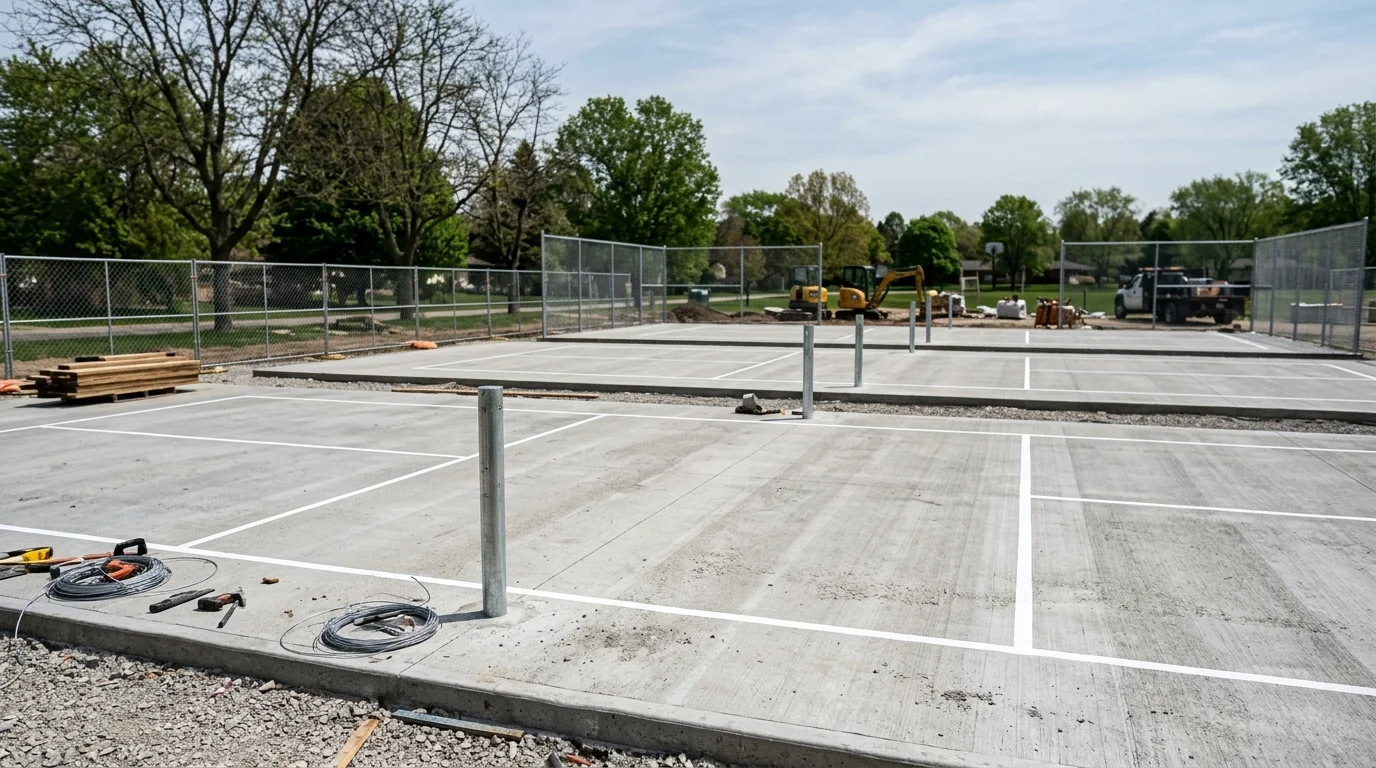
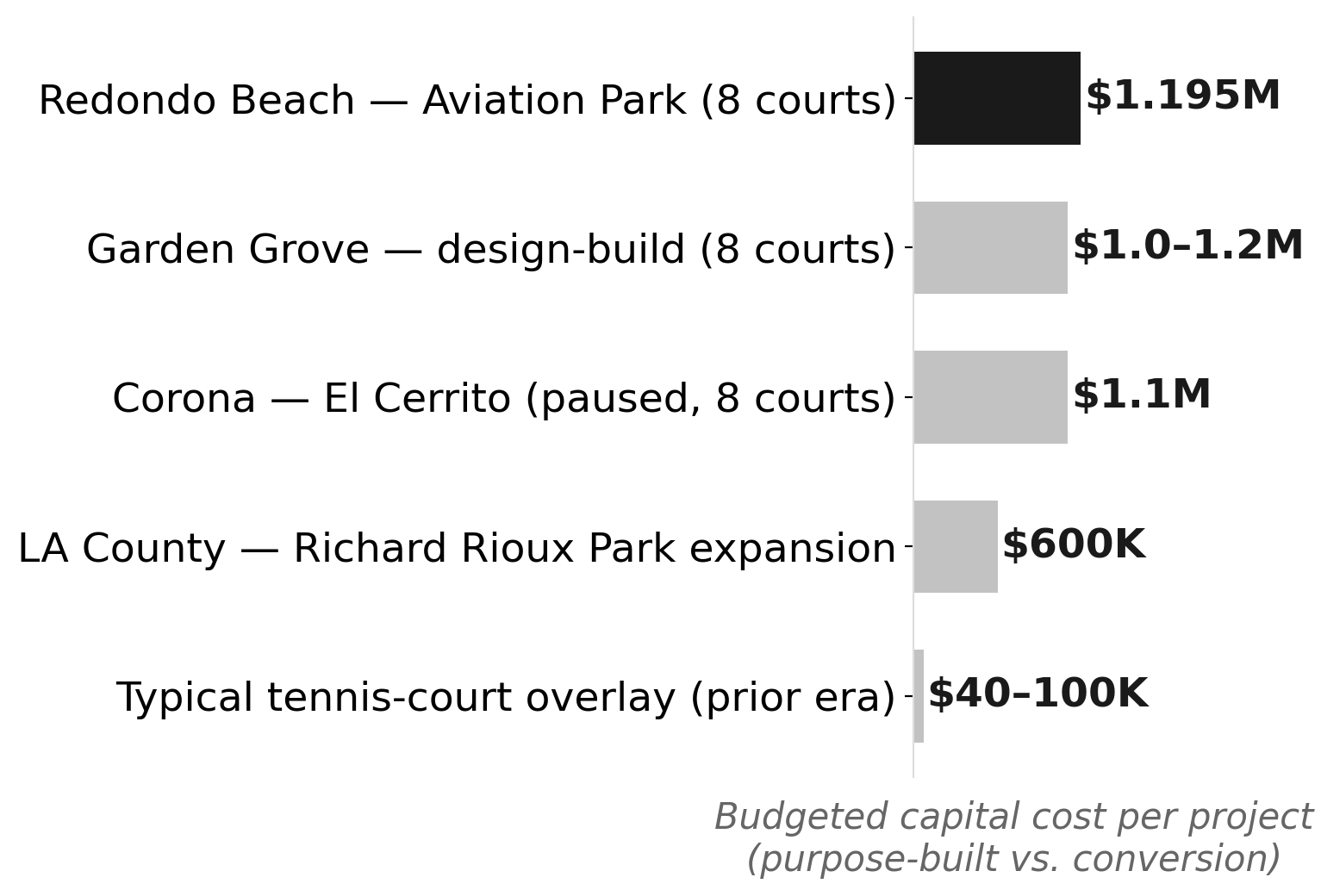
For the first several years of the sport's growth, municipalities could respond with relatively cheap overlays: stripe a tennis court for $40,000 to $100,000, add temporary nets, and declare the job done. Most of those conversions have already happened. What remains in the pipeline is purpose-built construction, and in California's cost environment that means $280,000 to $600,000 per eight-court outdoor complex, sometimes more. Garden Grove is soliciting design-build services for eight courts budgeted at $1 to $1.2 million, with bids due November 2026. Redondo Beach has $1.195 million spread across three fiscal years to build eight courts at Aviation Park. Carlsbad is awarding a construction contract this fall for eight courts across two community parks. These are not overlays. They are capital projects.
Two distinct funding mechanisms are driving the build-out, and they are reaching different kinds of cities. California's Proposition 68, the $4.1 billion parks bond voters approved in 2018, created competitive and per-capita grant rounds that are still disbursing through FY2027-28. That pipeline has enabled smaller and lower-income cities to enter the market. Rialto opened its first dedicated pickleball courts in August 2026, funded by Prop 68 per-capita grants. West Sacramento opened its first courts in July 2026, backed by a $7.8 million Prop 68 Statewide Park Development grant. Loyalton, a Sierra County city of roughly 700 residents, began construction in June 2026 using Prop 68 funds. Without a state grant program of this scale, most of these cities would have no near-term path to new courts.
Source: NationGraph.
Larger cities are moving on a different track: municipal Capital Improvement Program appropriations, funded through general or parks funds and driven by years of organized constituent pressure. Los Angeles County's Board of Supervisors approved $600,000 for a pickleball expansion at Richard Rioux Park in December 2025, with construction awarded in July 2026. Torrance filed a CEQA exemption for eight new courts at Wilson Park and has construction underway. These cities are not waiting for state grant cycles. They are writing checks from their own capital budgets, which is why the surge correlates so closely with the FY2026-27 budget cycle, when pickleball courts became a standard parks capital line item across dozens of city councils simultaneously.
A third, smaller funding stream runs through the federal Land and Water Conservation Fund, administered by California State Parks as a 50% match grant. Ventura applied for a $4.2 million LWCF grant in 2025 to build courts at Camino Real Park, one of the larger single-project asks in the state. The LWCF round moves on federal timelines, separately from both the Prop 68 windows and local CIP cycles.
The 2026 State of the Courts report from the National Recreation and Park Association puts the national context plainly: 43% of parks and recreation departments added or planned to add pickleball courts in 2024-2026, but the report also notes that many of the easy conversions have already been completed and that municipal budgets are constrained. California amplifies both sides of that equation. The state has among the longest pickleball participation histories in the country, so demand pressure is real and well-organized. But California's construction costs are significantly above national averages, so the gap between what residents want and what a city can afford to build is sharper here than almost anywhere else.
That gap is producing visible divergence. Some cities are racing to build ahead of demand; others are pausing to watch the private market. Corona's city council voted to halt a $1.1 million El Cerrito pickleball CIP project after 17 private courts opened nearby, a signal that at least some of the unmet demand is being absorbed by commercial facilities. How many other cities will reach the same conclusion once their own private court inventory grows is an open question.
What's next: Garden Grove's bids close in November 2026, making it the most immediate live procurement to watch. Prop 68 grant windows remain open through FY2027-28, so smaller cities that have not yet received awards could still enter the queue. The more telling signal will come in the spring 2027 CIP season, when city councils decide whether purpose-built courts at $1 million-plus per project still make the cut against competing infrastructure priorities.