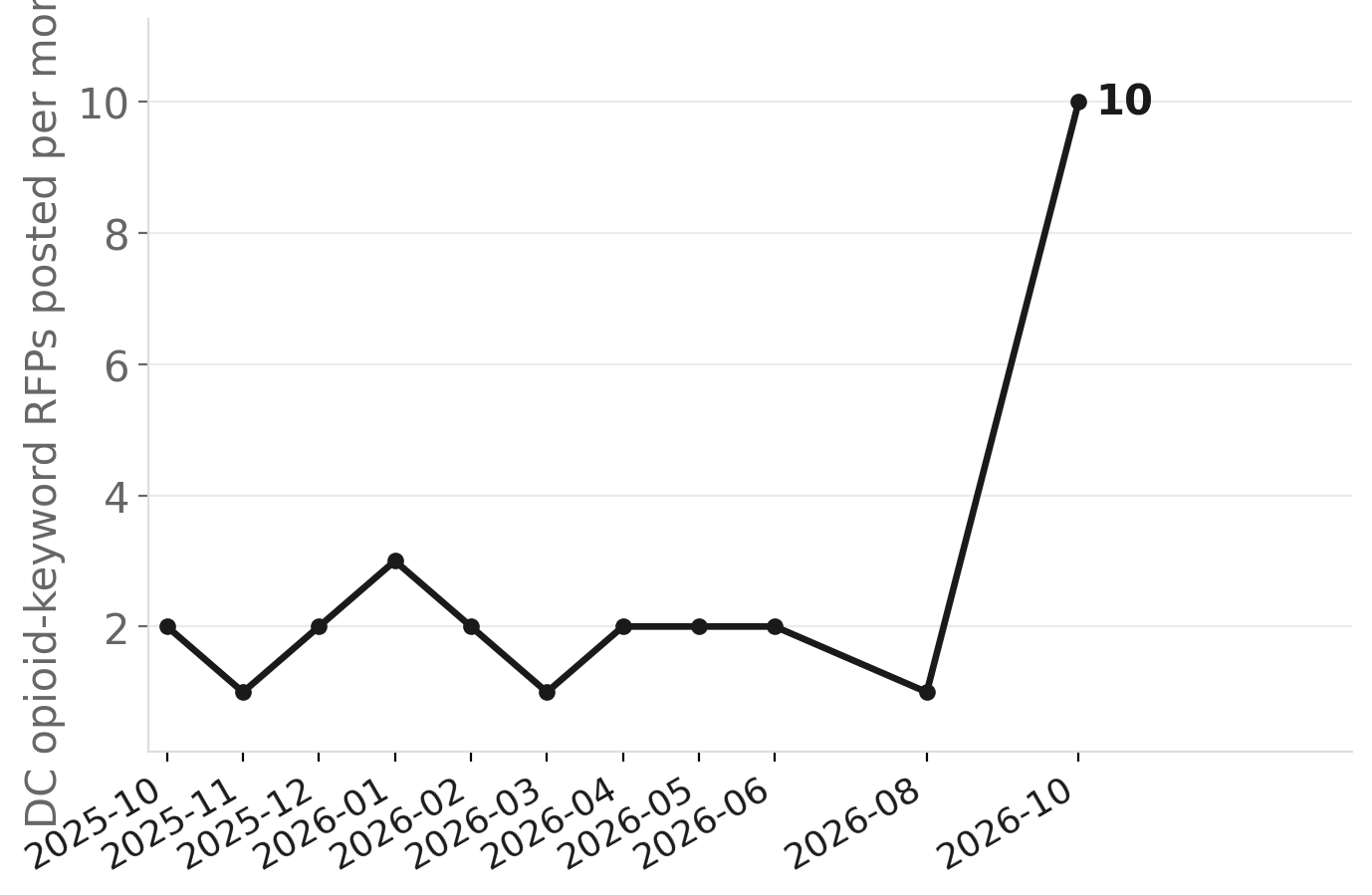
Washington logged 10 opioid-related funding solicitations in the last 30 days, against a monthly average of roughly 1.8 over the prior year, a 5.5-fold surge that reflects a coordinated federal grants push arriving at precisely the moment the District's own government is accused of quietly draining a separate pot of opioid money to pay routine bills.
The two developments are legally and mechanically unrelated, but their collision illuminates something important about how opioid funding actually works in the District.
Eight of the 10 solicitations came from DOJ's Bureau of Justice Assistance, with two more from OJJDP. The batch includes the FY2026 COSSUP Site-Based Program, which offers awards of up to $7 million per jurisdiction for comprehensive overdose response programs spanning law enforcement, prevention, treatment, and reentry. Alongside it: the COSSUP Training and Technical Assistance award (up to $2 million, deadline November 2), Adult and Veterans Treatment Court programs, youth-focused OJJDP initiatives, and Tribal Justice technical assistance grants. Nearly all dropped onto the federal grants portal within a narrow September-October 2026 window, which explains the near-zero RFP count from July through September followed by a nine-unit surge in October.
Source: NationGraph.
The federal pipeline behind these NOFOs is substantial. The FY2026 Labor-HHS appropriations package, enacted in January 2026, allocated $1.6 billion nationally for State Opioid Response grants and $75 million for drug courts. DOJ's treatment-court and COSSUP solicitations are executing against those appropriations now. DC-area nonprofits, treatment providers, law enforcement agencies, and courts are all eligible applicants, though these are national competitive programs, not set-asides for the District.
Separate from this federal competitive stream, the District's government already holds $76.2 million in an active SAMHSA State Opioid Response grant, the single largest federal opioid obligation in DC, running through September 2027. Total active federal opioid grants in DC across all HHS awards reach $103.5 million. That is the formula-allocation channel: money disbursed to DC as a quasi-state entity, with different eligible uses and a different legal framework than the DOJ competitive grants now flooding the portal.
Then there is the third stream, and the one generating the most friction.
DC's expected share of national pharmaceutical opioid settlements exceeds $100 million. Those funds flow into the District's Opioid Abatement Fund, governed by DC Code §7-3221, which requires the money to "supplement, and not supplant" general-fund expenditures on addiction services. The FY2027 budget, which the DC Council passed in June 2026 and which was pending congressional review, proposes directing roughly $7.8 million from that fund toward Medicaid contributions and addiction treatment centers that were historically covered by the general fund.
Chad Jackson, chair of the District's Opioid Abatement Advisory Commission and himself in recovery, called the maneuver illegal supplantation. More than 80 individuals and 30 organizations signed a protest letter. DC Council Health Committee Chair Christina Henderson and DC Attorney General Brian Schwalb jointly demanded a written legal justification from DBH Director Barbara Bazron by July 31. DBH spokesperson Denise Reed defended the budget as legally certified and noted that the funds at issue support 17 community-based providers who served approximately 9,800 residents last year.
The legal question turns on what "supplant" means in practice. If the District had previously funded those 17 providers through the general fund and is now substituting settlement dollars in their place, freeing up general-fund appropriations for other purposes, that is textbook supplantation under the statute. The District's position is that the settlement funds directly support abatement activities and therefore comply with the law's intent. The disagreement is not merely procedural: DC depends heavily on settlement dollars and federal block grants to sustain its behavioral health infrastructure, and the "supplement not supplant" restriction exists precisely because jurisdictions under budget pressure face strong incentives to do exactly what DC is accused of doing.
For DC residents who use or work in addiction treatment services, the stakes are concrete. If the settlement funds are ruled improperly diverted, the 17 community-based providers currently funded through the abatement account face a funding cliff. If the diversion stands, the abatement fund shrinks by $7.8 million in year one, and the precedent is set for future budget cycles.
The next signal to watch is whether DBH provided a satisfactory legal response to Henderson and Schwalb after the July 31 deadline, and whether congressional reviewers, who retain authority over DC's budget, raise the supplantation issue during the review window. On the federal side, the COSSUP Site-Based deadline has passed, but the COSSUP TTA deadline of November 2 remains open, and DC-area applicants are still in the running for treatment-court and youth-program awards. Whether new competitive federal dollars actually reach District residents depends on who applies, and whether local providers have the grant-writing capacity to compete while their existing funding base is under dispute.