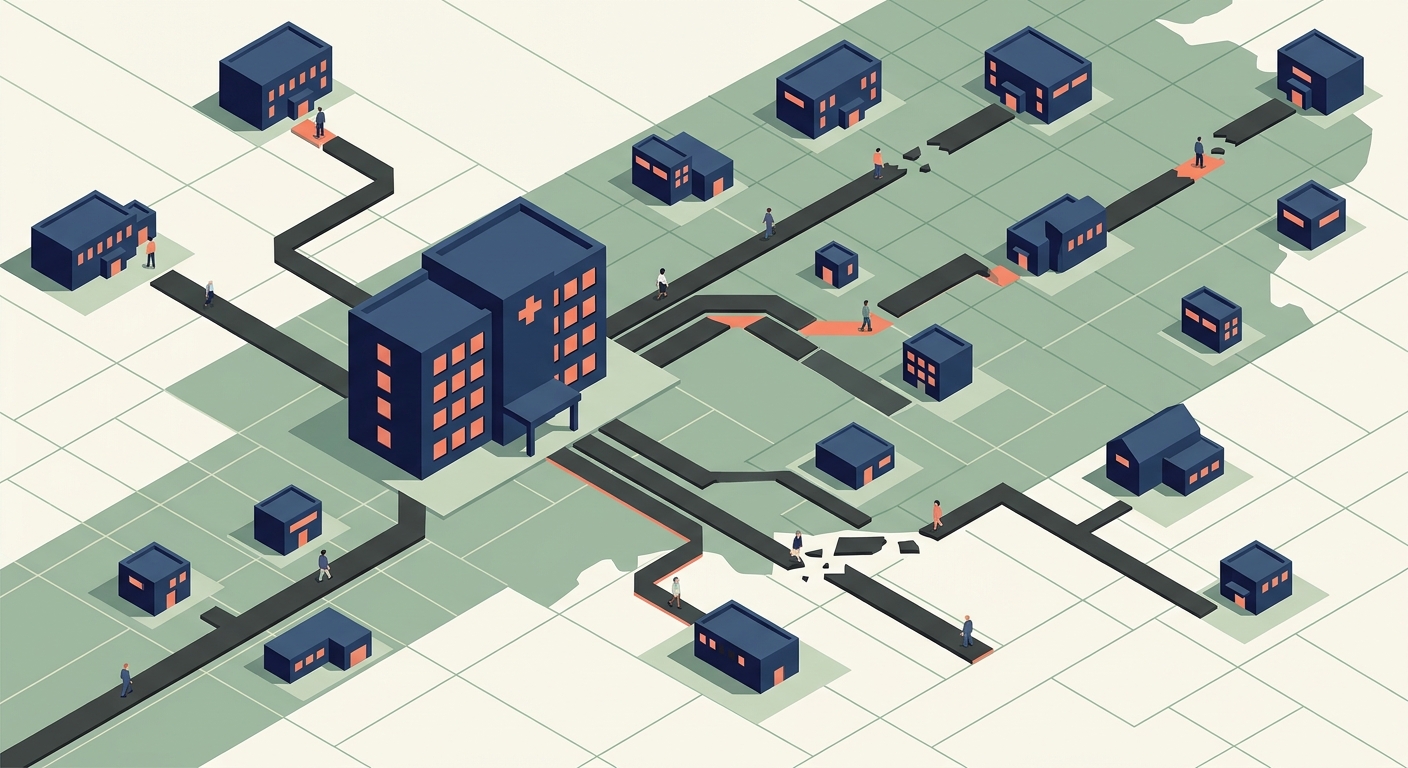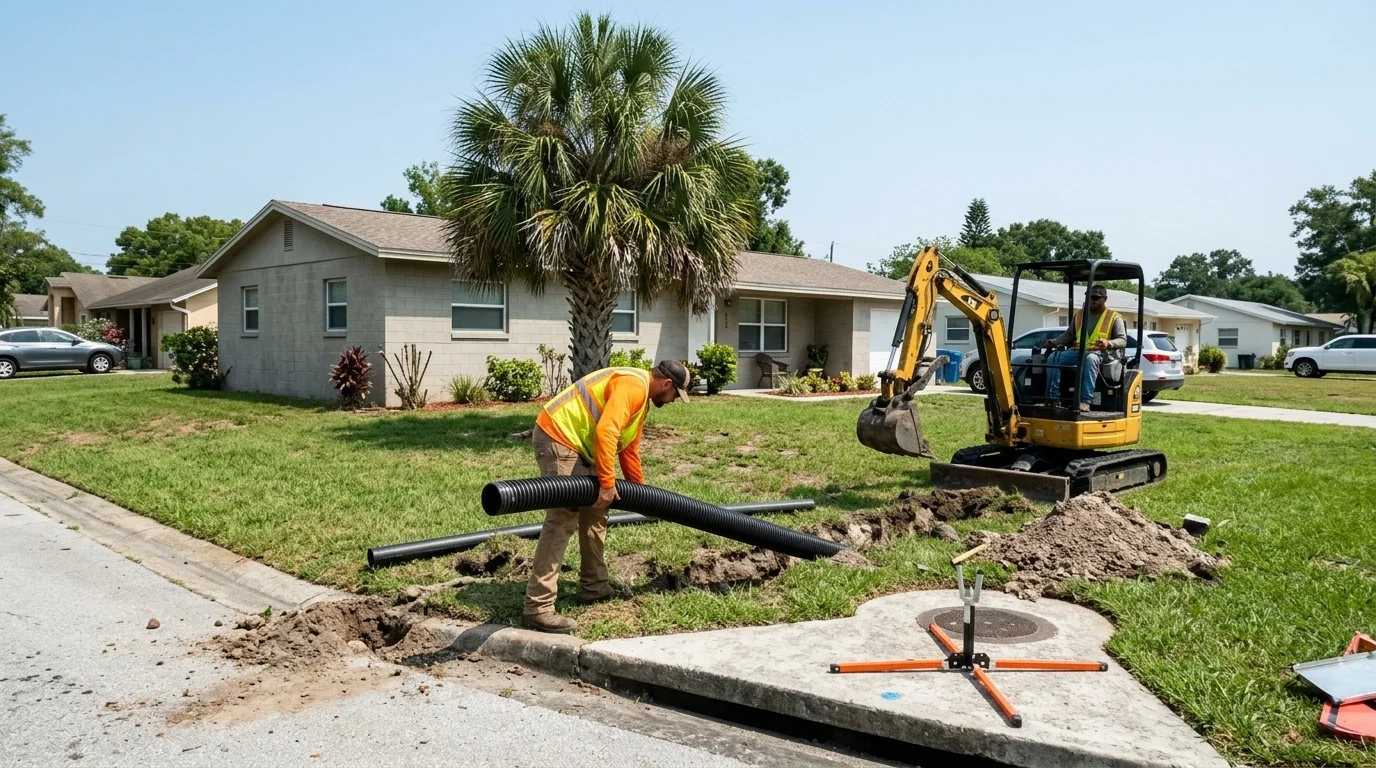
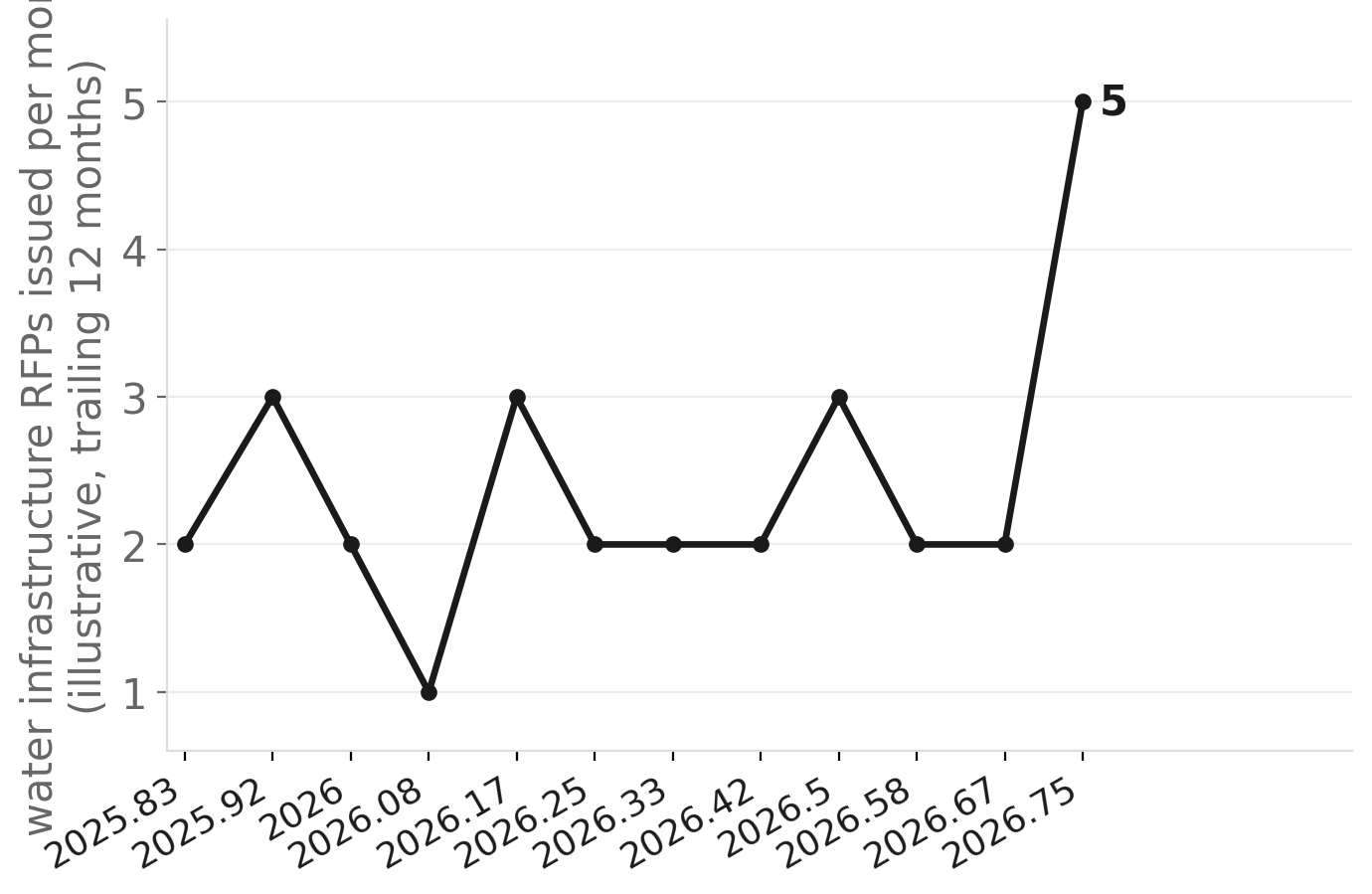
Indiana issued five water infrastructure RFPs in the last 30 days, against a trailing average of roughly 2.2 per month, a 2.3x spike that reflects not a new announcement but years of accumulated federal funding finally becoming construction contracts.
The towns doing the bidding are not the ones that typically make headlines. Fairview Park in Vermillion County. Spurgeon in Pike County. South Whitley in Whitley County. These are small, often rural communities that cannot receive federal community development money directly from HUD and must compete through Indiana's Office of Community and Rural Affairs instead. Many of their water systems date to before 1980. Some face lead service line exposure; others are contending with PFAS contamination from agricultural and industrial runoff. What they share is that they spent the last one to three years securing grants, and are now, simultaneously, required to spend them.
Two distinct federal mechanisms are driving the procurement surge, and they should not be confused with each other.
Source: NationGraph.
The first is OCRA's Wastewater and Drinking Water program, a HUD-sourced federal block grant that OCRA administers as competitive construction awards capped at $750,000, exclusively for non-entitlement communities under 50,000 in population. OCRA awarded $10.2M to 15 communities in March 2026 and followed with $14.2M to 19 rural communities on August 12, 2026, two of the largest CDBG water rounds Indiana has run. The program is the single largest line item in OCRA's 2026 Annual Action Plan at $13M allocated. Grant agreements attach milestones: preliminary engineering report approval, an IDEM construction permit, and a competitive bid, all within a defined window. Miss the window, lose the award. Fairview Park's RFP, currently in market for a water storage, wellfield, and distribution rehabilitation, is traceable directly to its $750,000 CDBG award from that March round. The gap between announcement and shovel is the story.
The second mechanism is the EPA Drinking Water State Revolving Fund, administered not by OCRA but by the Indiana Finance Authority. The DWSRF is a separate program entirely: EPA capitalization grants that the Authority re-deploys as low-interest loans to public water systems of all sizes. Indiana Finance Authority holds $340.4M in newly-committed DWSRF grants with 2025 start dates, including a $135.8M base capitalization grant and a $25.5M WIIN Emerging Contaminants grant targeting PFAS remediation. The SFY2026 Intended Use Plan, posted June 2026, sets lead service line replacement and PFAS remediation as the top two loan priorities for the fiscal year ending June 30, 2026, a deadline that compresses procurement into the current window. Loan recipients who have reached project readiness are moving to bid. The larger-city entries in the current RFP cluster, including Fort Wayne's chemical supply contract and CSO compliance work in Mishawaka and Elwood, reflect this track.
The contamination pressure behind both programs is not theoretical. Indiana American Water returned nearly $25.5M in PFAS litigation settlement credits to customers in 2026, a concrete sign that exposure claims are being resolved financially even as the physical remediation work is still going out to bid. PFAS is present in Indiana groundwater serving communities well beyond those served by Indiana American Water, and the DWSRF's emerging contaminants tranche exists specifically to fund that remediation at the utility level.
Indiana's overall EPA water grant portfolio stands at roughly $504.6M across 49 active grants, a substantial number, but it trails Illinois at $592M and Ohio at $586M in recent DWSRF commitments. That gap gives Indiana both room and incentive to push deployment faster. The state's track record on grant absorption is solid, it ranks among EPA's recognized leaders in watershed restoration outcomes, but absorbing a grant and putting pipe in the ground are different tasks. The current RFP activity is where the second task begins.
For residents of the communities now advertising bids, the practical meaning is straightforward: the contractor selection process is live, construction timelines are being set, and the water system upgrades that were promised when grant awards were announced are entering the phase where delays become costly. For observers watching Indiana's broader infrastructure posture, the next signal to watch is whether the August 2026 CDBG round's 19 awardees begin reaching procurement readiness at a similar pace over the next two to four quarters, which would extend this elevated RFP rate well into 2027.