Michigan counties issued 7 opioid-related RFPs in the last 30 days, twice the trailing 12-month average of 3.4 per month, and the counties doing the spending are largely the ones the state recently named as laggards. The cause is not a sudden worsening of the overdose crisis. It is a public accountability report.
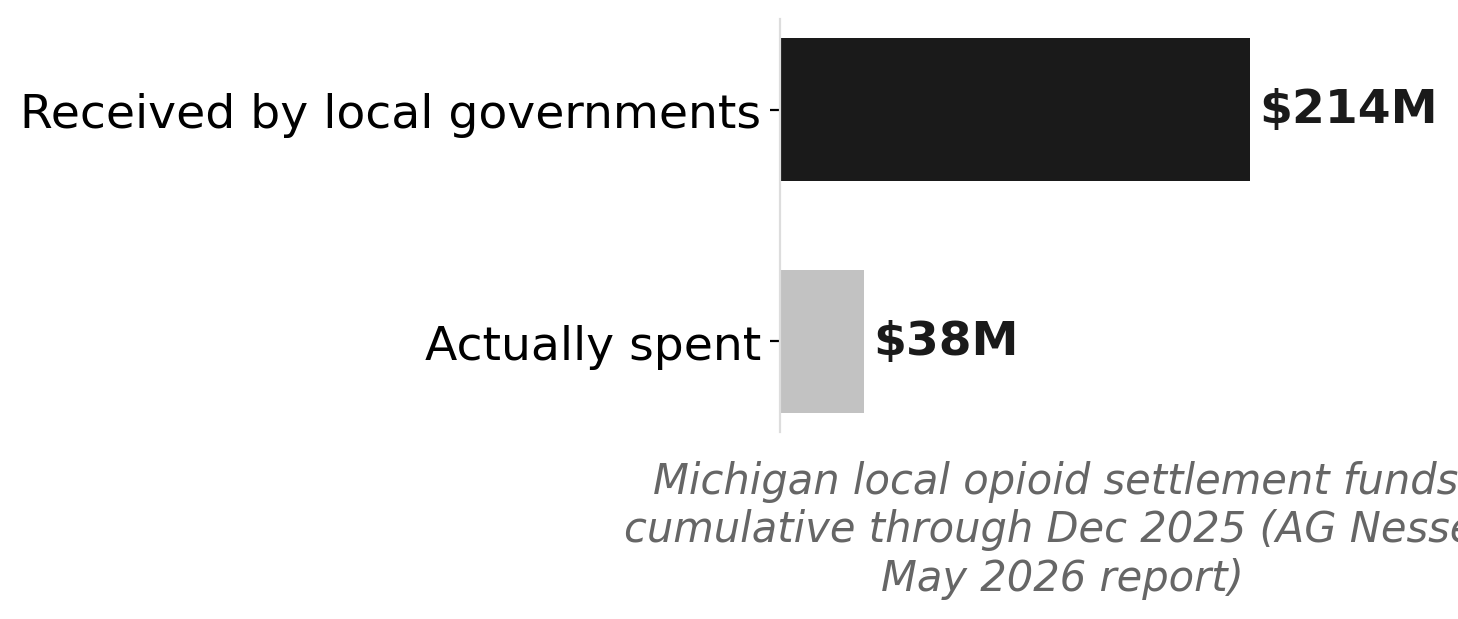
As of December 2025, Michigan's local governments had received $214 million in national opioid settlement funds and spent $38 million of it, 17.7%, according to Attorney General Dana Nessel's May 2026 Opioid Settlement Spending Guidance and Report, the first of its kind the state has ever released. Twelve counties, concentrated in northern Michigan and the Upper Peninsula, had spent nothing at all. That left roughly $176 million sitting in local government bank accounts while overdose deaths continued.
Nessel's report named the non-spenders explicitly. That naming created political pressure that years of crisis headlines had not. Within weeks of publication, procurement activity accelerated. The 7 RFPs issued in the past 30 days match the highest monthly totals in the trailing 13-month window, figures also reached in December 2025 and February 2026. Ohio, Indiana, Wisconsin, and Illinois combined issued only 3 opioid RFPs in the same period.
Source: NationGraph.
The counties now posting RFPs include Gratiot, Chippewa, and Midland, mid-size and rural jurisdictions that appear on the underperformer map, alongside Ingham and Berrien, which are issuing two RFPs each. The geographic spread is meaningful. These are not the state's largest urban counties, which have more administrative capacity and moved earlier. They are the counties that needed the most pressure to build a procurement process from scratch.
Two forces converged to produce this moment. The first is the AG's report itself. The second is the budget calendar. Michigan counties begin their FY2027 budget cycles with an October 1 start, which means competitive grant decisions that feed into next year's spending plans have to be made now. The revised State-Subdivision Agreement, finalized in July 2025, also tightened the timeline: counties must now file bi-annual spending reports by September 30 and March 31, with the first September 30 deadline already passed. A county that has not issued an RFP has little to report.
It is worth keeping the three funding streams separate, because they work differently. The RFP surge is driven almost entirely by the local government share of the national opioid settlements, funds distributed directly to Michigan's 258 local government units, each of which must run its own competitive procurement to grant money out for remediation activities. At least 70% of those funds must go toward treatment, recovery housing, harm reduction, or prevention under the settlement's terms. That decentralized structure is why procurement is happening at the county level rather than flowing through Lansing.
Separately, Michigan's FY2026 state budget included $131.75 million from the Opioid Healing and Recovery Fund, a state appropriation administered through MDHHS for substance use disorder programs statewide. And the state holds $232 million in active federal opioid grants, including a $74.2 million SAMHSA Opioid STR award running through September 2027, less than half of which has been disbursed. Those streams are managed at the state level and are not what is driving the county RFP surge, though they fund the service infrastructure that county grantees plug into.
On October 12, MDHHS announced $3.4 million in new Recovery Housing Investment Program grants to 18 agencies and reported awarding more than $12 million in settlement funds to more than 50 agencies over the preceding months. That activity reflects the state share moving. The county share, which is equal in size over the long run, Michigan expects $1.84 billion in total settlement receipts through 2040, split evenly between state and local governments, is what has been slow, and what is now accelerating.
For residents in Gratiot, Chippewa, or Midland counties, the practical consequence is that treatment programs, recovery coaches, and harm reduction services that settlement money was always supposed to fund may finally be put out to bid. Whether those RFPs produce contracts, and whether the services materialize before another reporting deadline forces another round of accountability, is the next thing to watch.
The September 30 bi-annual reporting deadline has now passed. The next one is March 31, 2027. Counties that issued RFPs in the last 30 days will have something to show by then. Counties that did not will face the same public ledger.