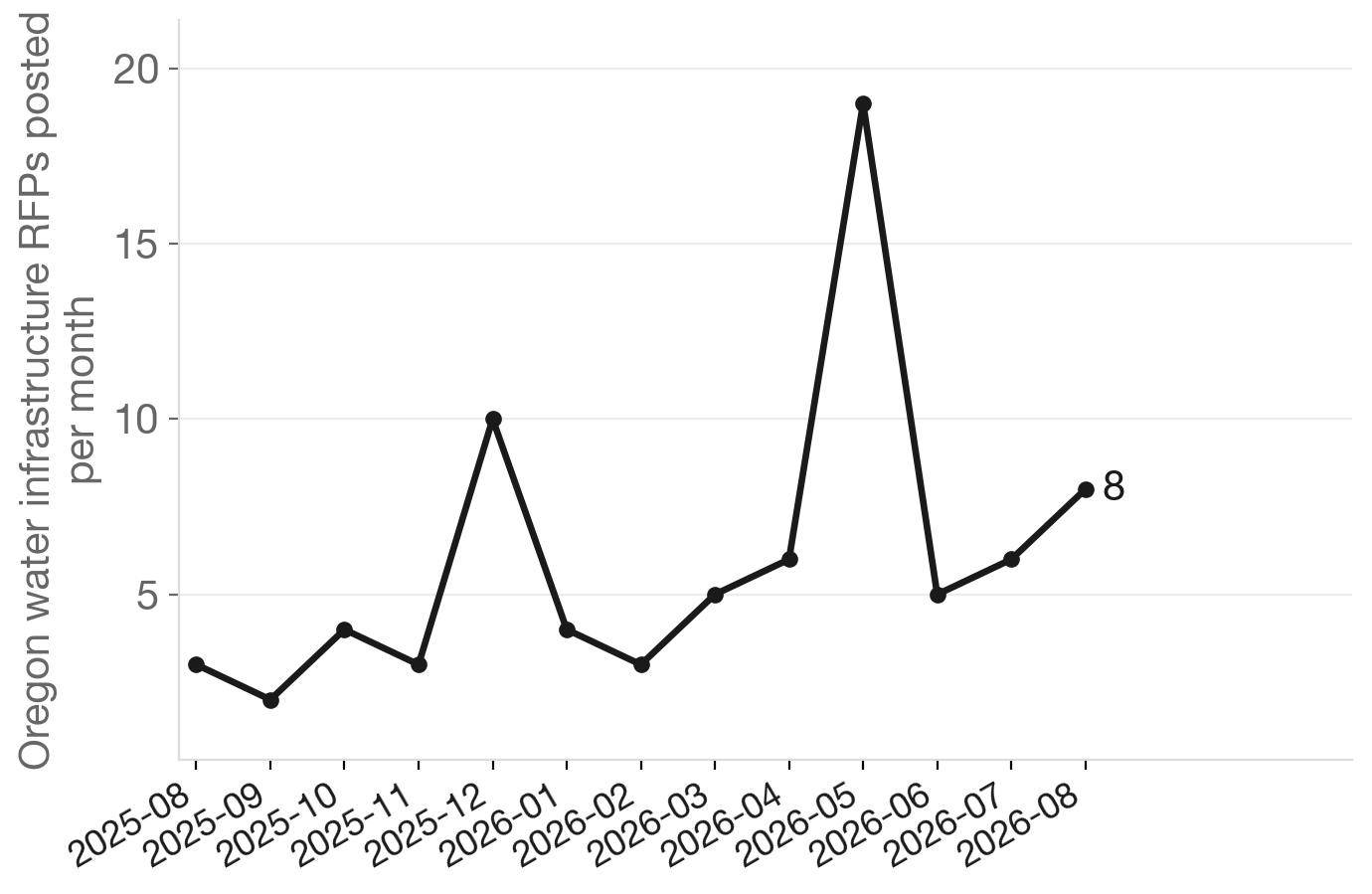
Oregon water utilities have issued 8 infrastructure RFPs in the last 30 days, against a 12-month average of roughly 3.2 per month. That 2.5-times spike is not a seasonal quirk. It reflects something more structural: the simultaneous arrival of three federal pressures that have compressed years of potential procurement activity into a single urgent window.
The most immediate pressure is money sitting unspent. Across 90 active federal water infrastructure grants in Oregon, agencies have obligated $325.7 million but outlayed only $67.7 million, leaving roughly $258 million in committed funds that must be converted into actual pipes, treatment equipment, and meters before grant windows close. The Oregon Health Authority has received DWSRF tranches totaling more than $53 million since April 2025. Oregon DEQ has drawn down an additional $30 million through the Clean Water SRF in the same period. Senators Merkley and Wyden announced a further $37.4 million in EPA Drinking Water SRF funds for Oregon on June 12, 2026. Capital that isn't deployed is capital that goes back.
The second pressure is regulatory. The EPA requires all public water systems to complete initial PFAS monitoring by April 26, 2027, and Oregon has 24 systems already exceeding the 4 parts-per-trillion standard the agency set for PFOA and PFOS. Oregon DEQ reinforced that timeline independently: in April 2025, the agency added six PFAS compounds to its state hazardous substances list, the first such update since 2006. That move means Oregon's compliance clock runs on state authority, not federal, and is not subject to the EPA's proposed extension of the treatment compliance deadline to 2031. For the 24 systems currently out of compliance, the monitoring deadline is fixed, and the procurement lead time to get treatment solutions in place is not unlimited.
Source: NationGraph.
The third pressure is forward-looking. WRDA 2026 cleared the Senate Environment and Public Works Committee unanimously on July 15, 2026, carrying Oregon-specific provisions that include SRF reauthorization at $3.5 billion per year for the Clean Water SRF and more than $3.75 billion for the Drinking Water SRF, plus an Environmental Infrastructure Authority aimed at Willamette Valley drawdown communities. Senator Merkley called the bill's advancement a significant step for Oregon water priorities. Utilities that get projects shovel-ready now are better positioned to draw from the next tranche when it arrives.
The issuing entities in the current surge span the full range of Oregon's roughly 3,400 public water systems. Lincoln City's advanced metering infrastructure rollout and procurement activity from Gresham and Milwaukie represent the urban and coastal end. The most structurally significant RFP in the current window may be the Oregon Health Authority's Drinking Water Infrastructure Needs Survey, a state-level pipeline-mapping exercise that historically precedes a wave of downstream municipal procurements tied to SRF loan disbursements. When OHA maps the need, the loan applications follow.
That timing matters because Oregon's infrastructure is not in a position to defer. The state's drinking water systems carry a C grade from infrastructure assessors, a rating that reflects both aging urban pipe networks in the Willamette Valley and the particular vulnerability of small rural systems, which bear a disproportionate share of the PFAS burden. The $18.9 million WIIN emerging-contaminants grant the EPA directed to OHA was specifically targeted at small and underserved communities, the systems least able to self-finance treatment upgrades and most dependent on the grant windows closing at the right moment.
The monthly procurement time series makes clear this is not a one-month spike. May 2026 saw 19 Oregon water infrastructure RFPs, the highest count in the 15-month window available. December 2025 reached 10. The current 30-day reading of 8 suggests August will hold near recent highs. The underlying cadence reflects utilities working backward from two hard dates: the April 2027 monitoring deadline and the grant expiration schedules that DEQ and OHA are managing in parallel.
For residents of communities like Lincoln City or in the agricultural stretches of Eastern Oregon where nitrate contamination compounds the PFAS problem, the practical consequence is that infrastructure decisions being made in city halls right now will determine what comes out of taps for the next two decades. The procurement activity is visible; the treatment capacity it produces will not be for several years.
The next signal to watch is whether WRDA 2026 clears the full Senate before the end of the fiscal year. A floor vote would trigger the next round of SRF planning cycles and likely push Oregon's monthly RFP count higher still.