Sixty-two Florida government institutions issued a housing procurement request for the first time in over a year during a single 30-day window ending May 25, 2026, a burst of bureaucratic activity that signals two slow-building forces finally hitting the same deadline at the same time.
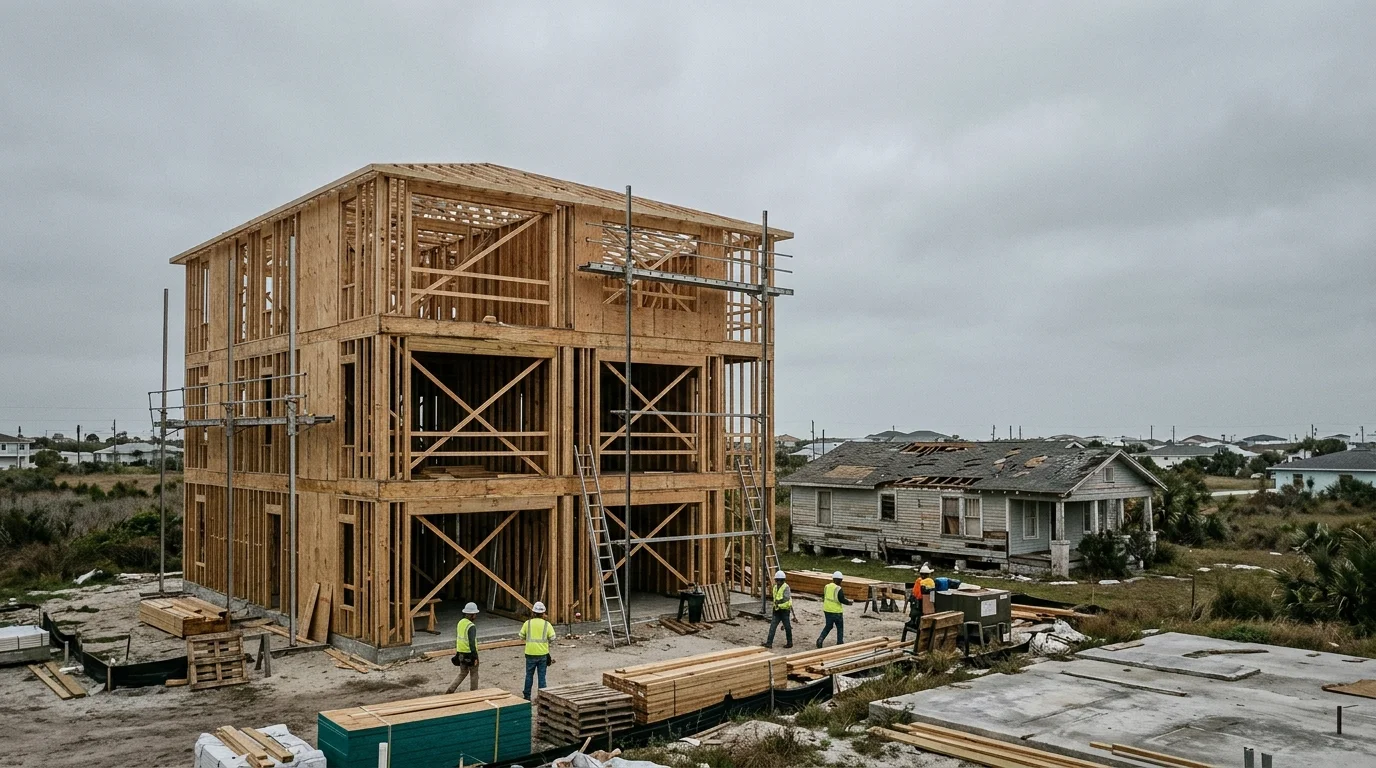
The first force is $4 billion in federal disaster-recovery money. In January 2025, HUD allocated CDBG-DR funds to Florida to address unmet recovery needs from four named storms that struck in 13 months: Idalia (August 2023), Debby (August 2024), Helene (September 2024), and Milton (October 2024). Damages from Helene and Milton alone exceeded $100 billion. The county-level grants that flowed from that allocation are enormous, Pinellas County received $813 million, which the Florida City and County Management Association described as the largest such grant in the county's history; Hillsborough expects $709 million; Pasco received $585 million; Manatee received $252.7 million. Most of those performance periods started in mid-2025. Procurement, the phase where governments actually hire contractors, typically lags grant approval by six to eighteen months. That clock has now run out.
The second force is statutory. Governor DeSantis signed SB 1730 in June 2025, the third strengthening of the Live Local Act's preemption language since the law first passed in 2023, closing loopholes municipalities had used to deny affordable housing approvals. A fourth iteration is advancing in the 2026 legislative session, this time applying preemptions to land owned by counties, municipalities, and school districts directly, which is why Hialeah is now issuing RFPs for multifamily development on city-owned parcels and why Jacksonville has put out a Single-Family Development Program solicitation. For local governments sitting on underused public land, the calculus has changed: build, or face preemption challenges in court.

Source: NationGraph.
The procurement titles clustering in this 30-day window are a direct read-out of those two pressures. Pensacola is soliciting pre-qualified contractors across CDBG, CDBG-DR, SHIP, and HOME programs simultaneously. Nassau County is re-bidding SHIP Rental Housing Development Assistance. Palm Beach County launched a Tiny Homes Transitional Housing pilot funded through opioid settlement dollars. The geographic spread mirrors HUD's own map: institutions issuing RFPs run from Escambia and Bay counties in the Panhandle, ground zero for storm exposure, south through the Tampa Bay region and into Miami-Dade and Monroe. Florida has 47 HUD-designated Most Impacted and Distressed counties from the 2023-2024 storm declarations, and the procurement surge is concentrated in exactly those places.
By volume, Florida's 62 first-time-in-a-year housing RFP issuers in a single month trails only California (111) among large states, outpacing Texas (51), Georgia (47), and New York (43). That gap reflects something structural: no other large state is simultaneously running disaster-recovery disbursement at this scale and a statewide zoning-preemption regime aggressive enough to compel local governments to initiate construction on their own land.
There is a catch embedded in the speed. The Florida Policy Institute has flagged that the Florida Department of Commerce has declined to establish a Homeowner Reimbursement Program, leaving a category of storm-damaged homeowners outside the disbursement pipeline. That gap pushes more unmet need onto county-level programs, which are now the ones racing to hire contractors, and means the construction activity flowing from these RFPs will skew toward rental and multifamily development over direct homeowner repair, at least in the near term.
For Floridians in storm-affected counties, the practical consequence is a construction labor market that is about to get significantly more competitive. Every jurisdiction issuing a CDBG-DR RFP is drawing from the same regional contractor pool, and several of the largest grants, Pinellas, Hillsborough, Pasco, are geographically adjacent. Cost overruns and timeline slippage are the standard outcome when multiple large public clients chase the same subcontractors at once.
The next signal to watch is whether the 2026 Live Local Act expansion, which has cleared committee and is headed for a Senate floor vote, passes before the legislative session ends in May. If it does, the universe of public land eligible for preempted affordable housing development expands substantially, and the RFP volume that spiked in April and May is likely to look modest by comparison.