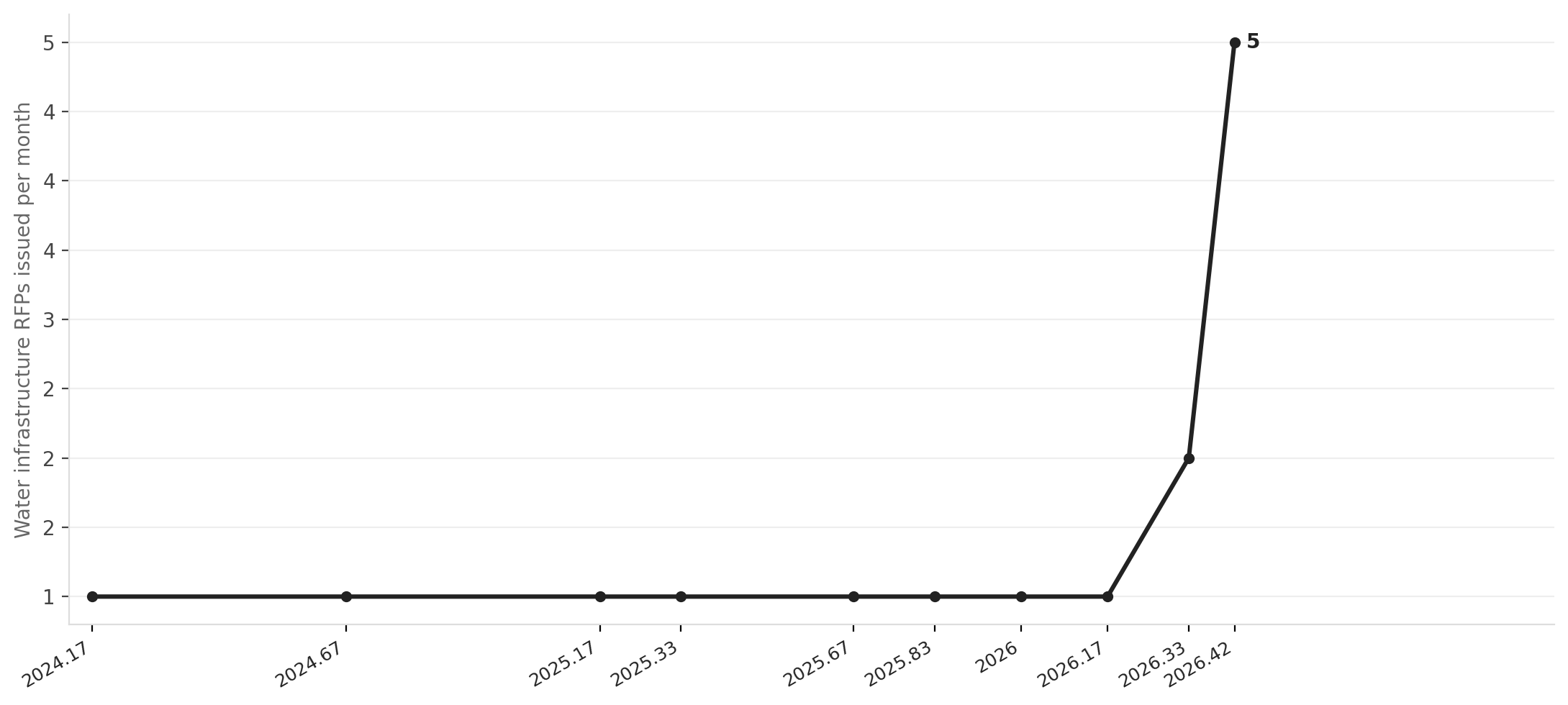
Delaware issued five water infrastructure RFPs in the last 30 days, six times its trailing monthly average of fewer than one, the sharpest single-month procurement spike in a two-year window that showed near-zero activity through most of 2024. The number is modest in absolute terms. What it represents is not: a federal funding pipeline that has been accumulating pressure since 2022 is finally releasing it at the local-government level, and a uniquely Delaware contamination crisis is the force that kept the pressure from bleeding off.
The mechanics of the timing are specific. DNREC opened its 2026 CWSRF and DWSRF project solicitations on January 16, with Notices of Intent due in February. The Water Infrastructure Advisory Council reviewed and approved the resulting Project Priority Lists on March 25. That sequence, from solicitation to priority list approval, is the standard 18-to-24-month journey from a federal SRF commitment to a shovel-ready local RFP, and it maps precisely to the May-June spike now visible in procurement data. The Bipartisan Infrastructure Law has been sending Delaware money since 2022. The RFPs are arriving now because that is how long the pipeline takes.
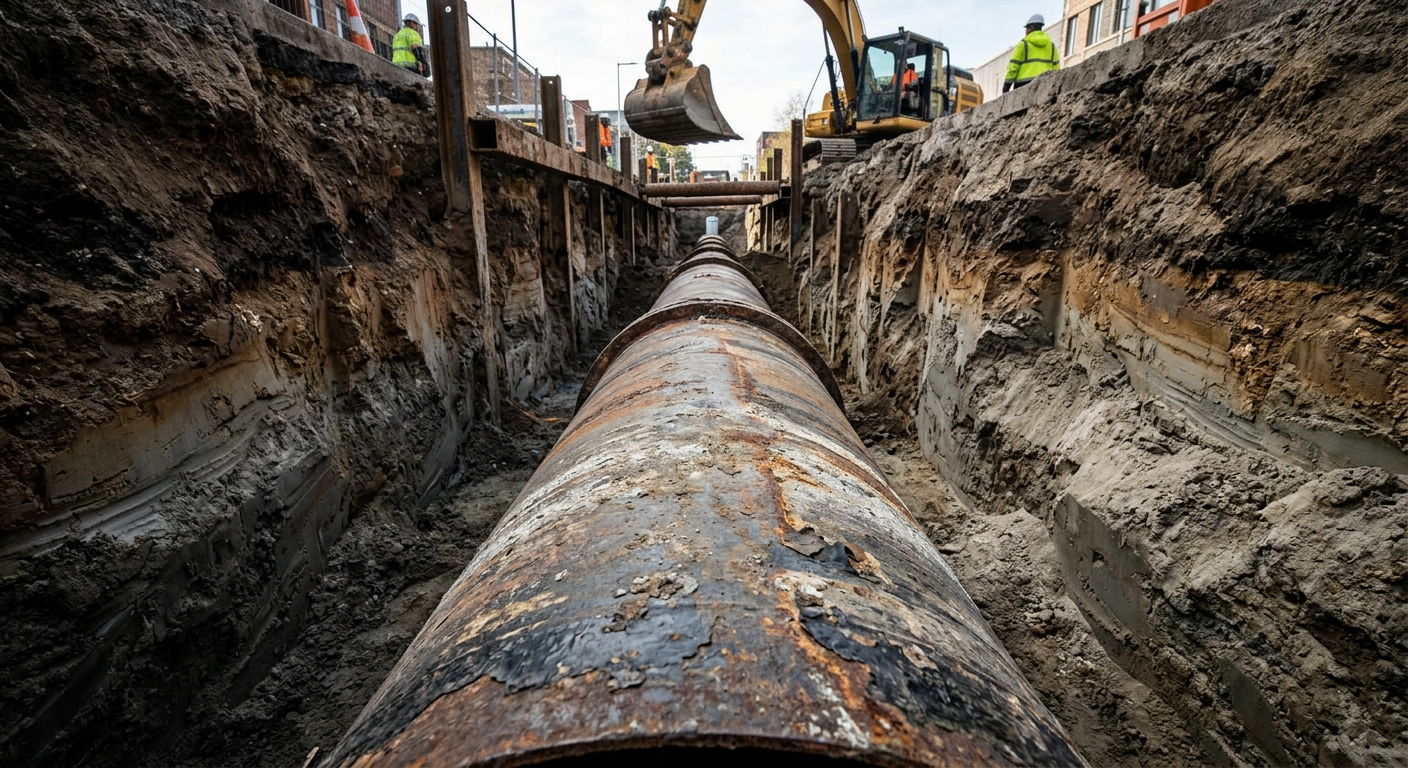
Both projects currently in active procurement sit in New Castle County: Wilmington's 11th Street Dry Weather Pump Station and Newark's Academy Street Storm Sewer Improvements. They represent the leading edge of a much larger queue. Delaware holds more than $216 million in currently active federal water grants across 69 awards, and since 2024 alone the state has taken on $155.5 million in new SRF and WIIN commitments. Of that, $29.3 million comes specifically from WIIN Emerging Contaminants grants, a category that exists almost entirely because of PFAS.
Source: NationGraph.
PFAS is where Delaware's story diverges from every other state running the same federal playbook. DuPont built its chemical manufacturing legacy along the Christina River basin, and its spinoffs Chemours and Corteva inherited both the operations and the liability. The contamination is concentrated in New Castle County, the same geography producing the current RFP wave. In 2021, Delaware's Attorney General reached a settlement with DuPont, Chemours, and Corteva that created a dedicated remediation trust fund, a non-appropriated, non-federal stream of capital for PFAS cleanup that no peer state has access to. That parallel funding structure means Delaware can layer remediation dollars on top of SRF financing in ways that accelerate project timelines and expand what's financially feasible.
The urgency sharpened further on March 31, when DNREC, the Division of Public Health, and the Department of Agriculture jointly released Delaware's first-ever PFAS Implementation Plan, describing a coordinated, science-based approach to reducing contamination risks across drinking water, food supply, and public health. The plan formally designated PFAS removal as a top-tier water funding priority and unlocked the dedicated Emerging Contaminants grant dollars that had been waiting for a policy framework to attach to. For project sponsors who had been watching the solicitation calendar, that March 31 release was a green light.
The 2026 project priority lists confirm that the RFP wave has further to run. The draft CWSRF list includes PFAS removal at Wilmington through a gasification integration project. The draft DWSRF list names PFAS removal equipment at the City of Dover's Porter Plant water source. Dover is the state capital and sits outside New Castle County, which means the procurement activity is not a single-city phenomenon: it is moving south.
For residents of Wilmington and Newark, the immediate change is construction-phase activity on projects that have been in planning for the better part of two years. For residents in Dover and the surrounding Kent County communities, the signal to watch is the DWSRF Porter Plant project moving from the priority list to an actual solicitation, which under the standard SRF calendar would be expected in the second half of 2026. The PFAS Implementation Plan commits state agencies to public reporting milestones, so the next checkpoint will be visible.
The broader question is whether the compression of the procurement timeline holds. The SRF pipeline is a federal-to-state-to-local chain with multiple handoff points where delays accumulate. Delaware has so far moved faster than most states of its size, in part because DNREC has run annual IIJA solicitation cycles without interruption and in part because the DuPont settlement trust removes one of the most common bottlenecks: local match financing. Whether the five RFPs issued this month convert to awarded contracts on schedule, and whether the Dover and Wilmington PFAS projects reach solicitation before the end of the fiscal year, will determine whether this spike is the beginning of a sustained construction phase or a single compressed pulse.