Twenty-six Pennsylvania institutions issued housing-related RFPs in the last 30 days after going more than a year without soliciting a single one, a surge that traces almost directly to a single event: the Pennsylvania Housing Finance Agency's disbursement of $93.4 million in PHARE grants across 432 initiatives in all 67 counties in late June 2026.
The money is now in local hands. The clock is running.
The procurement wave didn't come out of nowhere. Governor Shapiro signed Executive Order 2024-03 in September 2024, directing the creation of a statewide housing plan. That plan landed on February 12, 2026, with 30 strategic initiatives and the explicit goal of closing a projected shortfall of 185,000 homes by 2035. Pennsylvania currently ranks 44th nationally in new housing construction and has more than half its housing stock over 50 years old. The plan was a signal. The PHARE disbursement was a starting gun.
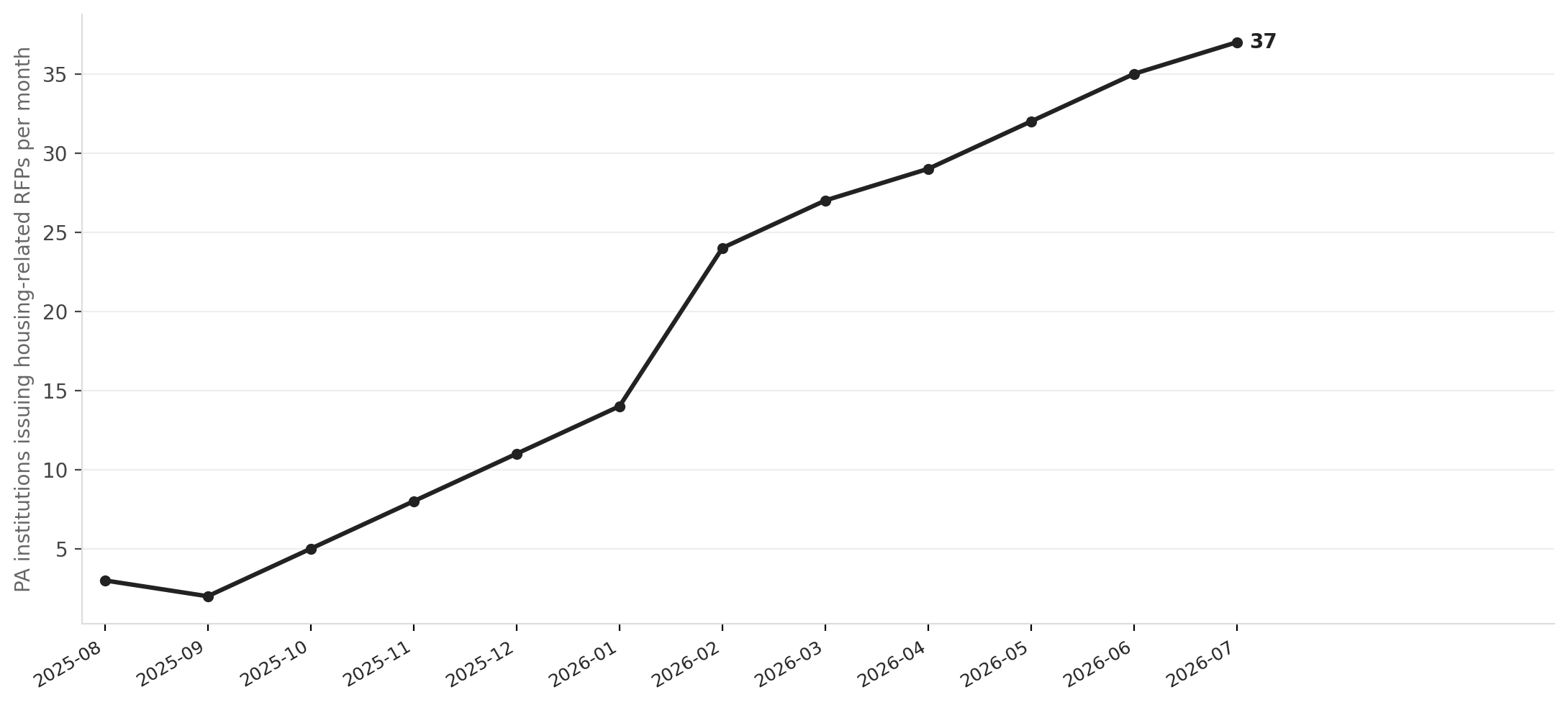
Source: NationGraph.
Monthly housing RFP activity tells the story in stark terms. In August through October 2025, between two and five Pennsylvania institutions per month were active in housing procurement. After the Housing Action Plan's February release, that figure jumped to 24 to 37 institutions per month and has held there. The June grant disbursement pushed it to 26 new entrants in a single 30-day window, many of them agencies that had been dormant in this category for over a year.
The procurement activity is substantive, not ceremonial. The Bethlehem Housing Authority is soliciting developers for Project-Based Vouchers tied to new affordable construction in Northampton County. Monroe County's housing authority, serving the Poconos region, is searching for a developer partner to build affordable elderly housing. Montgomery County Housing Authority is pursuing master leasing arrangements specifically for unhoused individuals with opioid use disorder, a procurement that layers housing policy onto the state's ongoing addiction crisis. And PHFA itself is in the market for new compliance software to manage the growing volume of housing grant programs it administers, a telling indicator that the administrative infrastructure is straining to keep pace with the dollars flowing through it.
The scale of the underlying federal portfolio gives context to why Pennsylvania's housing agencies are now moving with urgency. HUD's active grant portfolio in Pennsylvania totals $2.26 billion across more than 2,000 active grants. On top of that, more than $330 million in new Section 8 voucher tranches flowed to Pennsylvania housing authorities in 2026 alone, with Philadelphia, Pittsburgh, Allegheny County, and Montgomery County among the largest recipients. For agencies holding that kind of federal commitment, failing to demonstrate local execution capacity is not a bureaucratic failure. It risks clawback and deprioritization in the next competitive cycle.
The Shapiro administration's plan is deliberately structured around that competitive pressure. Its design is incentives over mandates: communities that adopt pro-housing zoning reforms and demonstrate deployment capacity get priority access to state funding. That means an agency that moves slowly on its PHARE allocation isn't just losing time. It's potentially losing its place in line when the 2026-27 budget's proposed $1 billion Critical Infrastructure Investment Fund begins allocating dollars. The fund, backed by general obligation bonds, is still working through the legislature, but the competitive queue it will create is already shaping local behavior.
Not everything is moving smoothly at the policy level. As Spotlight PA reported in June 2026, Pennsylvania lawmakers are pushing new housing bills, but local government organizations are actively resisting any state reduction in local zoning control. The plan's incentive structure sidesteps that conflict for now, but it also means the pipeline depends on voluntary municipal cooperation, which varies considerably across 67 counties with different political compositions, housing markets, and administrative capacity.
For a Pennsylvania resident, the near-term implication is that housing projects that have been in planning limbo are about to move into active development phases in a compressed window. Affordable senior housing, voucher-linked new construction, and supportive housing for people exiting homelessness are the categories with the most active procurement right now. Whether those projects get built at the scale the plan envisions depends on whether local authorities can execute their current solicitations before the next budget cycle resets the competitive queue.
The next signal to watch is PHFA's fall 2026 compliance reporting, which will show how many of the 432 PHARE initiatives from the June disbursement have moved from award to active contract. That number will determine whether the current procurement surge is the beginning of a durable build-out, or a single spike that runs ahead of local capacity to absorb it.