Seven cybersecurity solicitations have hit Georgia's public procurement portals in the last 30 days, more than three times the monthly average, and most of them trace back to a single deadline: the federal State and Local Cybersecurity Grant Program is running out of money, and the local governments holding its dollars have to spend them or give them back.
In March 2026, GEMA/HS announced nearly $9.9 million in SLCGP sub-awards to 44 Georgia schools and local governments, the largest single distribution of federal cyber dollars the state has made under the program. Those sub-grantees didn't receive a check and a pat on the back; they received a performance clock. Agencies that sit on grant funds without contracting risk forfeiture. So the solicitations arriving this summer are the mechanical consequence of checks written in the spring.
The most concrete product of that wave is Macon-Bibb County's Next Generation 9-1-1 ESInet and Public Safety Communications Modernization solicitation, RFP 27-006-LH, due August 27, 2026. The county is bidding to replace a 911 infrastructure that, according to the Georgia 911 Authority, has remained largely unchanged since 1968, even as more than 80 percent of calls now arrive from wireless devices that the old system was never designed to handle. An IP-based Emergency Services IP Network would let Macon-Bibb route calls across redundant data paths, handle text-to-911, and eventually integrate video and location data. For a consolidated city-county of roughly 157,000 people, this is not a luxury upgrade: it is the minimum viable infrastructure for a modern public-safety answering point.
Source: NationGraph.
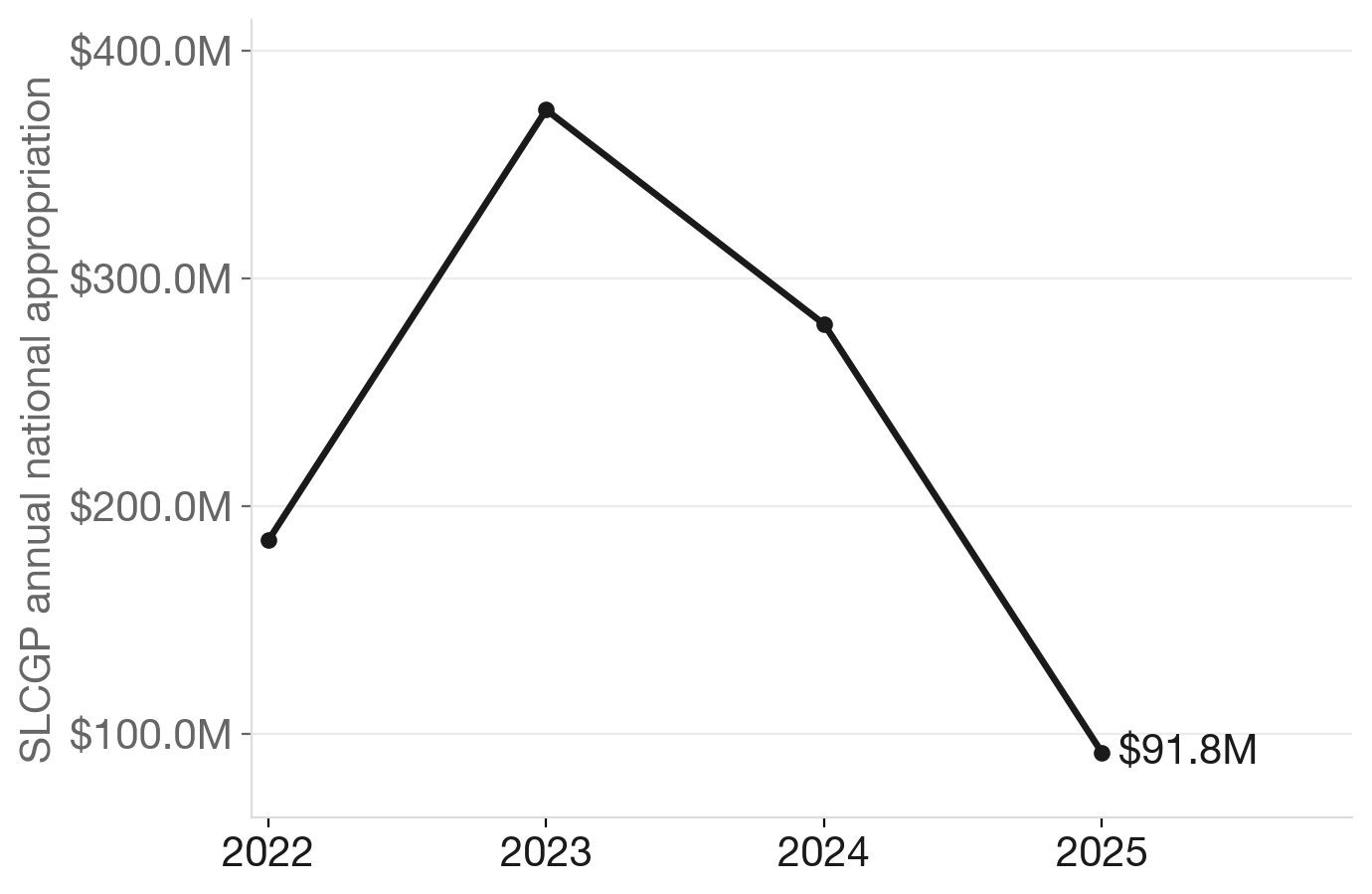
The broader federal picture explains why the procurement window is so compressed. The SLCGP was created by the 2021 Bipartisan Infrastructure Law with $1 billion spread across four fiscal years. That envelope is nearly gone. FY2025 is the program's final tranche, at $91.75 million nationally, down from $374 million in FY2023, a 75 percent reduction in program scale. Georgia's two active SLCGP grants total roughly $10.1 million: $7.59 million from FY2024, running through December 2028, and $2.49 million from FY2025, running through August 2029. GEMA/HS opened FY2024 sub-grant applications on April 1, 2026, and the FY2025 window opens September 1. The summer between those two dates is, in effect, the state's last on-ramp for new applicants before the federal program ends.
Georgia's administrative structure gave it unusual capacity to move quickly. The state runs its SLCGP pass-through through a dual-agency model, with GEMA/HS as administrative authority and the Georgia Technology Authority as technical co-administrator. That arrangement let the state evaluate and distribute sub-grants to 44 entities at once, a volume that would have overwhelmed a single-agency structure. Few peer states built comparable pipelines, which may explain why Georgia landed at the front of the national spend-down curve.
A second federal pressure vector arrived June 2, 2026, when a White House Executive Order directed CISA to expand AI-enabled cybersecurity tools and services to state and local governments. Legal analysts tracking the order note it creates new federal obligations to push defensive technology downward through the intergovernmental system, which could accelerate contracting timelines for state agencies that want to align their purchases with incoming CISA toolsets rather than procure twice. For Georgia sub-grantees already drafting RFPs, the order is both a signal and a complication.
Georgia Tech Research Corporation holds more than $6 million in active Department of Energy CESER cybersecurity grants through 2027, plus roughly $3.2 million in NSF cybersecurity research, giving the state a technical bench that most of the 44 sub-grantees can draw on through existing state relationships. That backstop matters when a county of 157,000 is trying to specify an ESInet without an internal engineering team.
For residents in the counties and school districts that received sub-awards, the summer's procurement activity is largely invisible. What will become visible, over the next 18 to 36 months, is the infrastructure it buys: upgraded 911 switching, hardened network segmentation, endpoint protection for police and fire dispatch systems. The failure mode, if agencies miss their contracting windows, is equally invisible until something breaks.
The next signal to watch is the FY2025 sub-grant application window, opening September 1. How many Georgia entities apply, and how quickly GEMA/HS distributes the remaining funds, will determine whether the current procurement wave is a one-summer event or the first of two. After that window closes, there is no announced successor program at the federal level.