Federal flood grants to Kentucky have reached $8.99 million in the last 90 days, a 1,263 percent increase over the $660,000 recorded in the same window a year ago, and the money is flowing into a region that is already mid-way through spending billions from the last disaster.
The new surge is driven almost entirely by the USDA's Emergency Watershed Protection Program, which awarded Pike County $5.24 million and the Big Muddy Creek Watershed Conservancy $3 million in grants issued by early April 2026. The Kentucky Department of Military Affairs added $757,000 in FEMA Flood Mitigation Assistance funds in the same window. Together, those three awards account for nearly all of the spike.
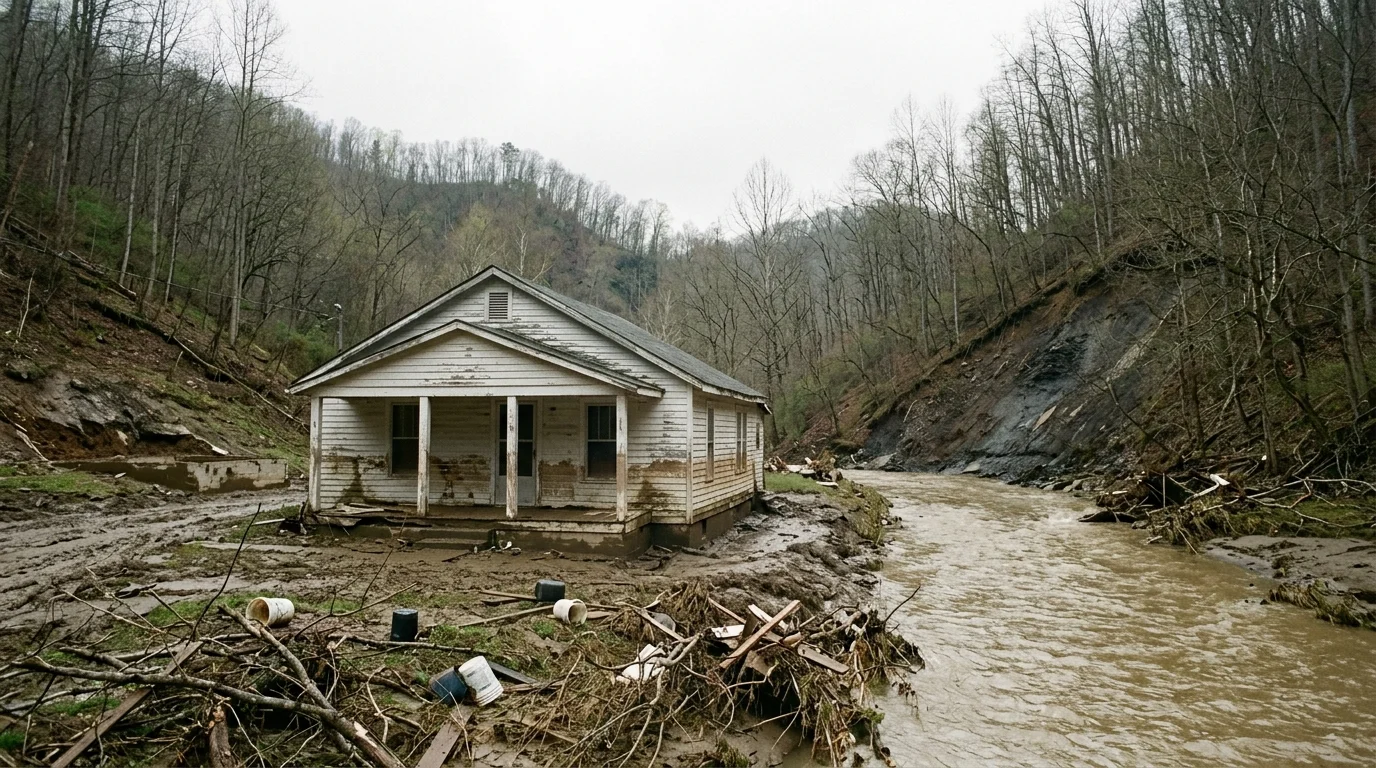
The proximate cause is the February 14-16, 2025 floods, which killed at least 22 people, triggered more than 1,000 water rescues, closed more than 300 roads, and knocked out power for 40,000 residents across Eastern Kentucky's coal-region counties. President Trump approved an Expedited Major Disaster Declaration on February 24, 2025, initially covering 10 counties, that unlocked the federal response pipeline. State Sen. Phillip Wheeler (R-Pikeville) estimated Pike County alone lost 11 bridges and faced $50 million in infrastructure damage from that single event.
Source: NationGraph.
What makes the current moment unusual is the overlap. Kentucky is not recovering from one flood disaster. It is recovering from three federally declared events since 2021, and the funding streams from each are active simultaneously. The USDA's existing EWP portfolio in Kentucky already includes 24 grants totaling $150.9 million obligated since the catastrophic 2022 floods, yet only $19.2 million of that total has actually been disbursed. The bulk of the 2022 money is still mid-flow, with obligation periods running through 2029, even as the 2025 disaster has now seeded its own new grant pipeline on top of it.
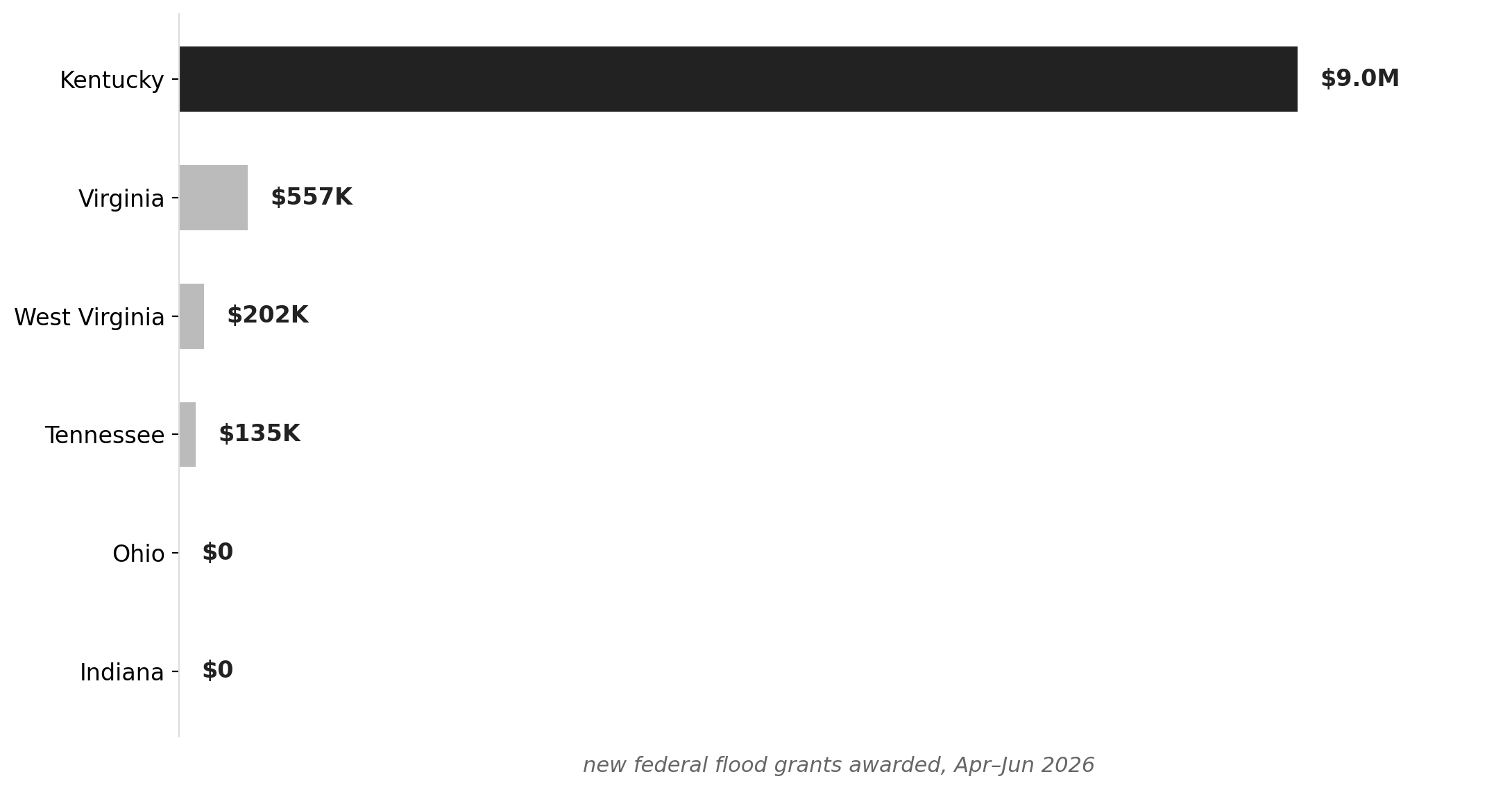
That overlap is structural, not accidental. The NRCS EWP program does not require a FEMA declaration to activate: the NRCS State Conservationist can independently declare a watershed emergency and open a 60-day sponsor application window. That faster trigger is precisely why EWP dollars are showing up in grant databases before many FEMA-channel funds have moved. It also explains why Kentucky's flood grant volume in the trailing 90 days dwarfs every neighboring state combined. Virginia received $557,000, West Virginia $202,000, Tennessee $135,000, and Ohio and Indiana both recorded zero. The geography of the spending matches the geography of the exposure.
The policy response has also shifted in character since 2022. Repair and drainage work remain part of the portfolio, but the dominant model is now buyout and relocation. In October 2025, Gov. Andy Beshear announced a $118.2 million buyout package backed by $106.7 million in federal EWP funds and $11.4 million in state Land Management and Preservation Program bond funds covering the required cost-share. The program targets roughly 600 homeowners across Floyd, Knott, Letcher, McLean, Perry, and Pike counties. Eight new high-ground communities are already under construction in Knott, Letcher, Floyd, Perry, and Breathitt counties to rehouse survivors.
The logic behind that shift is rooted in the region's physical and economic reality. Eastern Kentucky's hollows were developed along floodplains because high ground was scarce and expensive. Steep, historically deforested slopes amplify runoff. Local governments in some of the nation's most economically distressed counties cannot self-finance the kind of drainage infrastructure that would meaningfully reduce flood risk. Repetitive loss properties in narrow river valleys are not engineering problems with engineering solutions, at least not at a cost local governments can bear. Relocation, backed by federal cost-share programs, has become the policy of least-bad options.
For residents still waiting on 2022 buyout closings while their neighbors are newly displaced by the 2025 event, the practical question is sequencing. The $150.9 million already obligated from the earlier disaster is disbursing slowly, as construction of receiving communities, title work, and appraisals move at bureaucratic pace. The new 2025-triggered grants add volume to that queue without necessarily adding processing capacity.
The next signal to watch is how quickly the $118.2 million buyout package announced in October 2025 moves from obligation to actual property closings, and whether the eight new communities under construction can absorb displaced families before another flood season forces the question again. Eastern Kentucky has now had a federally declared flood disaster in 2021, 2022, and 2025. The calendar, not the funding level, may be the binding constraint.