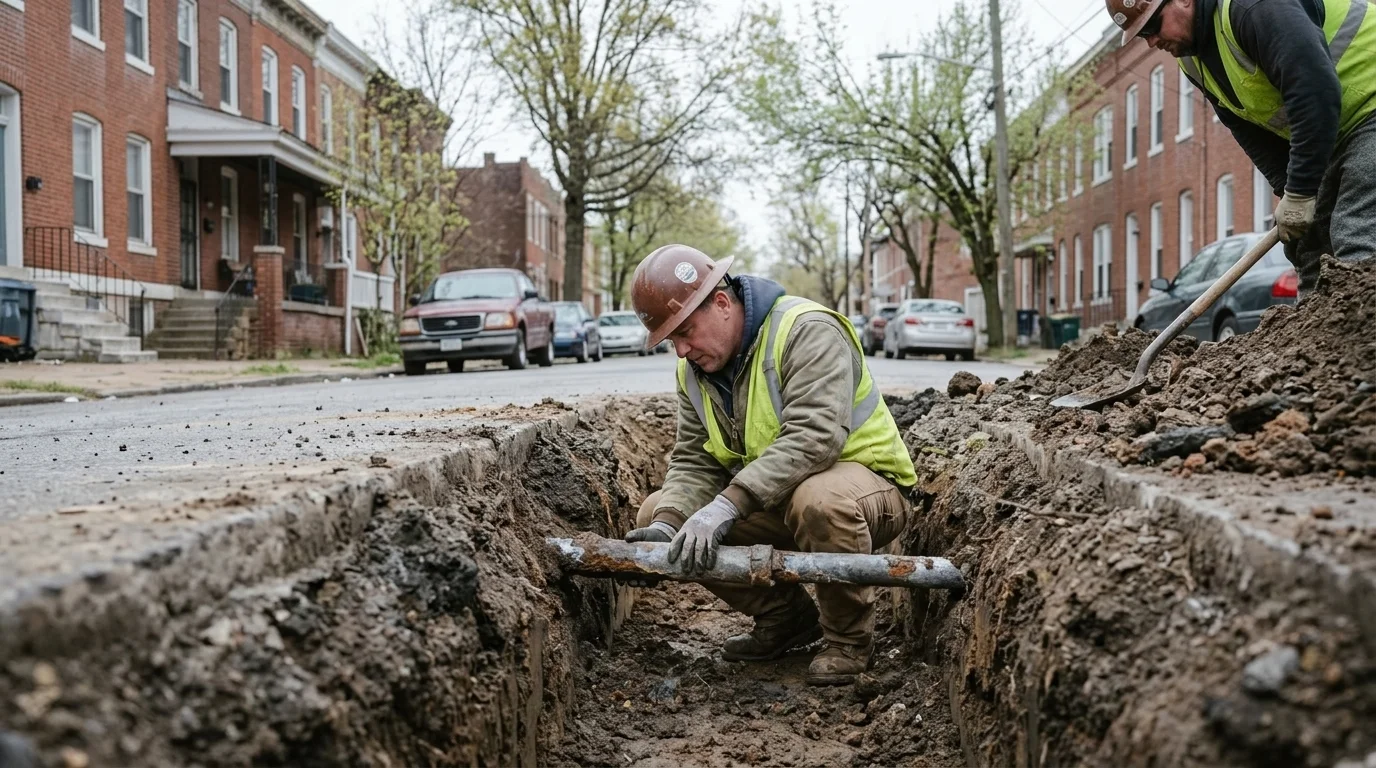
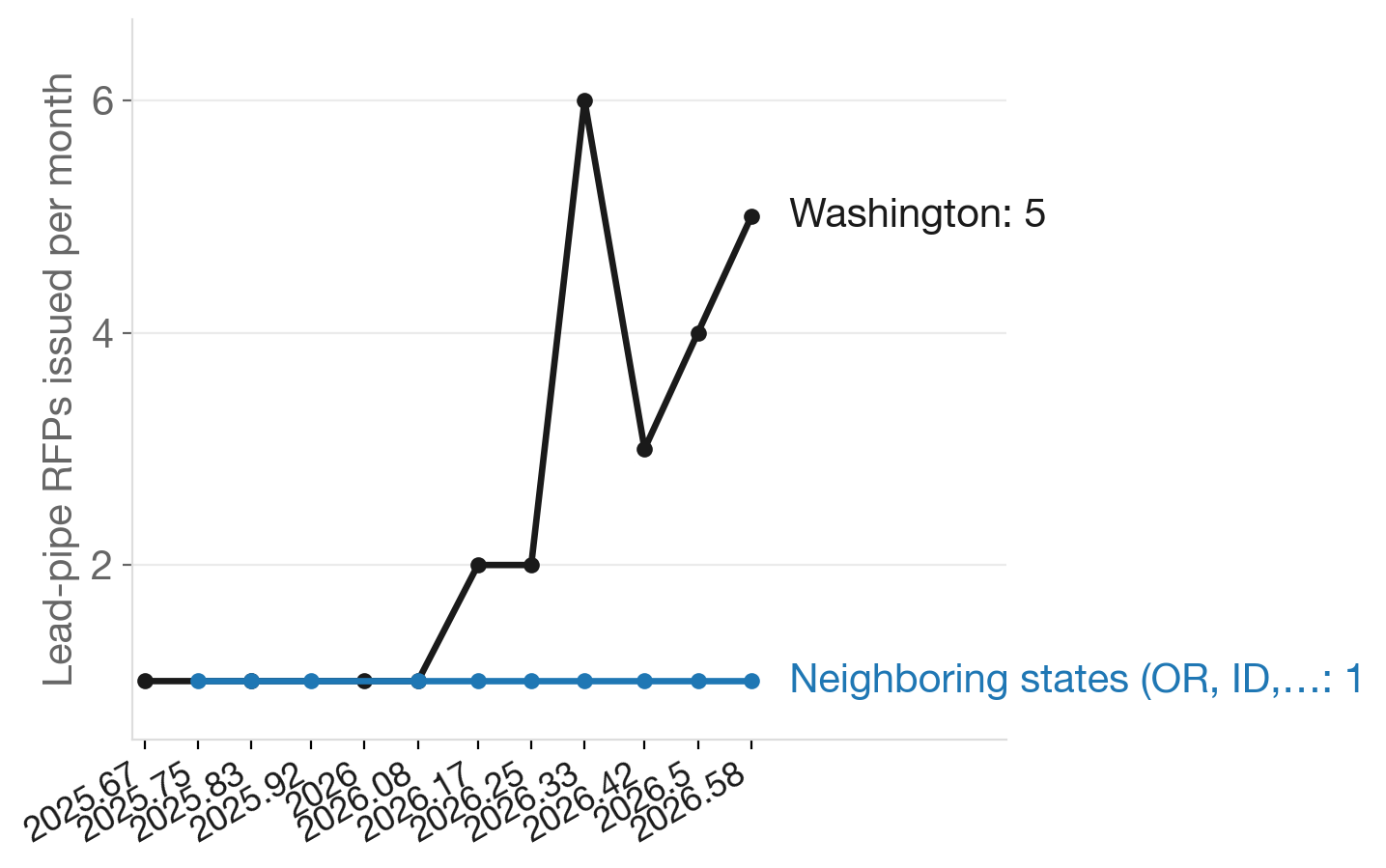
Washington water utilities issued five lead-pipe replacement RFPs in the last 30 days, against a 12-month average of roughly 1.3 per month, a 3.8x acceleration that began almost immediately after a state rulemaking adoption most Washingtonians never noticed.
On July 14, 2026, the Washington State Department of Health formally amended WAC 246-290, the state's primary drinking water regulations, to incorporate the EPA's Lead and Copper Rule Improvements into binding state code. Before that date, the LCRI's most demanding requirement, full replacement of every lead service line within 10 years, regardless of measured lead levels, existed as federal law. After July 14, it also became an enforceable state obligation, with the Washington DOH empowered to compel compliance. The procurement spike followed within weeks.
The immediate pressure point is a deadline that is now less than 16 months away. Under the LCRI framework, water systems must file baseline inventories and written lead service line replacement plans with state regulators by November 1, 2027. That is well inside a typical procurement-to-construction cycle. A utility that has not yet hired engineering consultants or contractors is already behind the timeline needed to have a credible written plan in hand by November 2027, let alone shovels in the ground.
Source: NationGraph.
Washington entered this sprint in a stronger position than most states. By the October 2024 federal inventory deadline, Washington utilities had submitted more than 1,500 lead service line inventories covering 87.6 percent of Group A service lines, a completion rate that gave local systems a working map of where their pipes actually are. Utilities that know their pipe locations can move directly to procurement once they have legal certainty about the mandate. The July WAC adoption provided that certainty.
The funding infrastructure was already in place. Washington DOH holds at least $143 million in active EPA Drinking Water State Revolving Fund grants from IIJA-era appropriations, with multi-year tranches running through 2029 and 2030. Sub-grants have already reached local systems: the City of Seattle received $12 million in DWSRF funds, the Town of Mattawa received $7.1 million, and the City of College Place received $2 million. A separate $2.72 million EPA grant under the Safe Drinking Water Act covers voluntary lead testing and reduction in schools and childcare facilities. According to Washington DOH's lead rule guidance, the state has been building this funding stack since before the federal rule was finalized.
The state-specific nature of Washington's surge is visible in the contrast with neighboring states. Oregon, Idaho, and Montana each logged at most one lead-pipe RFP in any single month over the same 12-month window. No comparable spike. The pattern rules out a national seasonal artifact or a shared regional push. Washington's acceleration is a direct consequence of its own regulatory calendar.
Nationally, the stakes behind these procurement decisions are substantial. The EPA estimates 9 to 9.2 million lead service lines remain in the ground across the country, and the LCRI requires at minimum 10 percent annual replacement pacing to meet the 10-year deadline. As CDM Smith's LCRI analysis notes, the rule represents the most far-reaching lead pipe mandate in U.S. history, affecting systems of all sizes. For Washington utilities that treated the federal rule as aspirational guidance during 2024 and 2025, the July 2026 state adoption removed that ambiguity.
For residents, the practical meaning is this: if your water system has not already mailed you notice of a lead service line on your property, one may be coming. The LCRI requires utilities to notify property owners before replacement work begins, and that notification wave follows directly from the replacement plan filings due in November 2027. Homeowners in older neighborhoods, particularly housing stock built before 1986, when lead solder and lead service lines were still common, are most likely to be in the queue.
The signal to watch next is how Washington DOH handles the November 2027 compliance filings. Utilities that submit credible, funded replacement plans will be in a position to access continued DWSRF tranches. Those that cannot demonstrate a shovel-ready pipeline by that deadline face both enforcement exposure under the newly amended WAC 246-290 and the risk of losing their place in the state's funding queue. The RFP surge suggests the better-capitalized systems already understand which side of that line they want to be on.