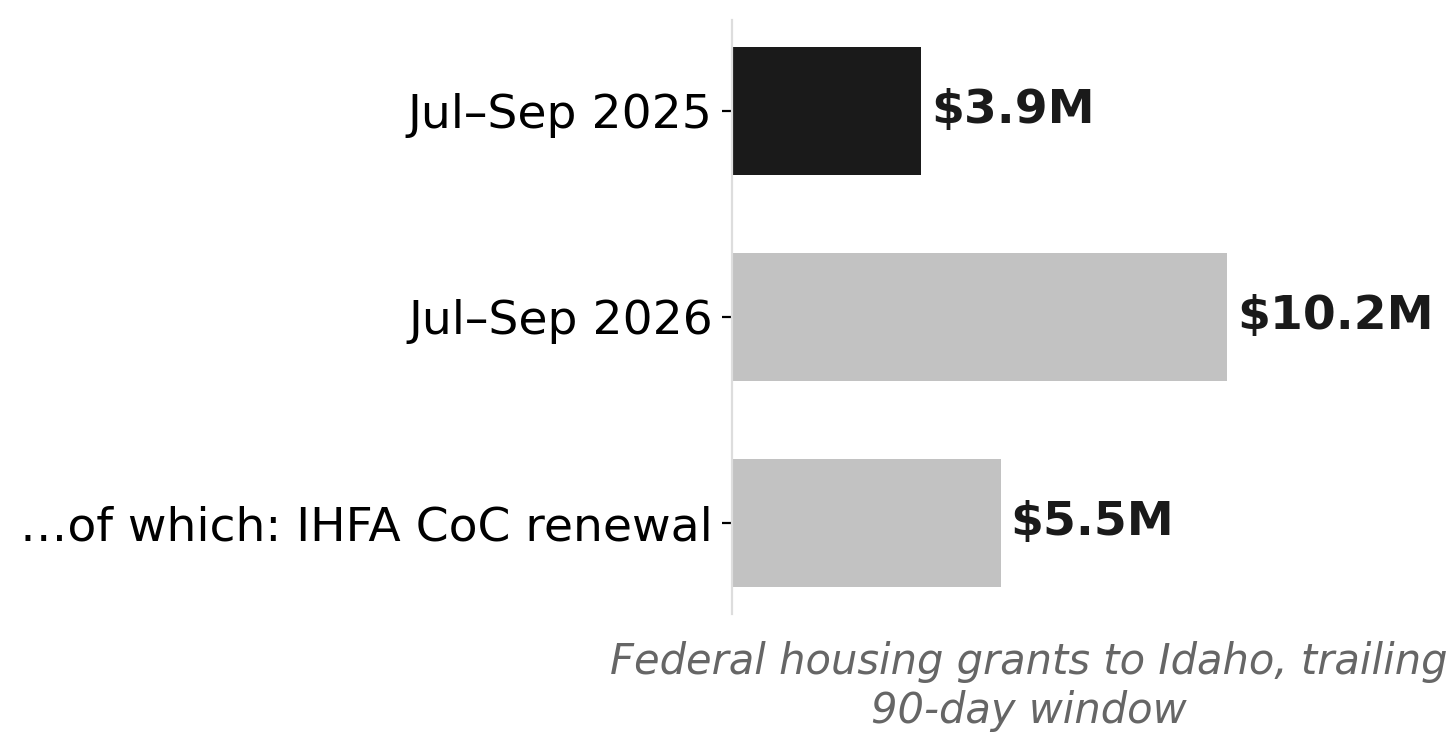
Federal housing grants flowing into Idaho reached $10.2 million in the trailing 90 days, a 161% jump from the $3.9 million that arrived in the same window a year ago. Nearly the entire surge traces to a single source: a $5.53 million Continuum of Care renewal grant awarded to the Idaho Housing and Finance Association, covering the statewide homelessness network known as the House Idaho Collaborative from July 2026 through June 2027. The check is the largest federal housing award Idaho has seen in this window in recent memory. The law that created the conditions for it was filed in federal court six weeks later, with opponents trying to dismantle the framework that will determine whether Idaho can hold onto anything like it going forward.
The mechanism behind the spike is specific. The Consolidated Appropriations Act, 2026 (P.L. 119-75), signed February 3, directed HUD to noncompetitively renew all expiring Continuum of Care grants on a rolling quarterly schedule rather than requiring programs to re-compete. On May 21, HUD released $2.4 billion nationally for projects whose grants were expiring in the third and fourth quarters. Idaho's IHFA award landed in that tranche. In prior years, a statewide CoC renewal of this scale did not exist in this window; the closest comparable was a $1.6 million Ada County Housing Authority award. The mandate changed the math entirely.
That noncompetitive renewal matters especially in Idaho because of how the state's housing infrastructure is organized. IHFA functions simultaneously as the state's housing finance agency and as the collaborative applicant for every county outside the Boise metro area. A single institution routes federal homelessness dollars to emergency shelters, rapid rehousing programs, and permanent supportive housing across a geographically vast stretch of the state. When HUD's renewal formula changes, Idaho has fewer distributed intermediaries to absorb the shock than larger states do, the exposure is concentrated.
Source: NationGraph.
The $5.53 million accounts for most of the 90-day surge, but it is not the full picture. Four Idaho housing authorities, IHFA, the Boise City/Ada County Housing Authority, Southwestern Idaho Cooperative Housing, and the Ada County Housing Authority, collectively received roughly $1.3 million in new Section 8 Housing Choice Voucher disbursements over the same period. The HCV program and the CoC renewal are entirely separate federal instruments: different statutory authority, different application processes, different eligibility rules. The voucher flow reflects formula-based rental assistance to low-income households renting in the private market, not homelessness services. But it arrives against the same backdrop of demand pressure. The Boise City/Ada County Housing Authority's Section 8 waiting list is currently closed, a visible signal that voucher supply is running well behind need in a market where rent inflation has outpaced incomes for years.
Idaho's total active HUD housing portfolio stands at $111.6 million obligated, with $37.9 million outlayed. The new CoC money lands on top of that existing footprint. But the future of the CoC program is now unsettled in ways that the size of the current award does not resolve.
One week after the May national disbursement, HUD released the FY2026 CoC Notice of Funding Opportunity on June 1. The new competitive framework represents a significant departure: it shifts roughly 30 percent of available funds away from permanent supportive housing toward transitional housing, makes more renewal grants competitive, and introduces a scoring criterion requiring client participation in treatment. According to the National Alliance to End Homelessness, the changes represent the most substantial restructuring of CoC incentives in years. A lawsuit challenging the new NOFO was filed July 2, 2026. IHFA, as the House Idaho Collaborative's managing applicant, faces a submission deadline of August 26 under a framework that may or may not survive judicial review.
For Idahoans who depend on the programs CoC funds, people experiencing homelessness, those in rapid rehousing placements, residents of permanent supportive housing units, the immediate effect of the renewal is stabilization. The $5.53 million keeps the statewide network funded through June 2027 regardless of what happens to the new NOFO. The harder question is what follows. If the lawsuit succeeds, HUD will likely need to reissue the competition under revised rules, introducing delays into a pipeline Idaho's safety net cannot afford to have go dark. If the NOFO survives, programs built around permanent supportive housing will need to reorient toward a transitional model to remain competitive, a shift with real consequences for the people those programs serve.
Idaho has no significant state-funded affordable housing production program to fall back on. Federal CoC and voucher dollars are not supplementing a state system; they are the system. The next signal to watch is whether the federal court intervenes before August 26, and what guidance HUD issues to collaborative applicants in the meantime.