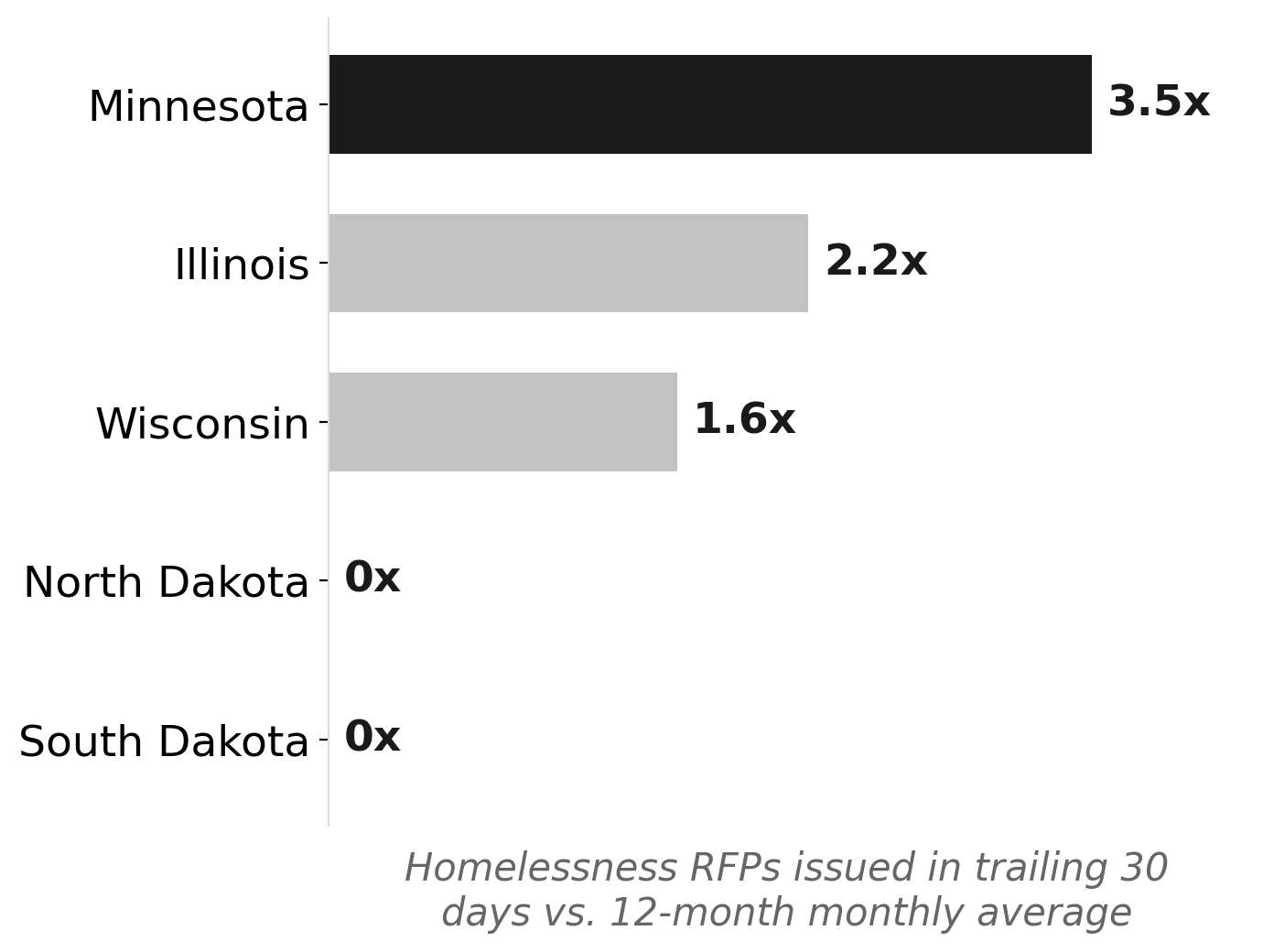
Minnesota issued five homelessness-response RFPs in the past 30 days, against a trailing 12-month average of roughly 1.4 per month. That 3.5x surge is not a statewide scramble, it is concentrated in two agencies, Ramsey County and the Minnesota Department of Human Services, both racing to get state money under contract before a hard December 31, 2026 deadline expires.
The deadline is the story. Minnesota's 2026 Legislature passed a $180.5M housing package that included $40M for the Family Homeless Prevention and Assistance Program, administered by Minnesota Housing, with a mandatory deployment deadline of December 31. That single date is the proximate trigger for three of the five RFPs: Ramsey County issued two solicitations for Emergency Solutions Grant funding (FY2026 and PY2027) and one specifically for FHPAP services. DHS, meanwhile, issued two RFPs for Integrated Support Services under the Long Term Homeless Supportive Services Fund, covering a July 2027 through June 2029 contract period with a potential five-year extension. Together, those two agencies are not just spending money on a deadline, they are sketching the architecture of what a state-funded homelessness system looks like when the federal version is no longer reliable.
The federal version is, at minimum, severely disrupted. The Trump administration rescinded HUD's FY2025 Continuum of Care Notice of Funding Opportunity in late 2025, and a separate HUD rule change slashed guaranteed year-over-year renewal funding from 90% to 30%. Minnesota providers had historically received $43 to $48 million per year through the CoC program, according to Minnesota Housing's own CoC program page. The rule change put approximately 3,000 supportive housing units in the state in legal and financial limbo. As the Duluth News Tribune reported, northeastern Minnesota alone stood to lose 1,600 beds.
Source: NationGraph.
Minnesota AG Keith Ellison joined a multistate coalition that won a federal appeals court ruling on April 2, 2026, blocking HUD's most restrictive eligibility conditions. HUD has since issued partial renewal tranches nationally, $349M in March, $1.09B in April, $2.4B in May 2026, but the injunction does not restore the rescinded NOFO, and providers still face new ideological eligibility requirements tied to anti-camping enforcement, ICE cooperation, and binary-sex definitions that some Minnesota nonprofits cannot meet without restructuring their programs. The litigation has bought time. It has not restored the funding.
The Legislature moved first. In March 2026, before the session's broader housing bill passed, Minnesota enacted Laws 2026, Chapter 43, authored by Rep. Michael Howard (DFL-Richfield), which redirected $13M in existing state appropriations as a bridge specifically for CoC grantees whose contracts expire before December 31, 2026. That program, the Homeless Response System Supplemental Resources Program, is administered by Minnesota Housing and targets the FY2024 CoC cohort most immediately affected by the federal withdrawal. The $13M bridge and the $40M FHPAP appropriation are distinct instruments: the bridge targets expiring federal grantees by name; FHPAP funds prevention and rapid rehousing for households at risk of homelessness more broadly. The DHS Long Term Homeless Supportive Services Fund RFPs represent a third, separate state mechanism, one explicitly designed to build multi-year replacement infrastructure running through 2029, not just to cover the current gap.
No neighboring state is moving at comparable speed. Illinois issued two homelessness RFPs in the same 30-day window against a monthly average of 0.91, Wisconsin issued one against an average of 0.64, and North and South Dakota issued none. Minnesota's exposure is unusually acute because its homelessness-response infrastructure was built around CoC partnerships since the 1990s. The state's decentralized nonprofit and local-government network has little margin to absorb sudden federal withdrawal, and rural Greater Minnesota communities have neither the local tax base nor the philanthropic capacity to self-fund. The Minnesota Homeless Management Information System's 2025 point-in-time count found all-time-high homelessness statewide, with unsheltered homelessness up 145% since 2014, a context that leaves the Legislature with limited political room to wait out the federal courts.
The DHS RFPs, with their 2027-to-2029 contract window, are the clearest signal of how state officials are reading the situation. A one-year bridge suggests officials expect the federal program to return. A multi-year contract with a five-year extension option suggests they are not counting on it.
The next visible checkpoint is December 31, 2026. If FHPAP dollars are not deployed by that date, they do not roll over. Watch for contract awards from Ramsey County and Minnesota Housing in the fall, and for whether the 2027 legislative session extends or expands the DHS supportive services fund based on what the first round of contracts reveals about provider capacity.