Montana has more cattle than people, and the diseases threatening those animals can move fast. The state is deploying $702,498 in federal funding to run disease surveillance across every major livestock species it raises, from the million-plus beef cattle grazing its rangelands to its commercial poultry flocks sitting along two major migratory bird flyways.
The cooperative agreement, administered through the USDA's Animal and Plant Health Inspection Service and received by the Montana Department of Livestock, covers five disease programs simultaneously: cattle, avian, swine, sheep and cervids, and a cross-cutting "One Health" component focused on diseases that can jump from animals to people.
The stakes for getting this right are high. Montana's cattle industry generates more than $2 billion in cash receipts annually, and it is almost entirely export-dependent: most animals are shipped to feedlots and processors in other states, meaning a single loss of disease-free certification can cut off market access overnight. The state has been down that road before with brucellosis, a bacterial disease that persists in bison and elk around Yellowstone. Montana regained its brucellosis-free status in 2010 after years of costly surveillance and testing requirements, and maintaining that status requires continuous monitoring of livestock near the Greater Yellowstone Area.
Source: NationGraph.
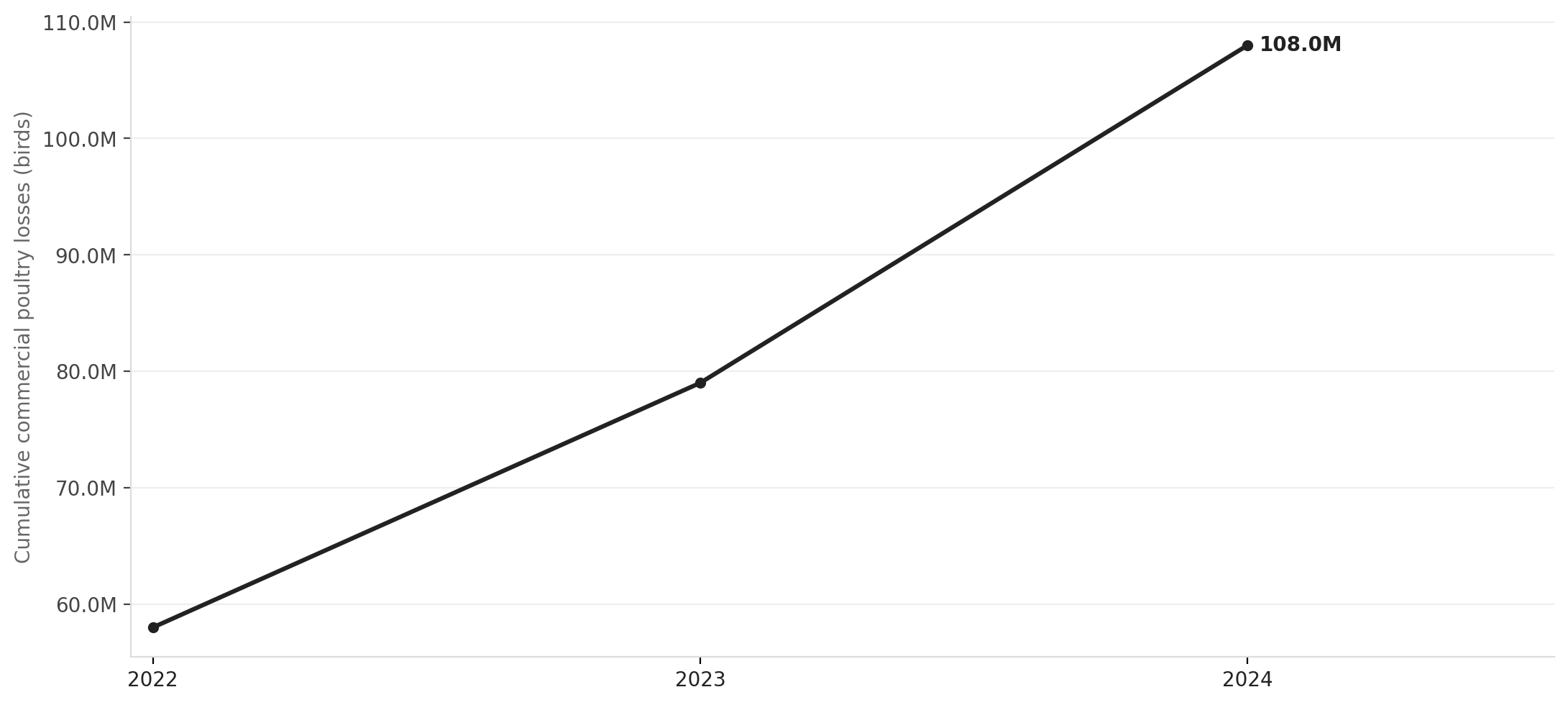
But brucellosis is only one concern on a long list that has grown considerably in recent years. The cattle program also watches for tuberculosis and bovine spongiform encephalopathy. On the avian side, the outbreak of highly pathogenic avian influenza that began in 2022 has killed more than 100 million commercial birds across the country and has cost billions in losses and federal indemnity payments. Montana saw confirmed cases in wild birds and poultry during that wave. Then in 2024, H5N1 jumped to dairy cattle in an unprecedented development that put every cattle-producing state, including Montana's roughly 20,000 dairy cows, under a new kind of scrutiny. Similar federal surveillance investments have been made in states like Indiana and Arkansas as the threat has widened.
For swine, the looming concern is African Swine Fever, which has devastated pig populations across Asia, Europe, and the Caribbean since 2018 and has not yet reached the U.S. mainland. A single confirmed case would likely trigger an immediate halt to American pork exports, a market worth more than $7 billion a year. Montana's swine sector is relatively small, but federal surveillance requirements apply regardless, and the program covers Classical Swine Fever and pseudorabies as well.
In the cervid program, Chronic Wasting Disease is the primary target. The prion disease, which kills deer and elk with no cure, no vaccine, and no reliable live-animal test, was first detected in Montana's wild deer in 2017 near Philipsburg. It has since spread to multiple hunting districts, threatening a hunting economy that generates hundreds of millions of dollars annually for rural communities.
The One Health component ties it together: it funds outreach to ranchers and the public about zoonotic disease risks, and it trains state and partner personnel in the Incident Command System, the emergency management framework used to coordinate large-scale responses. That kind of preparation matters in a state covering more than 147,000 square miles with ranching operations spread across remote terrain.
The funding covers the 2026 fiscal year. Whether Montana's coverage levels prove sufficient will depend partly on what the disease landscape looks like by year's end, a question that has grown harder to predict with each passing season.