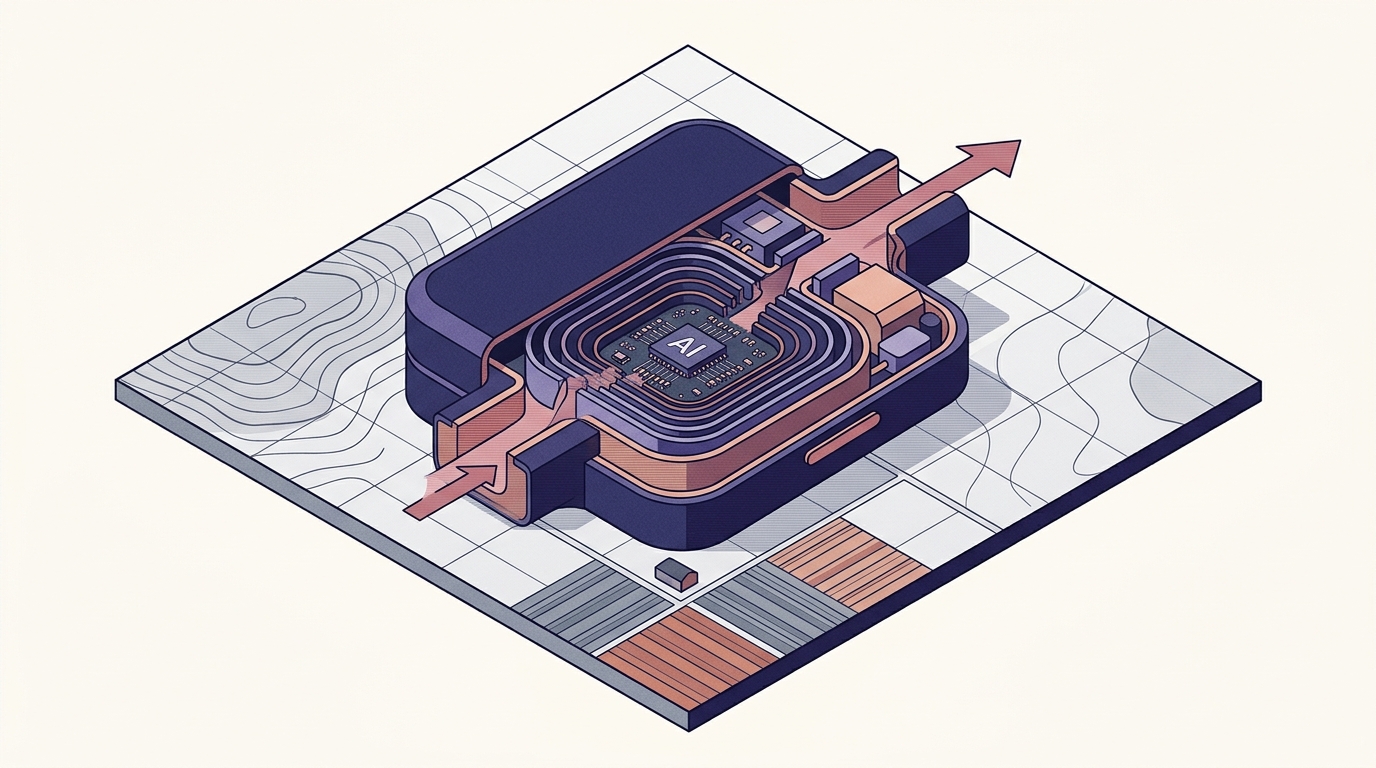
Researchers at six universities across Alabama, Arkansas, and North Dakota are building a wearable device that can detect the early signs of diabetes from a patient's own breath, without an internet connection or a doctor to read the results. A $854,889 federal grant from the National Science Foundation is funding the work, which centers on a branch of artificial intelligence called Edge AI — software that runs directly on phones, sensors, and small devices rather than routing data to remote servers in the cloud.
The distinction matters most in places where cloud connectivity isn't reliable. In western North Dakota, broadband access is spotty, distances to specialists are long, and Native American communities on reservations face some of the most acute health disparities in the country. That's why the inclusion of Nueta Hidatsa Sahnish College, a tribal college serving the Mandan, Hidatsa, and Arikara Nation on the Fort Berthold Reservation, stands out among the six consortium members. Native Americans in North Dakota experience diabetes at roughly two to three times the rate of the general population, and a breath-based monitor that functions offline and requires no specialist interpretation could meaningfully change how the disease is managed in those communities.
The diabetes device is the consortium's primary proof-of-concept. Using nano-scale sensing materials and miniaturized AI chips designed for ultra-low power consumption, the team aims to prototype a low-cost monitor that can flag diabetes risk without any laboratory work or physician visit. The leading institution is the University of South Alabama; North Dakota State University and the University of North Dakota are among the collaborators, alongside Alabama A&M University and the University of Arkansas.
The grant comes through the NSF's EPSCoR program, a decades-old effort to direct federal research dollars toward states that historically receive a small share of them. North Dakota, Alabama, and Arkansas all qualify, and the RII Track-2 mechanism specifically rewards multi-state partnerships over individual competition. The program has drawn criticism from lawmakers in high-funding states who see it as a carve-out from merit-based competition, but it retains strong support from rural-state delegations and requires states to put up matching funds as a condition of participation.
Beyond the device itself, the project includes a workforce development push: college students will get hands-on AI research experience, and high school teachers will be trained to bring Edge AI concepts into their own classrooms. With a 2023 Stanford report finding that the U.S. produces far fewer AI specialists than industry demands, and that gap sharpest outside coastal tech hubs, the consortium is betting that early investment in the teacher pipeline is as important as the research itself.
The consortium will work with unnamed private-sector partners to adapt the technology for other uses beyond diabetes care. No timeline for a finished prototype has been made public.