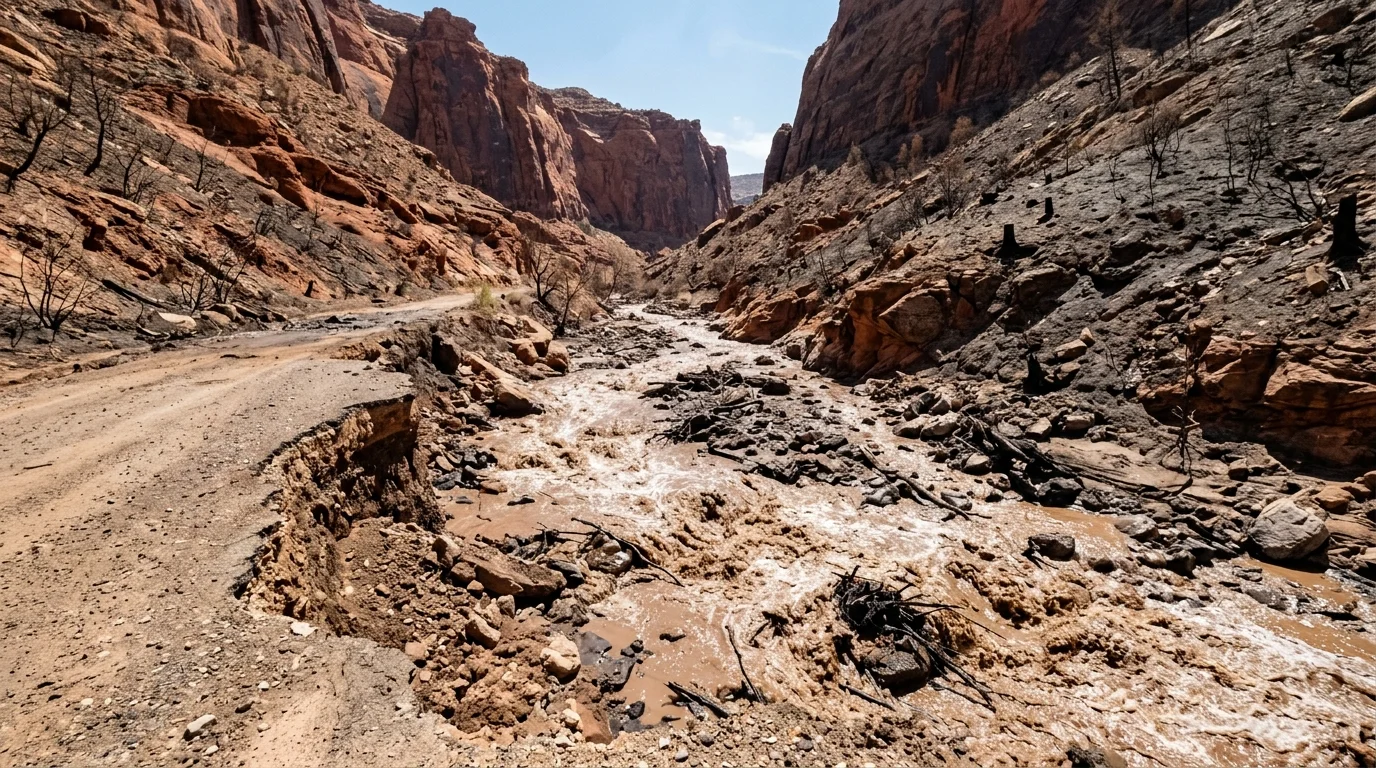
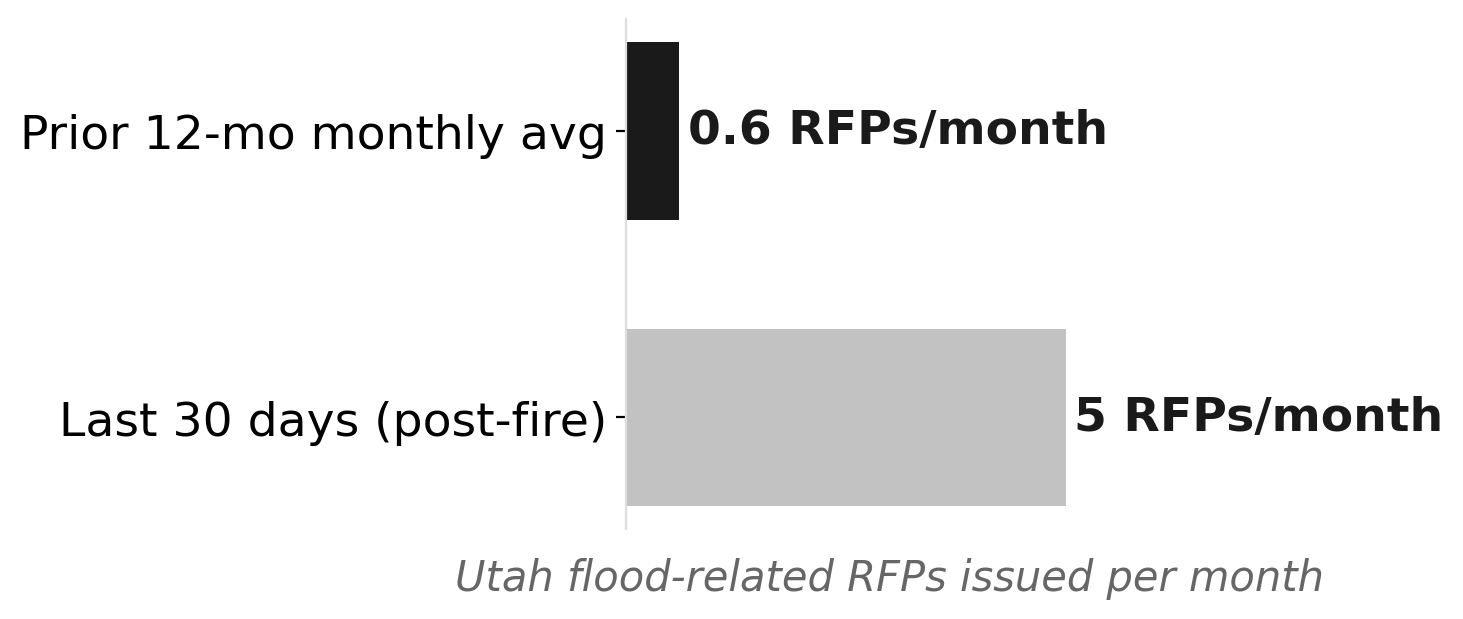
Utah has issued five flood-control procurement solicitations in the last 30 days, against a monthly average of roughly 0.6 over the prior year. That 8.6x spike is not a budget cycle. It is the procurement signature of a specific disaster chain: the Cottonwood Fire burned more than 97,000 acres in Beaver and Piute counties starting June 22, 2026, stripped the hillsides of the vegetation that slows water, and then the summer monsoons arrived. Debris flows followed the same canyons the fire had already destroyed.
Governor Spencer Cox declared a state of emergency for Beaver, Piute, and Sevier counties on July 22, citing what his office called a 'fire-flood nexus' with communities facing 'life-threatening flooding caused by those fires.' As KSL News Radio reported, the flooding destroyed portions of State Route 153 in Beaver Canyon and disrupted drinking water systems for Beaver City, Marysvale, Junction, and Circleville. The declaration activated Utah's Emergency Operations Plan and, critically, gave counties the explicit authority to 'pursue hazard mitigation funding and request additional state, federal or interstate assistance.'
The federal mechanism moving fastest is the USDA NRCS Emergency Watershed Protection (EWP) Program. EWP is worth distinguishing from the longer-term flood infrastructure programs counties normally use. It does not require a FEMA declaration. It activates on a determination by the NRCS State Conservationist and is specifically designed to fund rapid debris removal from stream channels and streambank stabilization after wildfires and floods, work that has to happen in weeks, not years. Since April 2026, USDA NRCS has obligated roughly $10.1 million in new EWP grants to Utah counties: $5.2 million to Sevier County, $1.9 million each to Carbon and Garfield counties, and $1.1 million to the City of Price. A Beaver County EWP award is pending, and the county's exigent RFP for Cottonwood Fire debris cleanup, due September 14, signals that obligation is imminent.
Source: NationGraph.
The compressed September 14 deadline on that Beaver County solicitation is the clearest signal of how the monsoon calendar is driving procurement. Counties are not issuing these RFPs on a normal schedule; they are issuing them with whatever time remains before the next storm. Eighteen Utah counties have declared local emergencies related to wildfire, flooding, or drought since April 2026, and the footprint is still expanding: Meadow Town in Millard County declared its own local flood emergency in August, a county that sits well north of the original Cottonwood Fire perimeter.
A separate federal program adds to the procurement total without being part of the emergency response. Washington County's $9.9 million USDA NRCS Watershed Protection and Flood Prevention Operations (WFPO) grant for the Gould Wash Flood Protection Project was committed in June 2026 and runs through 2029. WFPO is a long-term planned infrastructure program authorized under the Watershed Protection and Flood Prevention Act of 1954, requiring multi-year planning and environmental review, categorically different from EWP's rapid-response purpose. Washington County is now pairing that grant with a new flood mitigation infrastructure RFP due September 30, moving the longer-term project into active procurement at the same moment the emergency work is ramping up.
Those two programs, EWP and WFPO, are being administered by the same USDA NRCS Utah office but doing different things. The RFP spike is being driven primarily by EWP emergency procurement. The Washington County WFPO grant represents a parallel, longer-running investment that coincidentally overlaps in timing. The distinction matters because NRCS Utah has announced it will not accept new WFPO preliminary investigation applications in 2026 due to funding constraints, meaning counties that do not already have a WFPO project in the pipeline cannot start one. Emergency EWP is the only fast channel available, which concentrates procurement urgency exactly where the RFP data shows it.
The total active federal flood grant portfolio across Utah entities now stands at roughly $57 million committed across more than 20 grants statewide. The five RFPs in the last 30 days span four jurisdictions: Beaver County, Washington City, Canyons School District in Salt Lake County (Park Lane flood repair), and Fayette Town in Sanpete County, which is seeking engineering services for flood planning. Southern Utah's canyon geography, burned hillsides draining directly into small communities with limited infrastructure redundancy, concentrates the risk, but the procurement wave is now showing up in school districts and small towns well outside the original disaster counties.
The practical question for the communities involved is whether contractors can mobilize before the monsoon window closes. Beaver County's September 14 deadline leaves roughly six weeks from the date of the emergency declaration to the bid opening. What to watch: whether NRCS obligates the pending Beaver County EWP award before that RFP closes, and whether the Meadow Town and other late-declaring counties can move through the EWP determination process in time to issue their own solicitations before fall.